
Helen Svoboda’s new language for the double bass
Helen Svoboda’s recent PhD research explores a new relationship between listening, instrument technique, visualisation, notation and composition.
Through her research, Helen hopes to inspire the next generation of musicians, not just bass players, to experiment with traditional musical practices.
“The idea is allowing obsession to take over,” Helen said. “Just getting obsessed with different sounds or techniques and realising that there's not just one way to learn them, use them or represent them.
“Through my research, I hope other people will remember that it's okay to have a different way of engaging with really complex techniques. I hope it inspires others to adapt it into their own methods or ways of representing sounds.”
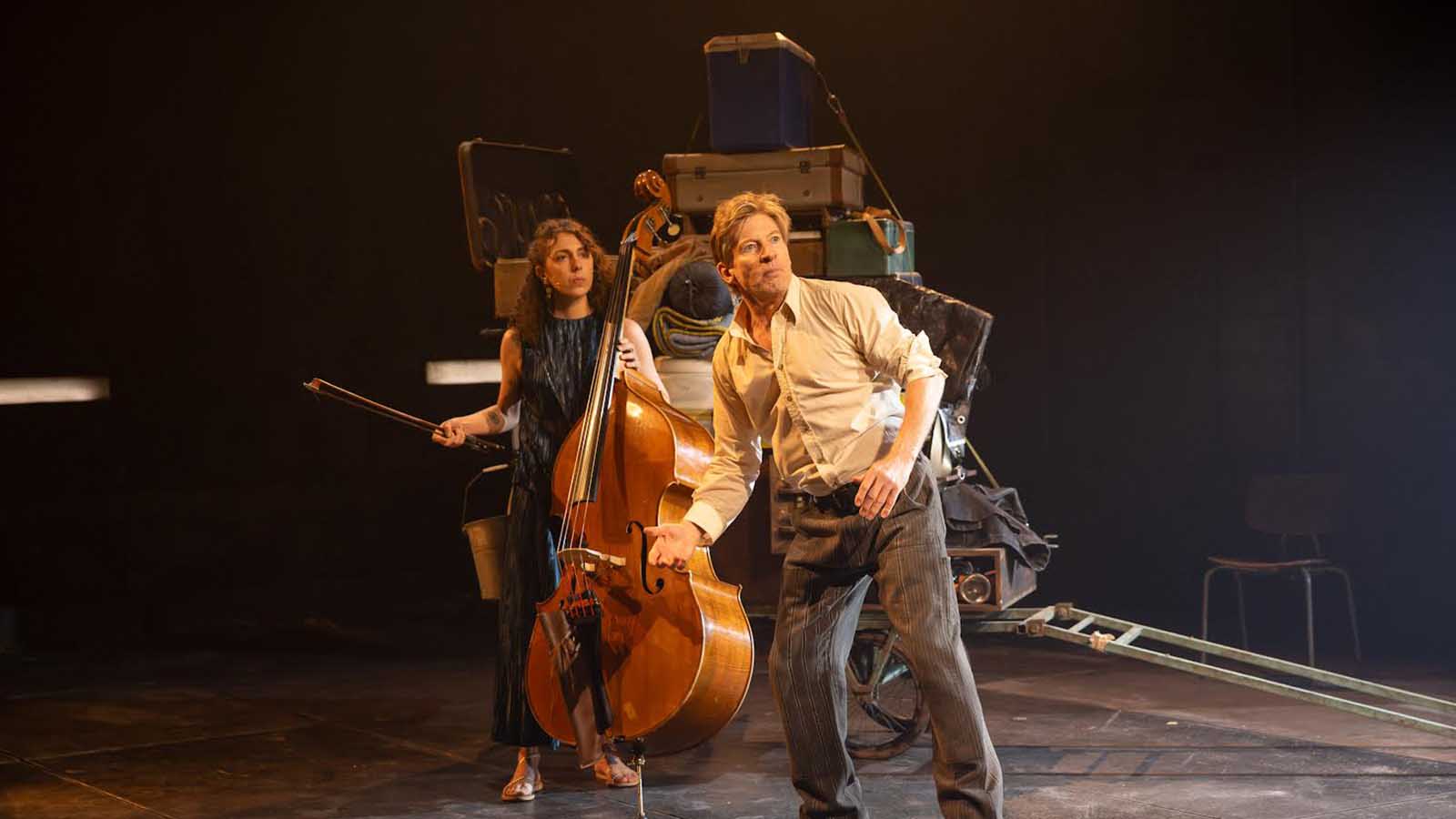
Helen Svoboda performing alongside David Wenham on stage. Photo credit: Daniel Boud
Helen was also recently involved in Sydney Theatre Company's sold-out show, An Iliad, an adaptation of Homer’s Ancient Greek saga of heroes, gods and battles.
“It was an amazing experience,” Helen said. “I was given total creative freedom to play how I would usually play; I could respond intuitively.”
The performance sparked a major new interest, which she plans to continue exploring in future projects.
“It wasn’t even on my radar to be involved in a theatre production,” she said. “However, I discovered this amazing potential for experimental music to be a prominent part of storytelling. I’ve always felt that experimental music can be so much more accessible if we attach a story to it.
“For me, [this production] opened up a real interest that had already been developing in previous work. It helped me realise this interest of not just being a musician performing on a stage, but to think about the role of a character telling a story, even if it's quite abstract.”
Helen’s PhD research centres on a core concept called the ‘Composer Photograph’, a term describing a photograph taken by a musician specifically as source material for a composition.
“At the centre of my research, there's a framework called the Composer Photograph,” Helen explained. “It looks at photography-based stimuli, where these photographs become edited and augmented into animated scores to inspire overtone improvisation on the double bass.”
The photographs Helen uses come from a variety of inspiration, with different photos evoking different sounds.
“You take a photograph when you're drawn to something, and you may not use it for the intention of music making, or you might,” Helen said. “It’s a moment of wonder. There was one photo I took of Tasmanian tree bark with these amazing worm etchings in it, and I took that specifically because it inspired sound and I knew I was going to use it for a score.”
However, not every photograph is taken with the explicit intention of producing a score.
“On a residency in Finland in 2023, I took all of these incredible photos of the terrain, not realising at the time that they would inspire musical performance,” she said. “I was in this state of wonder, and later when I went through the photos, I thought, ‘This one is perfect, it evokes this particular sound.’”
Helen’s motivation for her PhD research stemmed from a desire to challenge expectations surrounding her instrument.
“I'm a double bassist and a vocalist, but predominantly, my practice is improvisation-based,” she said. “I grew up in classical music but always struggled to follow the page as a pianist and a flautist.
"So, when I moved to bass, I became really fascinated by overtones on the instrument as part of its sound world, and particularly in ways that they subvert expectations of how the double bass is expected to sound, because they just expand the entire range of the instrument into the register of the violin or sub-harmonic frequencies."
Experience the performance
Melbourne audiences will soon have the opportunity to experience Helen’s distinctive musical practice in An Iliad, starring David Wenham. Book tickets at Arts Centre Melbourne.
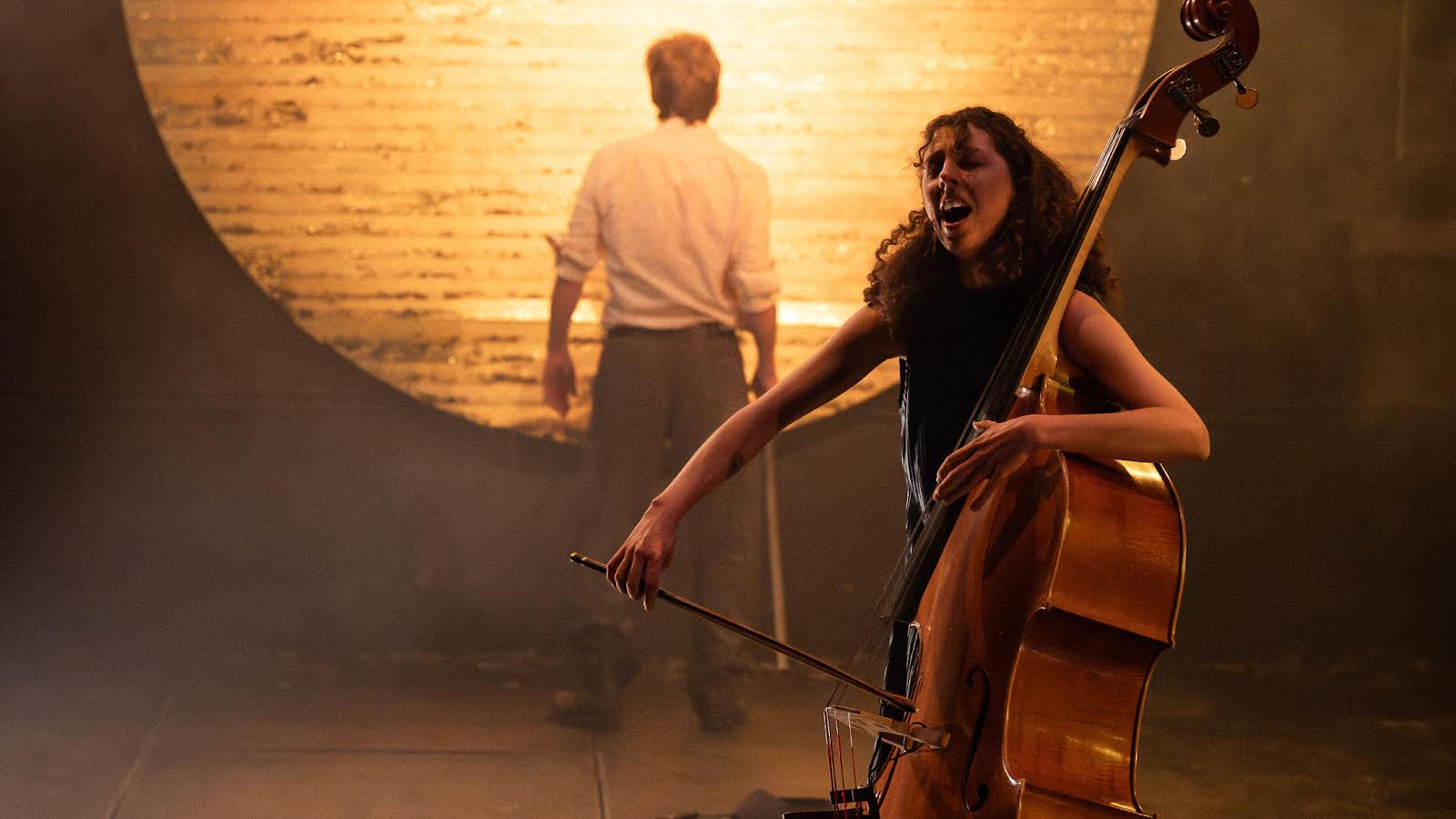
Helen Svoboda performing live on stage with her double bass. Photo credit: Daniel Boud