
Uplifting Local Government Disaster Readiness Capabilities
Researchers from Monash University have been awarded $1.27 million by National Emergency Management Agency (NEMA) to develop a landmark national framework for disaster readiness. Provided through Emergency Management Victoria as part of the flagship Disaster Ready Fund, this project will see researchers partner with thirteen diverse local government organisations across six states to assess and strengthen their disaster readiness.
The challenge
Local governments carry enormous responsibility for community-level disaster risk reduction – from land use planning and emergency management to asset management and recovery support. Yet as the Independent Review of Commonwealth Disaster Funding found most are under-resourced and under-equipped, with capability that varies widely from one council to the next.
The review specifically recommended that Australia identifies local capability gaps and improve information-sharing – a task this new framework is designed to fulfil.
Our response
Over the next two years, the team from Monash’s Faculty of Arts will co-design, test and refine the national capability assessment framework with thirteen local government organisations in Victoria, New South Wales, South Australia, Western Australia, Tasmania and Queensland.
Built using a systemic, multi-hazard approach, the framework will help local governments: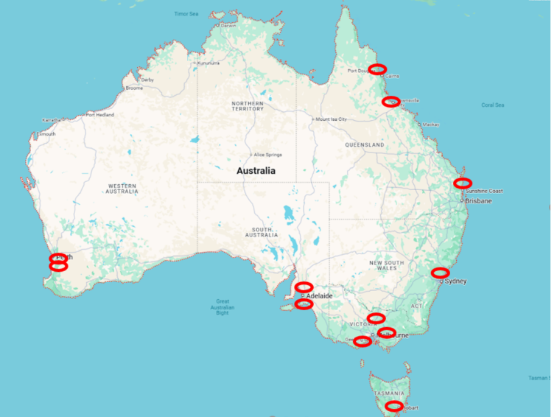
- Identify critical capability gaps and existing strengths
- Benchmark their disaster readiness against peers, accounting for local context
- Prioritise investment, reform and resourcing decisions
- Connect with other local governments for peer support and shared learning
- Access tailored training and resources where they're needed most
The framework is designed to be practical from day one and scalable from the start – ready to be embedded in state and federal disaster frameworks and adopted widely across the sector.
The Research Team
The project is led by a multi-disciplinary team from the Faculty of Arts with a strong track record in community resilience programs, such as Fire to Flourish and Flood to Flourish. The research team includes:
- Dr Zoe D’Arcy
- Dr Gretel Evans
- Dr Jana-Axinja Paschen
- Professor Briony Rogers
- Dr Adriana Keating
- Ms Elise Park
Why these partners
These partners, which include twelve local councils and one local council peak body, were chosen for their diversity in geography, hazard exposure, populations, resourcing and disaster experience. Collectively, they account for 3.70% of the national population and 4.14% of Australia’s GDP, spanning urban, peri-urban, rural, and remote contexts. They face higher-than-average risk of tropical cyclone and bushfire, and average flood and earthquake risk. The councils range from highly experienced to first-time disaster responders.
Developing the framework in partnership with such a diverse range of practitioners will help address challenges such as creating a framework that works across state jurisdictions; one that works for remote, under-resourced councils and well-established urban ones; and that is multihazard.