
Facilities
Education Centre
The Jock Marshall Reserve provides a unique wet-field biology experience giving students the opportunity to develop skills in sampling and surveying techniques. Samples collected within the reserve can be investigated and analysed in the onsite Education Centre. The JMR Education Centre is a state of the art facility fully equipped with microscopes and multimedia facilities and can accommodate up to 112 students.

Environmental Laboratories
The Environmental Laboratory building contains fully equipped controlled temperature rooms that are ideal for sensitive experiments requiring exact climatic conditions. These rooms have been designed to run at temperatures between 4 to 32 degrees. These rooms are remotely controlled and monitored by Monash's Engineering Services Office.

Mesocosms
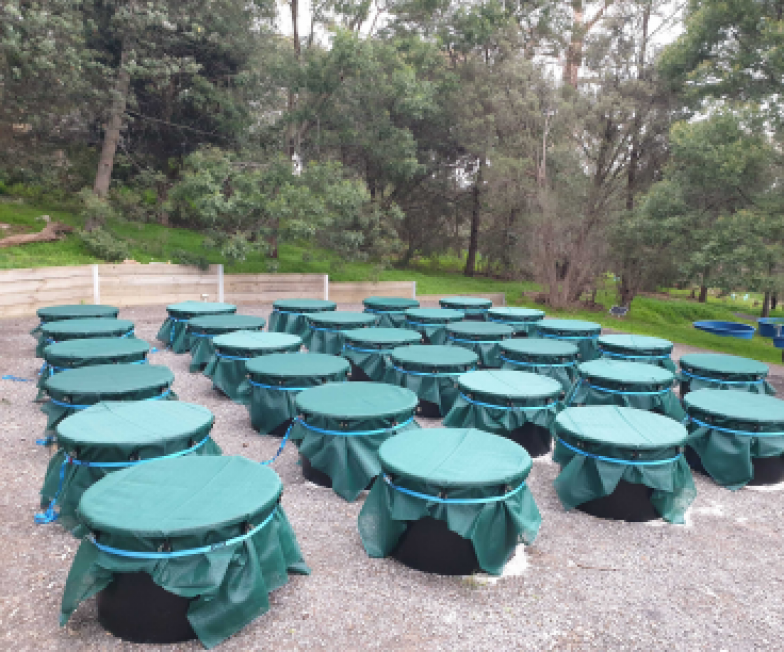
Within the reserve is a dedicated area for outdoor aquatic mesocosm experiments. The mesocosms are large durable tubs that allow researchers to carry out experiments under semi-controlled conditions. In ecology and evolutionary biology, mesocosms provide a critical link between field-based research and the highly controlled setups associated with laboratory-based experiments. Mesocosms enable scientists to integrate research across multiple spatial scales and at different levels of ecological complexity.
Water monitoring system and weather station
An industry standard water monitoring system and weather station is located on Farrington Pier. Data from remote loggers and associated infrastructure is frequently collected at set time intervals, recorded and stored on the Hobolink system. Water parameters that are recorded include pH, electrical conductivity, temperature, dissolved oxygen and turbidity. Weather parameters that are recorded include temperature, rainfall, barometric pressure, wind speed/direction, relative humidity and lux.

Transect lines
A total of 3 permanent transect lines are currently in place within the JMR grounds and are used in undergraduate units. A transect is a line or a series of sampling points in a line, positioned across a habitat or part of a habitat. They are used to conduct field surveys, in this case, to estimate the type, size and density of biological populations in the reserve.

Infrared cameras
Networked infrared cameras are installed throughout the grounds of the reserve, monitoring fauna 24/7. These cameras are triggered by motion and are configured to take still images and video footage.

Acoustic recorders
Acoustic recorders are strategically installed around the lake and wetland capturing sounds from wildlife including birds, frogs, bats and aquatic life. A total of six Wildlife Acoustic SM4 acoustic recorders are installed around the reserve.

Sampling piers, treatment wetland & lake
The JMR has a 0.2Ha lake that consists of two sampling piers that are used extensively by undergraduate students and external education programs. Storm water is channelled into the reserves wetland biofiltration system from nearby Halls of Residence carpark, the reserves paths and from the roofs of the buildings within the reserve before entering the lake. Water quality is improved through the biofiltration system with the removal of unwanted heavy metals and reduced levels of phosphates and nitrates
The treatment wetland has worked as an excellent teaching tool as students are able to study the outcomes of a functional biological filtration wetland and its positive effects on storm water pollutants.

Plant Science Complex (PSC)
Located at the north-east boundary of the JMR, PSC is a plant growth facility that provides opportunities for a wide range of plant based research projects including genetic, conservational and ecological studies.

Nature walk overpass
An award-winning 200m long elevated nature walk by Urban Initiatives, provides an entrance to the University from Blackburn road which then extends over the Reserve, to a connecting path in the University. The nature walk incorporates seating and informative signage along the way. Previously closed to the public, the Nature Walk allows students, staff and visitors to experience first-hand the exciting botanical life in the reserve and enjoy a unique bushland experience.Access at the canopy level ensures that the educational, research and environmental qualities of the reserve below are preserved.
