
August 2024
Welcome to the latest update from the mitoHOPE Program.
Progress report
Mitochondrial donation is new to Australia. It has to be carefully considered before it is introduced into clinical practice.
The mitoHOPE Program has two research programs. The preclinical research program will improve mitochondrial donation techniques and train our embryologists. To learn these techniques, our embryologists have been practising on mouse eggs. They will practise on donated human eggs once the required approvals are in place. The clinical trial will use these techniques to generate pregnancies. Improving mitochondrial donation techniques will help build the evidence base for introducing mitochondrial donation into Australia.
The mitoHOPE team is working to get everything in place to begin the preclinical research and training program.
Several things need to take place before the clinical trial can start:
- the preclinical research needs to show that mitochondrial donation techniques work safely,
- our embryologists need to show they can do the techniques,
- a human research ethics committee needs to approve the clinical trial research program,
- the Embryo Research Licensing Committee needs to approve the clinical trial research program.
At this stage, we expect that we may be enrolling participants into the trial in the second half of 2025. This may change depending on when the program receives the required approvals.
Is mitochondrial donation suitable for you?
Talk to your health professionals if you think mitochondrial donation may be suitable for you. They can help you understand the reproductive options that are most relevant to you.
Find your local genetics service on the Centre for Genetics Education website. You can also contact the Mito Foundation for information and support.
A visit from Greg Hunt
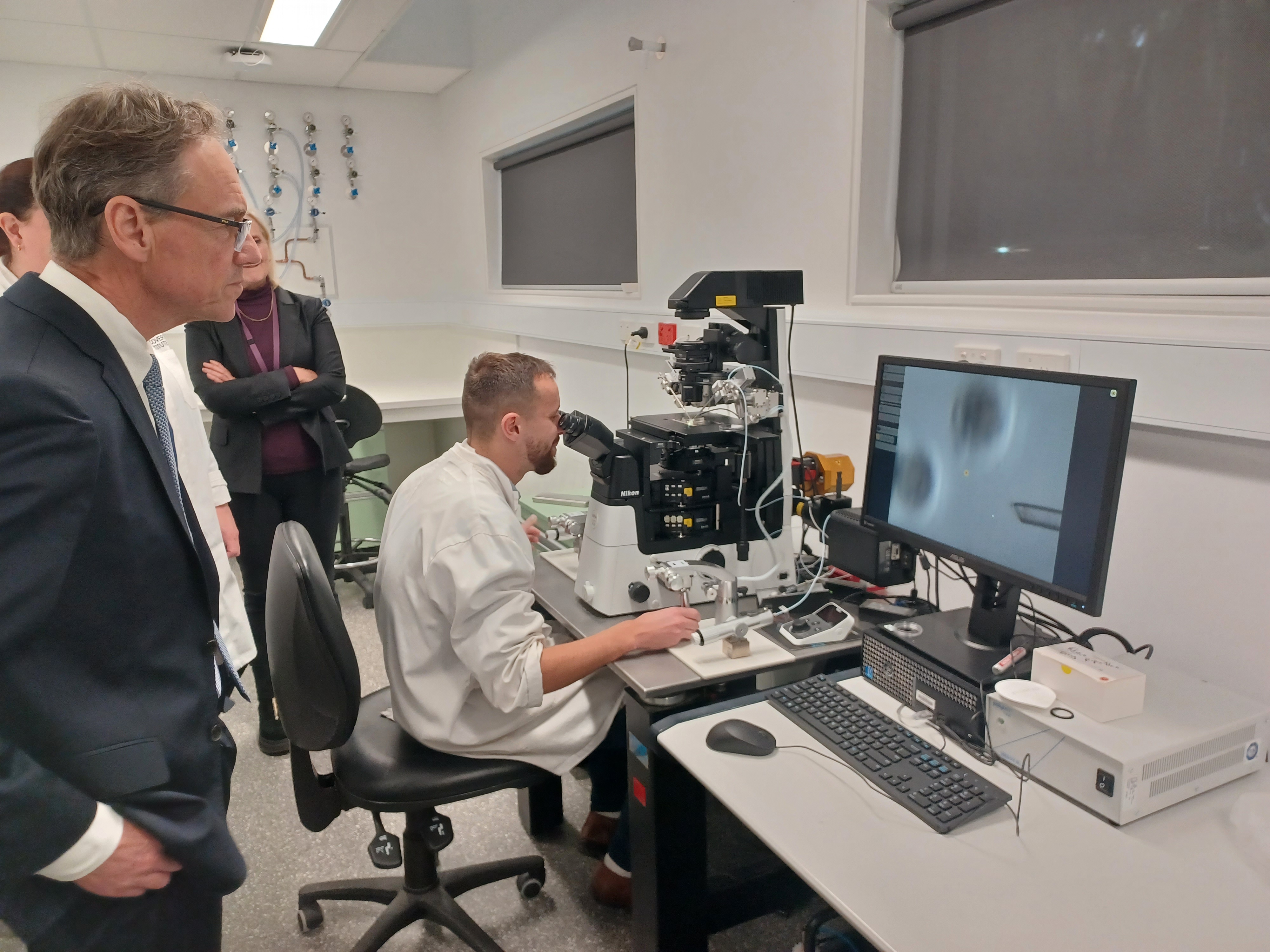
In May, we welcomed former Australian Health Minister Greg Hunt to Monash University. While he was in Parliament, Greg introduced the Mitochondrial Donation Law Reform (Maeve’s Law) Bill 2021. During his visit, he toured the mitoHOPE lab and watched a demonstration of mitochondrial donation on mouse eggs.
The mitoHOPE team set to tackle a bloody long walk
Last year, the mitoHOPE Program walked 35 km as part of the Mito Foundation’s Bloody Long Walk.
The team is banding together again in 2024 to tackle another Bloody Long Walk. Together they will walk 35 km along the Mornington Peninsula on 13 October.
If you would like to support the mitoHOPE team, you can donate or join the team via the Bloody Long Walk website. Funds raised will support people affected by mitochondrial disease.