
Egg donors
The mitoHOPE Program aims to expand the reproductive options available to people affected by mitochondrial disease (mito), including the experimental assisted reproductive technique of mitochondrial donation.
For some people affected by mito, mitochondrial donation might be their only option to have genetically-related children while reducing the chance of disease transmission. There is no cure for mito and the condition can be very serious and life limiting.
The program needs donor eggs to pilot the introduction of mitochondrial donation into Australian clinical practice.
Donate for research and training
Donating your eggs for research and training purposes will help us refine and improve the mitochondrial donation techniques before their use in the clinical trial. Eggs donated for research and training purposes will NOT be used for reproduction.
You may consider donating for research and training if you:
- have excess frozen eggs in storage; or
- are willing to have your eggs collected for the mitoHOPE Program
We are now recruiting donor eggs for research and training purposes.
This form is currently unavailable and will be back online soon. Please check again in 2 weeks.
Donate for reproduction
Donating your eggs for reproduction will help a person or couple to undertake mitochondrial donation in the clinical trial. It will also help us test the safety and efficacy of the procedure.
We are not recruiting donor eggs for reproduction at this stage. The website will be updated when we need eggs for reproduction.
How are eggs collected?
Are there risks associated with donating?
There are potential physical and psychological risks that will vary depending on your individual circumstances. For example, if you undergo an egg collection, mild to moderate levels of pain, discomfort and abdominal bloating are common symptoms. You will be informed of all potential risks, and counselling support is available to help you decide whether to donate.

mitoHOPE's donor coordinator Lauren will be one of the first people mitoHOPE egg donors meet when they express interest in donating their eggs to the program.
Who is eligible to donate eggs?
Eligibility varies depending on whether eggs are used in research and training or for reproduction.
If you choose to donate your excess frozen eggs, they may be eligible for donation if you were aged 21 years or more when the eggs were collected.
If you are having your eggs collected for the mitoHOPE Program, you may be eligible to donate if you’re between the ages of 25 and 38 years.
To check your eligibility to donate, please fill out the contact form below, and our mitoHOPE donor coordinator will contact you.
-
Egg donor process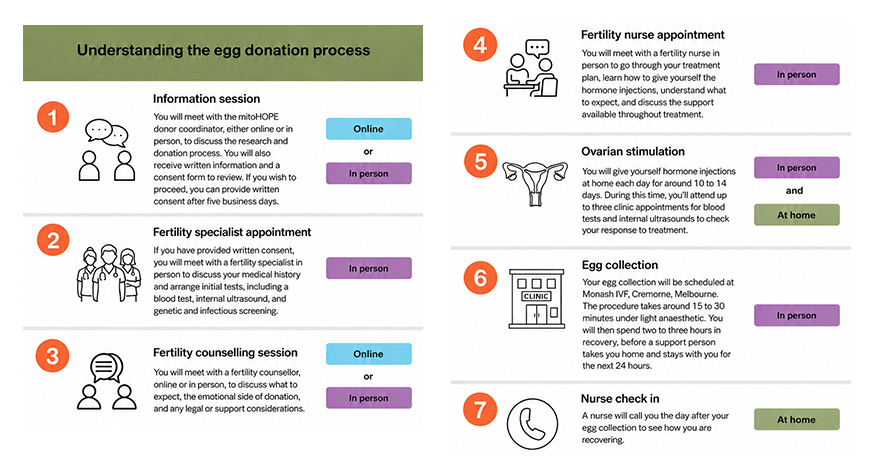
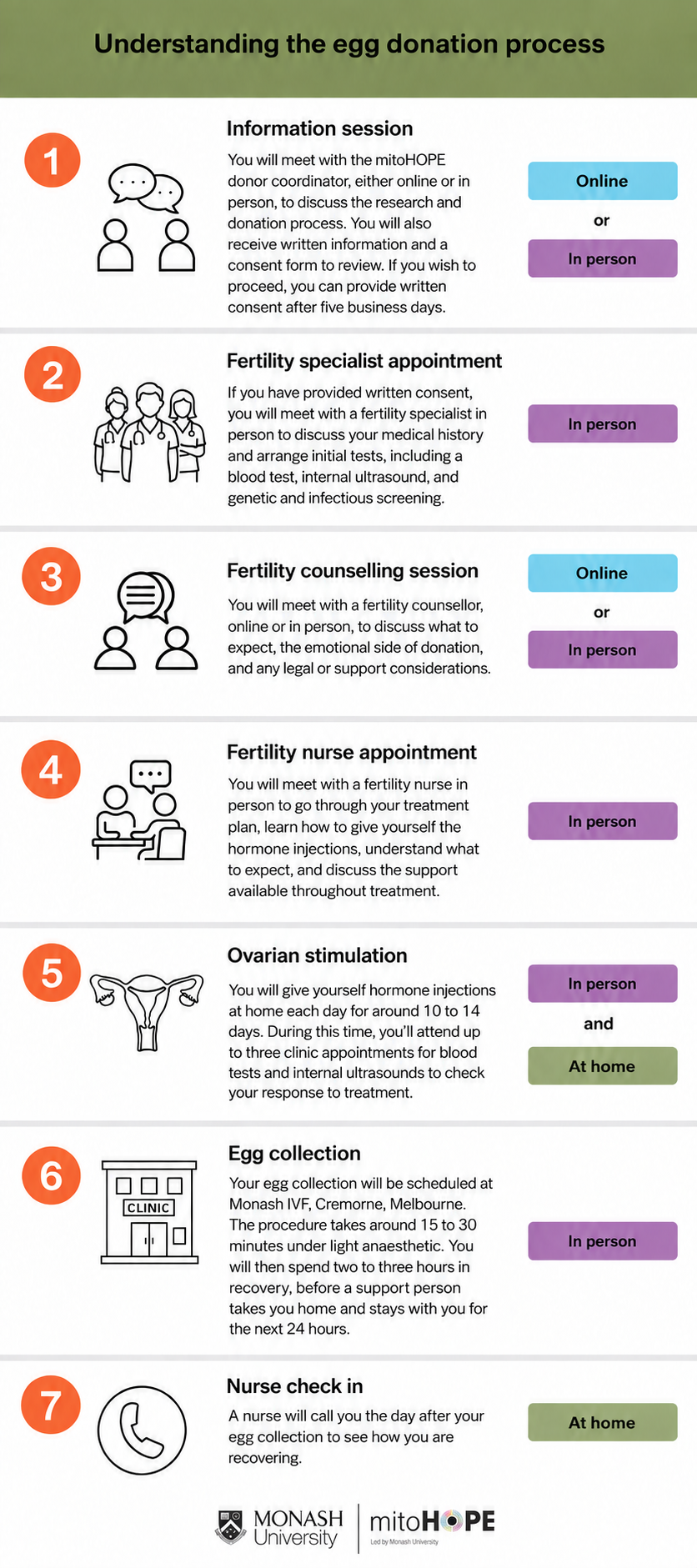
Understanding the egg donation process.
- Information session
- Fertility specialist appointment
- Fertility counselling session
- Fertility nurse appointment
- Ovarian stimulation
- Egg collection
- Nurse check in
Click on the graphic to enlarge
Contact us
If you are interested in donating your eggs to the mitoHOPE Program, please follow this link and you will be contacted by the mitoHOPE donor coordinator who will provide more information.