
December 2024
Welcome to the latest update from the mitoHOPE Program.
Progress report
We continue to work with the Human Research Ethics Committee and NHMRC Embryo Research Licencing Committee to gain approval to start using donor eggs for training and research in mitochondrial donation.
While we gain approval for the preclinical work, our embryologists are becoming highly proficient in mitochondrial donation using mouse eggs, so the transition to human eggs will be as seamless as possible. Our team is also preparing ethics and licence applications for future applications.
The clinical trial for mitochondrial donation is still anticipated to commence in late 2025. However, we cannot be definitive about time lines as we are dependent upon the regulatory process and associated approvals.
We understand that many of the mito community have been waiting for mitochondrial donation, and we are working as quickly as we can to start the program. We thank the mito community for their patience and understanding as we prepare to commence the trial.
While waiting for mitochondrial donation
If your family is affected by mito and you think mitochondrial donation may be suitable for you, keep speaking with your health professionals. They can help you understand the reproductive options that are most relevant to you.
The Mito Foundation is available to provide further information about options for building your family or help to find a health professional. You can also read some general advice on what you can do while you wait on the Mito Foundation website.
The Mito Foundation helpline can be reached at www.mito.org.au/helpline/ or on 1300 977 180.



mitoHOPE’s first publication: Pregnancy with mito
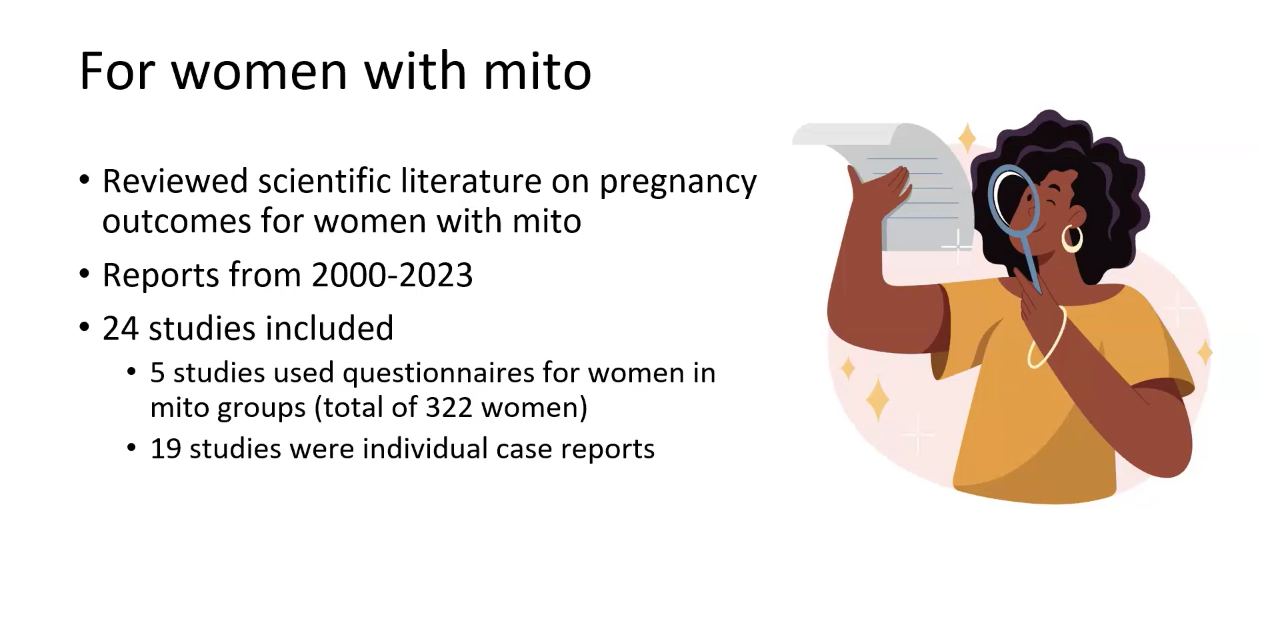
In September, the mitoHOPE Program published its first academic journal article: Pregnancy in women with mitochondrial disease – a literature review and suggested guidance for preconception and pregnancy care. The article aims to help health professionals and the mito community optimise the care of women with mito during pregnancy and childbirth. This guidance is the first of its kind in Australia.
Professor Lisa Hui, from the Murdoch Children's Research Institute, led the mitoHOPE Informed Decision-Making for Pregnancy and Parenthood Working Group. The group conducted the literature review and wrote the manuscript. This working group included a multidisciplinary group of clinicians, representative of the mito community and a bioethicist.
The literature review found that having mito may increase a person's risk of health problems during pregnancy. Although pregnancy may not have a serious impact for many women with mito, others can experience worsening of their symptoms and have a higher risk of pregnancy complications such as preterm birth.
It is recommended that women with mito receive pre-pregnancy counselling from a maternal fetal medicine unit before getting pregnant. This will provide them with information about their reproductive options, optimising their health before conceiving, and their individual risk factors for pregnancy complications. The article provides suggested clinical guidance for care before and during pregnancy for people with mito.
Mito Foundation has released a resource informed by the findings of Prof. Hui and her team. In November, the foundation also held a webinar about pregnancy with mito. The webinar was co-hosted by Prof. Hui and mito community member Abby Mason.
mitoHOPE holiday closure
The mitoHOPE team thanks the mito community, our partner organisations and staff, and all those who have expressed interest in the program for their valuable contributions in 2024.
The mitoHOPE operations office at Monash University will be closed from 12pm on Friday, 20 December 2024, and re-open at 9am on Thursday, 2 January 2025.

Bloody Long Walk
In October, mitoHOPE was pleased to host a team of volunteers and walkers at the Bloody Long Walk.
The Bloody Long Walk is an initiative run by Mito Foundation, a key partner in the mitoHOPE Program. The event raises funds for Mito Foundation’s work to find treatments and a cure for mito.
Visit the Bloody Long Walk website to learn more.
-