
Embedding Indigenous knowledges

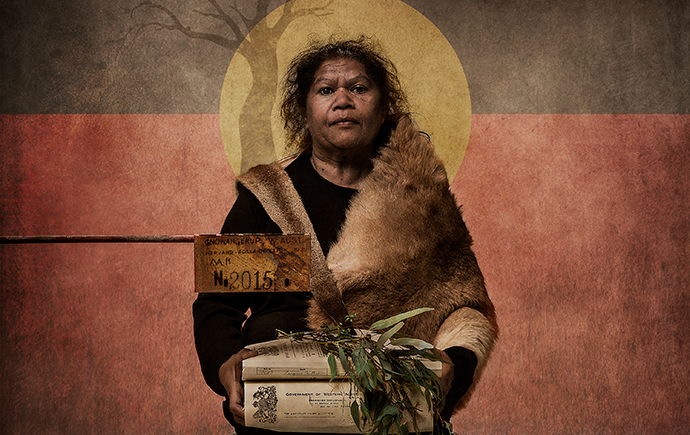
A paper published in The Lancet Planetary Health, by Monash researcher, Associate Professor Gabrielle Brand, argues that – while universities are focusing more on teaching sustainable healthcare, Indigenous knowledges and voices are being ignored. “We need to start recognising the innate Indigenous interconnections with Mother Nature and combine Indigenous and western ways of knowing in our health professions education programs to teach planetary health,” she said.
In 2018, Associate Professor Brand, a non-Indigenous nurse academic, met Rosalie Kickett, an Indigenous Noongar cultural healer and teacher based in Perth, and Steve Wise, a medical and fine-art photographer with Indigenous Fijian heritage, to assess ways they could visually and metaphorically represent Ms Kickett’s lived experiences in the education resource. Monash Sustainable Development Institute Senior Lecturer Gitanjali Bedi, a tertiary sustainability educator and environmentalist also joined the team to explore how planetary health and related practices can be taught in more transformative ways.
According to Associate Professor Brand, globally, the health-care sector has been slower than many other sectors in reducing its carbon emissions and broader environmental footprint. “Planetary health and sustainable healthcare are emerging topics in the education of health professionals. However, these have been largely restricted to a Western perspective,” she said.
According to Ms Kickett, the health-care workforce has to learn about the history of colonialism and its continuing effects. “To embed Indigenous knowledges and voices in planetary health education, the authors examined stories that have been told or learned about Indigenous Peoples in health professional education, explored ways to encourage a different way of knowing to the colonialist framing of Indigenous health and culture, and sought to create culturally safe spaces for decolonised learning in health professional education to ensure that learners see, hear, embody, and learn from Indigenous voices,” she said.
“We need to give them a glimpse of the past to understand the community that they’re working with, you know, and that patients and clients that they are working with to support understanding of what might have happened in the past and how it links to where a lot of our Aboriginal People are at today.”
Drawing on the 2021 Association for Medical Education in Europe Consensus Statement, the authors designed the education resource focusing on learning objectives that aim to embed Indigenous knowledges in health professional education, including an understanding of human interconnectedness with nature as a determinant of planetary health.
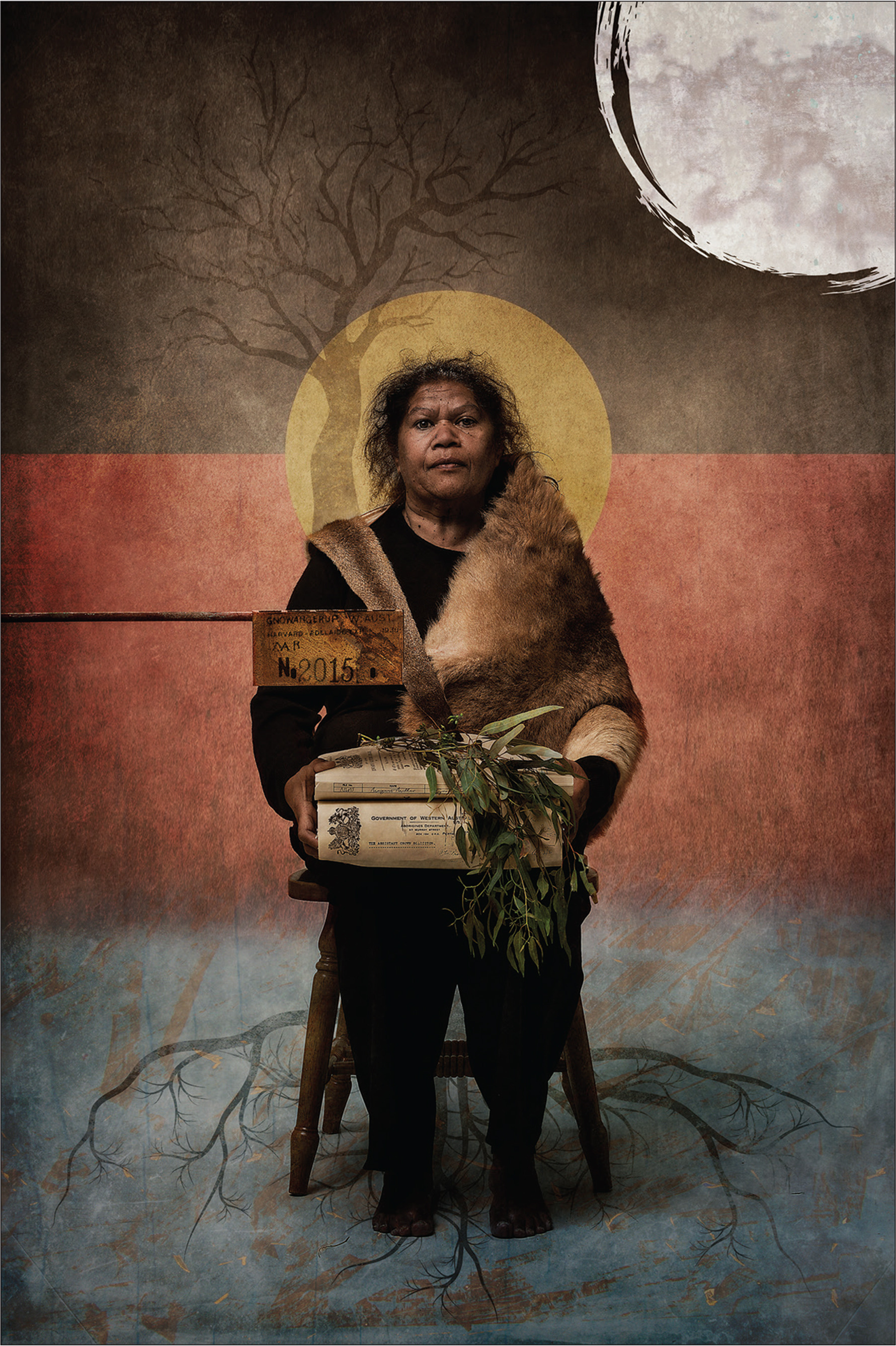
Portrait of Rosalie Kickett (Photo credit Steve Wise)
According to Associate Professor Brand the symbolism in the portrait of Ms Kickett aims to challenge the literal and concrete thinking of health professional learners. “For example, the deep roots symbolise the interconnection with nature that connects and nourishes all systems (eg, societal, economic, and cultural) that depend on it and the leafless gumtree behind the shoulder of Ms Kickett represents the disruptions of the current geological age during which human activity has impacted Earth's natural system processes and connection to health outcomes,” she said.
“There is also the need to acknowledge and understand our past to find solutions to problems today – so, narrative artefacts, including government files and historical signage taken directly from a police photograph of an ancestor of Ms Kickett, were included as a visible representation of the past as we encourage learners to acknowledge equity and social justice, specifically “how historical and political injustices, including settler-colonialism, white supremacy, racism, patriarchy, and capitalism and neoliberalism, have contributed to the disenfranchisement of populations and a degraded environment”.”
The portrait of Ms Kickett is projected onto a large screen without the provision of any context. Students are asked questions including: what can you see (ie, identify the main symbols in the portrait), what do you think the symbols in the portrait mean, and what makes you say that. Further questions ask learners to use their imagination by asking: what do you wonder and what are you curious to learn more about. “This education approach is designed to encourage tolerance of ambiguity and uncertainty, including questioning preconceptions and asking learners to reflect on unexplored world views,” Associate Professor Brand said.
After these small group discussions, an audio-recorded narrative from author Ms Kickett is shared with the group, including what each of the symbols mean to her. “Listening to Ms Kickett’s portrait descriptions aim to either affirm, discover, or challenge biases and cultural assumptions to create the tension needed for transformational learning to occur, including facilitating cultural literacy.”
According to Ms Kickett, the program will have enormous benefits for the next generation of health professionals. “When you train and you’re working in this field you know—my people can read a person and if they know that it's not genuine, they will refuse you know, because that respect is not given, it's not from the heart. And that's that blockage…When you’re working with them, Aboriginal People, Indigenous People, learn to walk alongside,” she said.
Narrative portrait descriptions from author Rosalie Kickett
“The deep roots and the water, the creek that brought me together with my childhood…connecting to land and the beauty within it.”
“The Aboriginal flag, like the roots keeps me grounded, turn to my boodja [land or country], to keep connected you know, that my spirit my Wirrin [spirit] is keeping me strong. The sun, the yellow represents that strength of life, that blows rays of light coming through that keep us, my people, my moort [family] together in the strong community we are today.”
“The kangaroo hide is a sign of respect that I hold amongst Aboriginal Peoples across the land. It also reminds me of the old days, my mum used to say how they used to live in mia mia [shelter made from natural bush] made up of branches and trees, twigged together. Whenever they got a kangaroo or so they use those parts for keeping warm…and their bedding and kept them strong…you don’t just go hunting for anything…it comes to you so you can feed your family. Now, when I go out to get bush medicine it heals me physically and within myself and it leads us to what we are meant to take and what we are not meant to take—it guides us. It is all part of us learning from the lands, it's free, a free spirit, I mean look at the birds, butterflies, the life.”
“The historical signage was taken from a real police photograph from one of my ancestors, Aboriginal People back in those days had to have a license [referred to as a dog license] as part of their movement, as part of their movement. And like, you know, like, they couldn’t really go after hours, into town, so they were areas they were all kept in, like, you know, their own little areas, and this is something that was passed around, if they were in a different area or in the town, they were dealt with by the Monarch [police].”
“The thick government files represent the native welfare you know, at that time way back then, my mum was taken away…they were all rounded up like cattles, and from, from the reserves…they came there and they said we’re gonna come and we’ll bring the kids back. But they never did. That system that we have forever being you know, monitored by causes a lot of our people to continue to live in fear, they fear the police, they fear the system, going into the health system, because they know that they’re going to be you know, files are going to be made up and the injustices…need to be corrected properly through and from our hearts, through our eyes and our voice.”
“The green gum leaves are very significant to our culture and part of healing…part of [our] smoking ceremony.”
“The wadjela [white people] moon represents the white people looking down on Aboriginal People…superior you know ways we haven’t got the knowledge; we haven’t got you know; we don’t know what's best for us, but we do! We have always felt they are suppressing us and continue to suppress us in a lot of ways. That's the problem a lot of my people face today…of not being heard and that's why people like me use my voice…make a pathway for my people.”