
What does a scientist look like? Generator start up champions curiosity in primary school students

Students with their STEMpal mail bag
Science Week may be over but fostering curiosity and scientific literacy from a young age never stops. Enter STEMpals, a groundbreaking initiative transforming how science is taught in primary schools across Australia… and describing what a scientist looks like.
Developing an idea to a reality
Founded by Dr. Jennifer Payne, an Adjunct researcher at Monash University, STEMpals connects grade 5 and 6 students with STEM professionals through a unique pen pal program. Dr Payne developed her NFP business idea with the support of The Generator, Monash's entrepreneurship hub based in Monash Innovation. Her aim was to inspire the next generation by providing students with real-life role models in the fields of science, technology, engineering, and mathematics.
The power of a pen pal
The concept is simple yet powerful. Students write handwritten letters to their assigned STEM professionals, asking questions about their STEM and what it means to work as a scientist in their field. These letters are exchanged three times over the school year, fostering a meaningful dialogue that encourages curiosity and a deeper understanding.
Dr. Payne explains, “The goal is to show students that STEM is not just a subject in school but all around them and a fascinating and dynamic field that they can be a part of even if they have never considered it before. By connecting them with real STEM professionals, we seek to ignite a passion for curiosity, creativity, discovery and learning.”
A deeper experience beyond online communication
While the often handwritten letters are delivered online, teachers have the option to print them out, creating a tangible and engaging experience for the students. Each term, the letters are presented at a Letter Party, where students celebrate their newfound knowledge and connections.
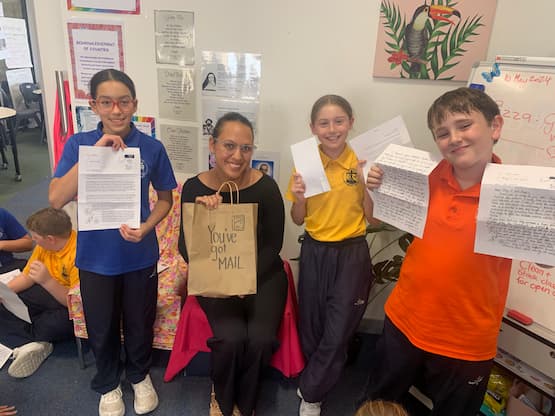
HolyCross College teacher, Katherine Roussety with STEMpal students
Inspiring the next generation
The impact of STEMpals is already being felt in classrooms across Australia. Teachers report increased engagement and enthusiasm for science among their students.“The students are always excited to receive their letters. It’s amazing to see how their questions evolve and become more sophisticated with each exchange” commented Katherine Roussety, a teacher at HolyCross College in Western Australia (WA), the first school in WA to join the program.
By providing students with a direct line to STEM professionals, STEMpals is not only enhancing their understanding of science but also showing them the diverse career paths available in STEM fields. This initiative is a testament to the power of mentorship and the importance of making STEM accessible and exciting for young learners.
STEM professional Dr Rebekah Duffin, an organometallic chemist and postdoctoral research associate for the Head of the School of Chemistry at Monash University, is working on metal-based antimicrobials. She signed up to the program to engage with the younger generation just starting their science journey. “I never had this opportunity or support and although I became a scientist anyway, personal discussions like I have with my penpals, could have made a huge difference,” she added.
“I joined the STEMpals program this year because I never had much support or understanding about what research was during my younger days. So, I am hoping that through this program, I am able to reach out to young aspiring scientists to tell them that science and research is fun!” said Zaahida Abdul Jalil, a second year PhD student studying the impacts of diet on female reproductive health.
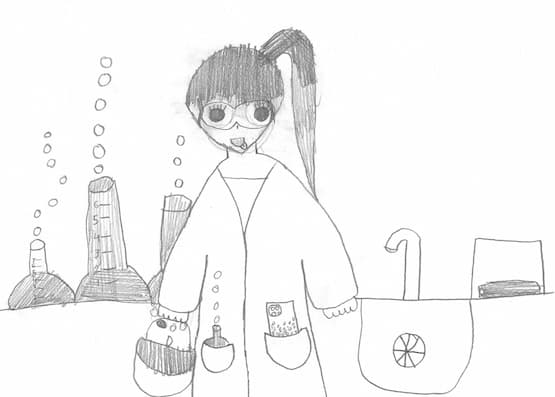
A student’s depiction of a scientist
“My STEMpals ask me a lot of questions like ‘How did you become a scientist?’, ‘Why is studying reproductive health important?’, or my favourite ‘What do you do all day?’ Asking questions is the first step to being a scientist and they always ask me some important ones,” she explained.
“I joined as a STEM professional as I wanted to inspire enthusiasm and curiosity for careers in science - like my high school biology teacher did for me,’ explained Zoe Magill, a final year PhD student studying dendritic cells and their role in fighting cancer “Science communication is so important even if it’s answering a question like ‘What does a scientist look like?’”
About The Generator
The Generator is Monash University’s Innovation hub for entrepreneurial skills and startup success. The innovative approach of STEMpals in making science education more engaging and impactful for primary school students - is one example of how Monash supports its change-making community.
“The programs available through The Generator introduced me to the most effective strategies to bring my idea to reality and create a pipeline of curiosity and contact between students and scientists. I truly believe you can’t be what you can’t see,” added Dr Payne.
Learn more about The Generator and STEMpals