
Path-OUD study

Participate in our study
We are looking for adults aged 18 to 60 years who are currently on medication assisted treatment for opioid dependence (MATOD) and are facing ongoing challenges with non-prescribed opioid use.
This study will investigate a new approach combining psychedelic dosing with structured therapy that could help shape future treatment options.
- Path-OUD: Psilocybin-Assisted Therapy for Opioid Use Disorder
- Phase 2: Currently recruiting
- Location: Melbourne, Australia
- Remuneration for study completion: up to $1520 in gift vouchers
Interested? Read more about our study below.
Contact us: email path-oud@monash.edu / ph 1800 964 197 / txt 0447 463 621
This study has been approved by MUHREC #47710 and registered on ANZCTR: ACTRN12625001368426.
-

Psychedelic-Assisted Therapy in Opioid Use Disorder
This education module has been designed as an overview of the current treatments available in Australia for Opioid Use Disorder and a primer on Psychedelic-Assisted Therapy with a focus on Psilocybin and the Path-OUD study. It's suitable for any clinician interested in learning more about these topics.
Presented by Adrian May, pharmacist on the Path-OUD study.
Reference document for Psilocybin in Opioid Use Disorder (PDF, 457Kb)
Support ResourcesIf you require immediate assistance please contact:
- |
|---|
Opioid Crisis in Australia
Australia recorded 2,356 drug-induced deaths in 2022, with almost 80% classified as unintentional. Opioids were the leading substances involved, contributing to nearly half of all drug-induced fatalities (Pennington Report, 2004).
Opioid use disorder is associated with significant long-term health impacts, including relapse, physical health decline and neurocognitive difficulties. These challenges often coincide with broader mental-health concerns and social disadvantage (Pennington Report, 2004).
These trends highlight an urgent need for improved treatment options and accessible harm-reduction strategies across Australia. This project is supported by Wellcome LEAP, as part of their $50M Untangling Addiction Program, focusing on breakthroughs in substance abuse prevention and treatment.
Learn more about our partnership with Wellcome Leap: www.monash.edu/turner-institute/news-and-events
Psychedelic-Assisted Therapy (PAT)
Findings from studies of psychedelic-assisted therapy (PAT) have shown promising breakthroughs for treating certain mental health conditions (Wheeler & Dyer, 2020). There are early signs that PAT could also be useful in treating substance use disorders. PAT typically involves integrating a psychedelic drug such as LSD, psilocybin or ayahuasca with a form of psychological or “talk-therapy”. In this study the psychedelic being investigated and integrated to PAT is psilocybin (PSI).
There are three distinct therapy phases:
1. Preparation Phase - 2 sessions with trained therapists to prepare clients for the psychedelic experience.
2. Dosing Phase - a day long session where clients take a dose of a psychedelic under supervision of trained therapists.
3. Integration Phase - 3 sessions after dosing to help process or make meaning out of the psychedelic experience.
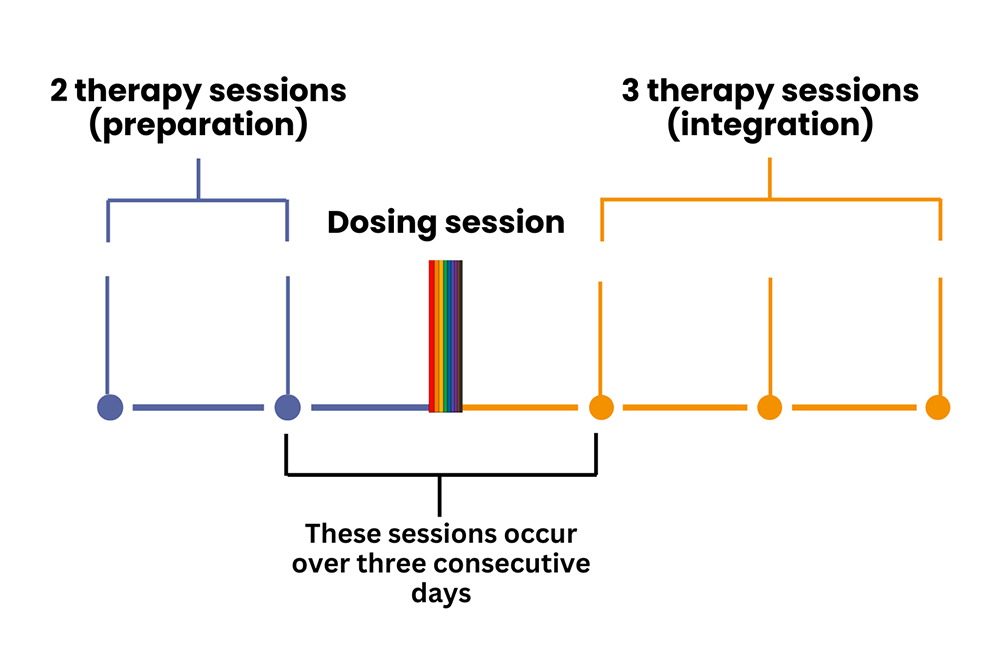
Path-OUD study process
In this study, we are evaluating whether a single dose of psilocibin, delivered as part of PAT, improves outcomes for people with OUD. We are examining whether it helps reduce non-prescribed opioid use and improves adherence to medication-assisted treatment for opioid dependence (MATOD).
We will also investigate how PSI works. This includes examining its effects on brain function and bio-behavioural processes associated with OUD, and exploring whether changes in biological markers are linked to improvements in clinical outcomes.
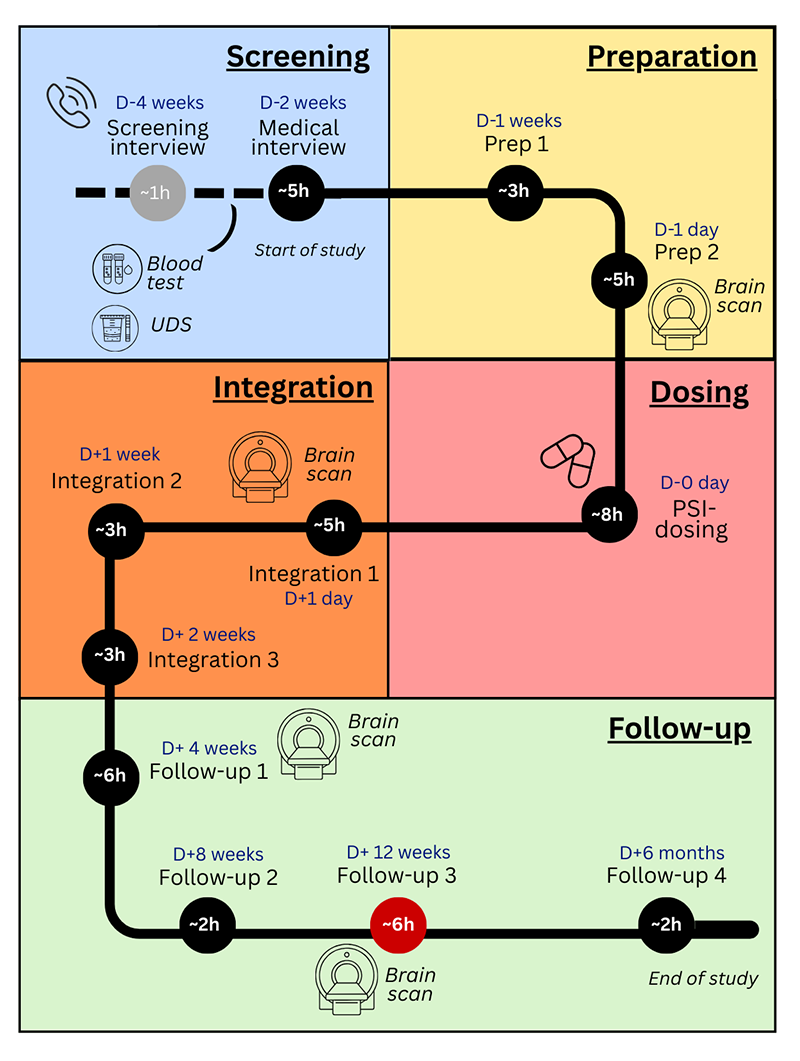
Interested participants receive a detailed explanation of the study process, but in general the study involves:
- Participants complete initial screening procedures and medical checks to determine study eligibility.
- If eligible, participants will be randomly allocated to receive either a high dose (67% chance) or low dose (33% chance) of the psilocybin. As this is random neither the participant or study team can choose which dose participants will receive.
- Participants will be asked to attend the PAT intervention involving two preparation sessions, one dosing session, and three integration sessions. These will be with trained and qualified PAT-therapists experienced in supporting people who struggle with chronic opioid use.
- Participants are also asked to complete questionnaires and interviews about their opioid use experiences, mental health and wellbeing, as well as undergo brain scans and cognitive assessments.
- Participants will attend follow up sessions at 4, 8, 12 weeks and 6 months after dosing.
Check our study flyer and participant explanatory statement for more information.
Who can participate?
- Adults aged 18 to 60 years old
- Currently on Methadone or Buprenorphine for Opioid Dependence
- Have used non-prescribed opioids in the past 30 days
- Are willing to share relevant medical records and medication history from their medical care team
- Are able to attend all in-person visits at Monash University in Clayton, Victoria
Information for clinicians wanting to refer
Clinicians interested in referring patients to the Path-OUD study can follow the steps below (or consult our Clinician FAQ for more details):
- Evaluate patient eligibility: Determine whether a patient may be a suitable candidate based on the study’s general criteria. If you’re not sure, you can speak with a member of our team.
- Discuss the study with the patient: Explain the study purpose, explore potential benefits, risks, and support their informed decision‑making.
- Provide study materials: Share the study flyer containing our contact details and a QR code linking to our screening survey. Participants will need to self-refer.
- Share clinical information when appropriate: After the patient provides consent to our research team, we will contact you to request relevant medical history needed for eligibility screening.
Please check out our clinician FAQ for more information. If you have any further questions, please don’t hesitate to reach out to the team at: path-oud@monash.edu / ph 1800 964 197
References
Penington Institute (2024) Australia’s Annual Overdose Report 2024. Melbourne: Penington Institute, August.
Available at: https://www.penington.org.au/wp-content/uploads/2024/08/PEN_Annual-Overdose-Report-2024.pdf
Wheeler, S. W., & Dyer, N. L. (2020). A systematic review of psychedelic-assisted psychotherapy for mental health: An evaluation of the current wave of research and suggestions for the future. Psychology of Consciousness: Theory, Research, and Practice, 7(3), 279–315. https://doi.org/10.1037/cns0000237