
Research
Our central research philosophy is one of knowledge growth. We believe in learning and developing skills as a group and are committed to working with industry partners and people with lived experience to develop this knowledge together. We focus on understanding how, why, and for whom suicide prevention interventions work to help our partners address identified problems and develop interventions that have real-world impact. This includes ‘upstream’ interventions, which work with young men in unpacking what healthy masculinity looks like for them, and ‘downstream’ interventions that train workers in high-risk industries to provide on-site peer support to those with suicide or mental health concerns. Our research here is jointly funded with an emphasis on collaboration and co-design of programs, working with people with lived experience and key industry partners.
As a team, we greatly value the inclusion of everyday voices and real stories to inform how we can effectively prevent suicide. For example, our qualitative research projects aim to provide a platform for those with lived experience. Through supporting and nurturing emerging researchers (including PhD and Honours students), we have developed a great capacity across various research methods, including; quantitative and qualitative work, mixed methods designs, and program evaluation.
Areas of research/projects
Boys and Men Suicide Prevention
Suicide rates among construction workers are 1.7 times higher than that of other male workers in Australia, with approximately one worker death a week by suicide. Through funding from Suicide Prevention Australia, we have partnered with Incolink – a provider of mental health training and services to the construction industry – in order to evaluate and optimise their Bluehats Suicide Prevention Program. This program was rolled out in 2018 in response to concerns about the suicide rate among construction workers, and provides gatekeeper training to volunteers who become Bluehats. These volunteers then provide on-site peer support and referrals to construction workers with suicide or mental health concerns. Our program evaluation will assess how the intervention is being implemented, which mechanisms are achieving impacts, and what opportunities are there for optimisation. We aim to reduce the rate of suicide within the sector by optimising the impact of this program.
Gatekeeper Training
In 2020, 3139 Australians died by suicide. Moreover, results from the 2007 National Survey of Mental Health and Wellbeing indicate that over 600 000 Australians had made a suicide plan, and over 500 000 attempted suicide during their lifetime. Despite these high rates, many emerging allied health professionals (such as psychology students) report feeling ill-equipped to manage suicide risk. Our lab is working with Monash University’s psychology department to develop a suicide prevention unit for the third-year program of study. By developing and teaching this unit, we aim to provide the future workforce with the knowledge, skills, and confidence to identify and provide support to at-risk suicidal individuals.
Youth Suicide Prevention
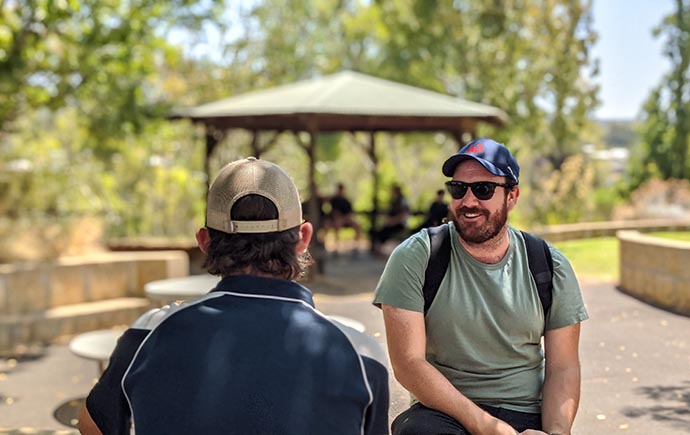 Males account for three-quarters of suicide deaths in Australia, and rates of suicide and suicide-related behaviour remain high among young Australians despite a national priority for preventing youth suicide. Despite the gendered nature of suicide and the known association between suicide and some masculine norms, few suicide prevention interventions have specifically targeted males, and fewer still attend to the role of masculinity. Tomorrow Man is a community-funded program seeking to address the problem of male suicide by challenging and transforming potentially harmful masculinities in young males. Their ‘Breaking the Man Code’ workshops facilitate honest and authentic conversations with male students in years 10, 11 and 12 to define a masculinity that “generates purpose, pride, and health for the men of today and tomorrow”. We have partnered with Tomorrow Man to evaluate and demonstrate the impact of their ‘Breaking the Man Code’ workshops through a cluster randomised controlled trial. We aim to use the knowledge from this trial to provide critically needed learnings about suicide prevention interventions aimed at young males and support for an expansion of the Tomorrow Man workshops.