
Ropes 2: The View from the Quarterdeck
“No ropes on boats!” This was the sailing instructor’s reprimanding response to my naïve questioning, “what do these ropes do?” What to call them then, these masses of apparently identical cordage? Too dainty to be called cable; too rigid to be called string. Too linear to be called thread; too malleable to be called line. No, it transpired that the umbrella term, rope, so favoured by landlubbers, has (almost) no place on a vessel.
Sailors unlearn early the arbitrary categorising of rope: each serves a purpose so singular and so specific that to call these coiled masses ropes is to wantonly induce confusion and disorder. It may well be that the chandlery - the sailor’s supermarket - is the only place where ropes exist in the nautical world. As soon as a boat leaves behind the certainty of the harbour, so too does it leave behind this vague and unhelpful nomenclature.
What follows are some categories that will be familiar to seafarers, and some definitions and descriptions to help distinguish these seemingly alike fibrous assemblages:
Shrouds: despite their massive presence, wooden masts can be weak and unsteady when not supported in their vertical endeavours by the standing rigging. Shrouds can include the forestay, sidestays, and backstays, and altogether they stop the mast toppling. The forestay connects the mast with the front of the boat; the sidestays attach to both the port and starboard sides of the hull; and the backstays run aft (to the back of the boat). Futtock shrouds (be careful how you say that one) are under tension as they connect the outboard edges of the top to the base of the next set of shrouds on a square-rigged ship. Confused yet? Here’s a diagram:

Diagram of futtock shrouds beneath the top of a square rigged ship (Pete Verdon 2005).
The dark blue rectangle is the main top, the blue lines are the futtock shrouds.
Halyards: these are used to haul sails, flags, and other items up the mast. The main halyard (“hal’yd”) commences at the deck, runs all the way to the very peak of the mast, through a block (pulleys are called blocks, didn’t you know) at the masthead, then back to the deck. To set the mainsail, the head (top corner) of the sail is attached to the end of the main halyard, then the free end is pulled, and the whole thing climbs up to the peak of the mast. The same is true of the other sails and their respective halyards. Elsewhere, “-hauls” - as in the outhaul and downhaul, for example - also belong in this discussion as they are used to fine tune the shape of the sail for optimum performance. The outhaul pulls the sail further out to the end of the boom or yard, while the downhaul acts in the opposite direction to the halyard (down instead of up). The boom vang enacts a diagonal force on the sail, and for no reason in particular is not a -haul or a halyard; it is a vang (though for added confusion it is a kicking strap in the UK).
Sheets: these are used to trim the sails so that they are set in the optimum position relative to the direction of the wind. A square-rigged ship has two sheets attached to each of its sails, one on the bottom left corner of the sail, and one on the bottom right. Shipboard - for reasons too tangential to explain here - left becomes port and right becomes starboard (“starb’d”). These terms are relative to the vessel as a whole, and not those onboard, who may face any way they please. Less intuitive, perhaps, are the names windward (“windw’d”) and leeward (“loo-ed”) which refer to the sides of the vessel relative to the direction of the wind. For example, suppose a ship were heading west, with a wind coming from the north. In this scenario, the ship is said to be on the starboard tack, because the wind is passing over the starboard side; the starboard side is the windward side. Inversely, the port side is said to be to leeward. If the ship were to now go about, so that it were facing east, these windward and leeward sides would swap. Now the ship is on the port tack, because the wind - still blowing from the north, passes first over the port side. This is important insofar as the windward sheets become braces, while the leeward sheets remain just sheets. So a piece of rope that was a sheet when the ship was facing west just became a brace because the helmsperson changed course. How intuitive.
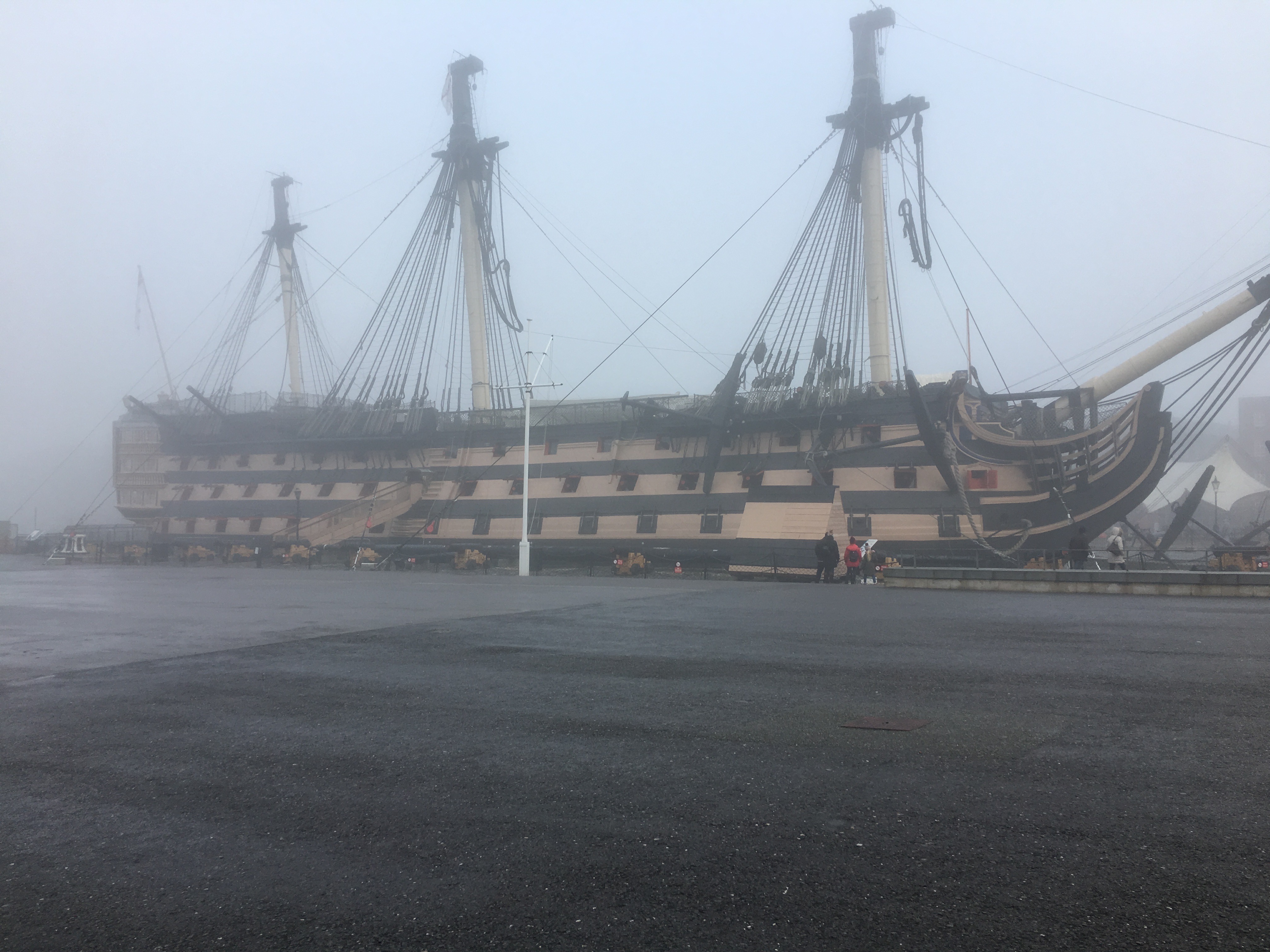
HMS Victory at Portsmouth (H. Croft 2016, personal collection).
Only the lower masts and their corresponding rigging were present on this day.
Cables: anchors are attached to a vessel by a cable. Prior to the introduction of iron chains in the early 19th century, anchor cables were of hemp, just like the rest of the ropes discussed here. Yet anchor ropes (could it be argued that an anchor cable is a sort of halyard?) have the distinction of being referred to as cables. Elsewhere, steering cablesconnect the ship’s wheel to the tiller, and ultimately to the rudder.

Cross-section of a typical square rigged main mast (H. Croft 2022, personal collection). Not to scale.
Lines: lifelines run all around the gunwale (“gunnel”) of a vessel and nominally stop sailors from falling overboard. Most often, though, they present tripping hazards to those trying to come ashore. Mooring lines are used to fix a vessel alongside a mooring, jetty, dock, pontoon, pier, landing, port, quay, wharf, berth, marina, harbour, breakwater, slipway, embankment, ramp, finger, stage, another vessel, or the shore (yes, the hyper-specific naming seeped out beyond the boundaries of the ship). Reefing lines are used to shorten sail. Sometimes they can be short lengths of rope that are simply wrapped around a bundled section of sail, in which case they become sail ties. Clewlines and buntlines are also imperative to this process of setting and reducing sail. Ratlines are the fun rope-ladders that allow sailors to ascend the rig.
Exceptions to the Rule
Sitting by the campfire, quintessential rum in hand, I raised this notion that there are no ropes on boats with some sailing colleagues. We philosophised a short while as the sun set, and what follows are the only ropes we know:
Bellrope: a tiny length of rope attached to the end of the ship’s bell that allows it to be rung.
Boltrope: Today the luff of the mainsail slots into a track in the mast. To make this work, a length of three-strand rope is sewn into the sail during manufacture.
Footrope: When the time comes to set sail, the crew ascend the ratlines, arrive at the top, then shuffle along the length of the yard. The footropes dangle a short distance below the yard so that the sailors can balance there while they work aloft.
Spare rope: Eventually ropes fail. Spare ropes are carried aboard by all but the most imprudent sailors, and can take any form.
Tiller rope: If a vessel is without an autopilot, the helmsperson may lash a rope to the tiller to keep the vessel on a steady course while they tend to other tasks.
Some oddities: lazy jacks aid in the bundling of a sail when the crew is small in number; the Flemish horse is the footrope at the most extreme (in both senses of the word) end of the yard; the topping lift keeps a spar off the deck; and the gasket is a type of reefing line that has nothing at all to do with rubber seals.
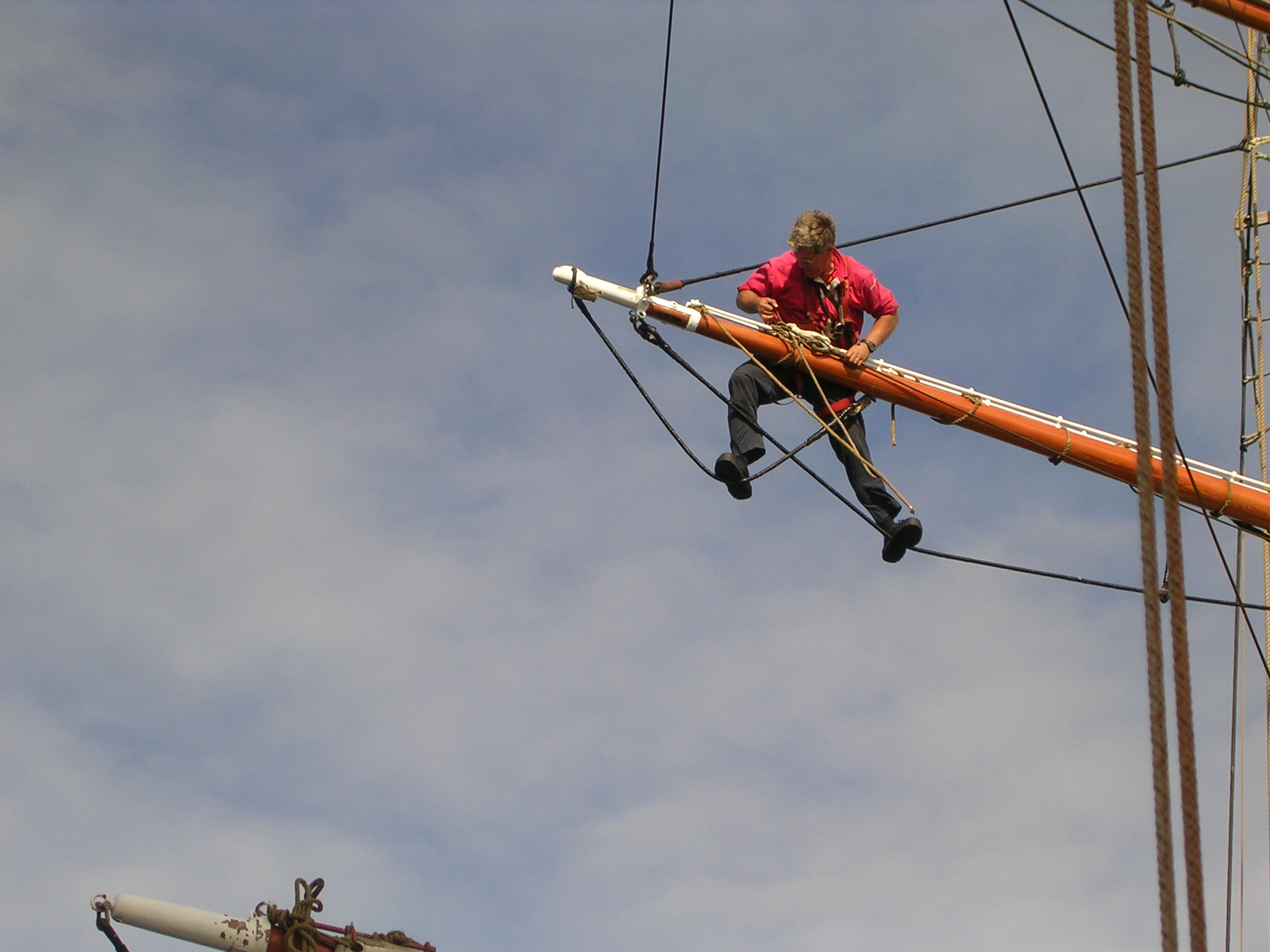
A deckhand standing on both the main footrope and the Flemish horse (Pete Verdon 2007).
The line behind his head is the main topgallant lift; the one pointing skywards is the main topgallant.
All of this is part of a much broader conversation around cultural relativity and perspectives. Materially, at least, the umbrella term ropes remains useful. Functionally, however, ropes have little meaning in the imaginings of the sailor. Within the microcosm of the sailing vessel, they are defined not by their initial process of manufacture but by their function in situ.