
Monash Professor of Music named Distinguished Creative Researcher 2025 by the Australian Council of Deans and Directors of Creative Arts
Professor Cat Hope from the Sir Zelman Cowen School of Music and Performance was recently named the Distinguished Creative Researcher 2025 by the Australian Council of Deans and Directors of Creative Arts (DDCA). This incredible award recognises her major contributions to music composition and performance research worldwide, and how she has transformed the understanding of creative research.
“This award means so much to me because it’s awarded by the DDCA, an organisation that understands the challenge of being both an artist and an academic. They comprehend the complexity of moving between and within artistic and academic pursuits,” Professor Hope said.
The award is also a reflection of her incredibly successful career as a practice-led researcher at the nexus of experimental music, digital animated notation, digital archiving and gender representation.
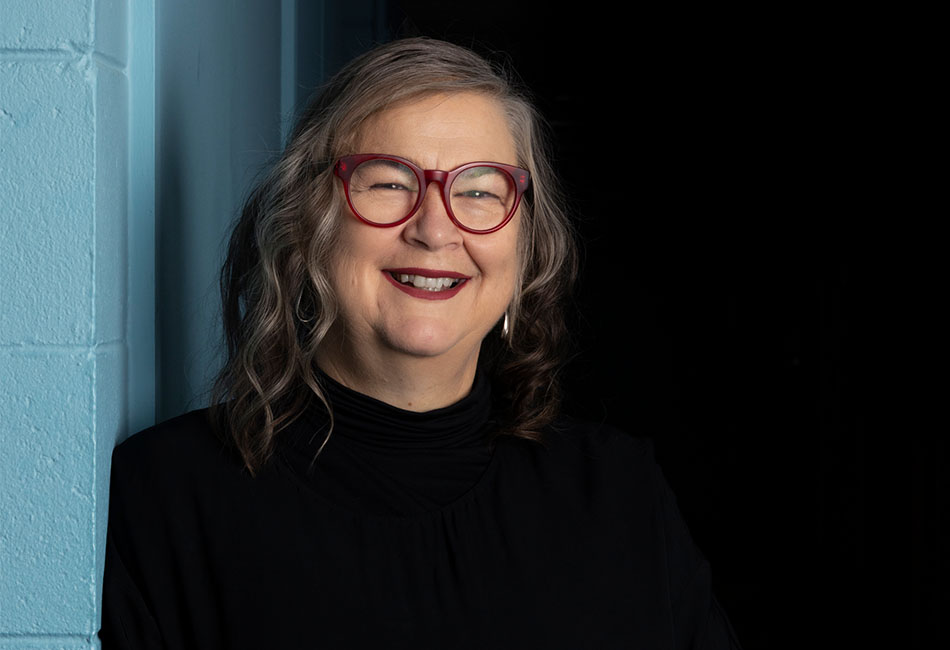
Professor Cat Hope (Photo: Emily McCoy)
From the flute to the Berlin Wall to experimental music
Professor Hope’s life as a musician may have started with a very traditional instrument, but after she completed her undergraduate degree and headed overseas, she found the opportunity to develop her own style and sound.
“I started off backpacking with my flute and ended up playing with lots of different groups, including playing Egyptian flute in an orchestra in Luxor, Egypt and a belly dancing group near Ürgüp, Türkiye. But it was when I was in Berlin, Germany, just after the Wall came down, that I started songwriting and creating my own music. East Berlin was full of musicians from around the world. The whole experience was an introduction to international thinking,” said Professor Hope.
On returning to Australia, Professor Hope couldn’t find any music projects she could contribute to, so she formed her own.
“After forming my own band, and making my own compositions, I became very interested in turning the role of the bass around, and making it the driving, rather than supportive, force of everything, including harmony and melody. This set in motion an approach to music that I have pursued ever since – culminating in my PhD entitled,’ The Possibility of Infrasonic Music’,” said Professor Hope.
“This was informed from having lived in Catania, Sicily, near Mt Etna, where I would listen to the volcano, which actually involves feeling it. I wanted to know if this feeling could be explored in music. This led me to create experimental, low-frequency focused sound and music compositions,” she said.
A new form of music required a new form of notation
Professor Hope’s desire to share her experimental music compositions brought a challenging realisation.
“I discovered that traditional music notation didn’t serve the communication of these ideas to musicians, so I tried writing them down as text, with limited success. That’s how I got into graphic notation, where animating drawings became the main method of creating music scores,” Professor Hope said.
Professor Hope has led a music research group that is also a music ensemble, Decibel. The team developed the Decibel ScorePlayer, a computer application that delivers the coordinated reading of animated, graphic notation, which can be found in the Monash App and Google Play stores.
“I believe there’s value in reading music together. It’s a core premise of my practice. We developed the Decibel ScorePlayer to allow composers to turn any drawing or image into a score and decide on the rules about how that image is read as music. For example, the height of the image might be the pitch, or a colour might be a particular instrument, or the thickness might be the dynamic,” said Professor Hope.
The application debuted on the iTunes store in 2013 with funding support from industry, and has been updated regularly ever since. It is used around the world by composers and performers, and can help bring together traditional and experimental approaches, existing scores and even incorporate recorded sound into a score.
A powerful revolution that facilitates artistic expression
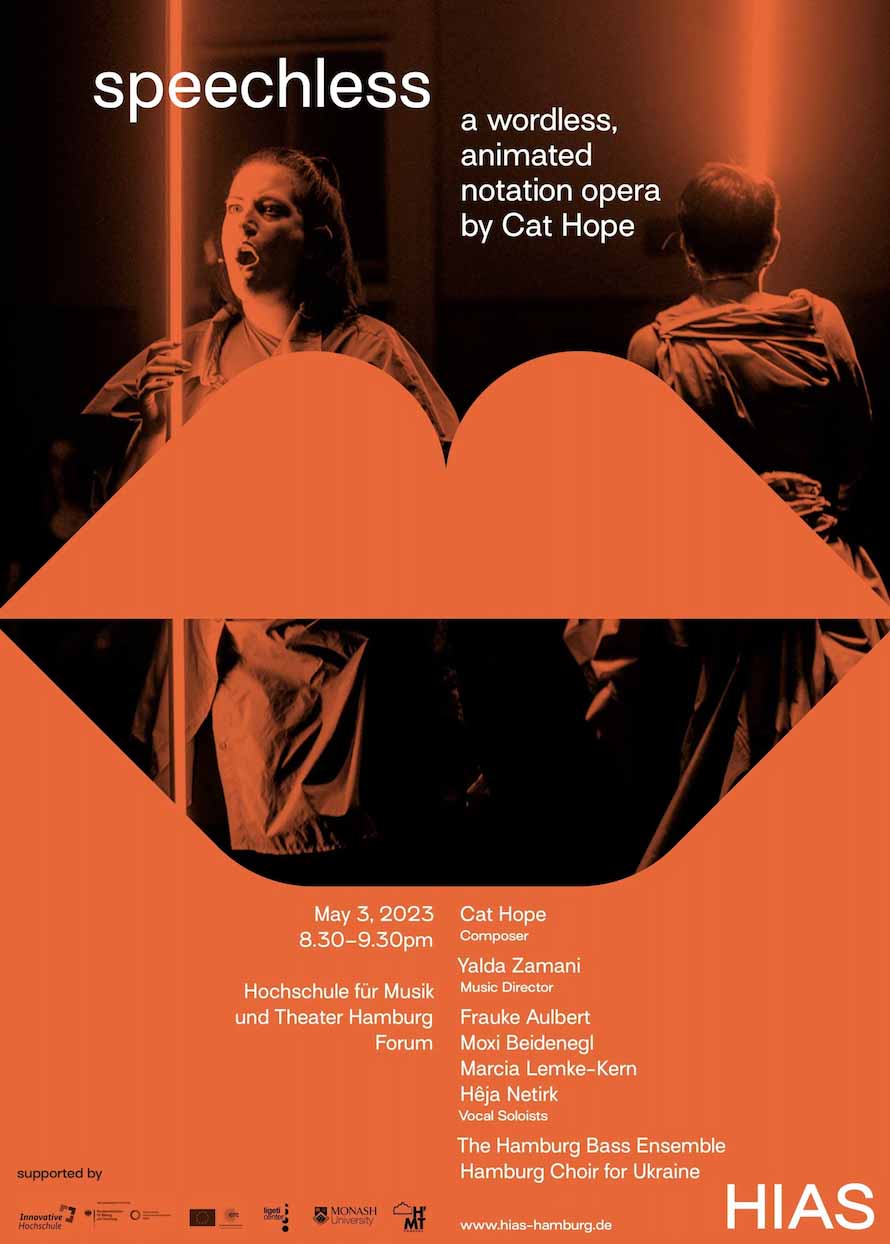
A prime example of how animated graphic notation works is the score for Speechless, an opera composed by Professor Hope, which was highlighted in the judges’ comments for the DDCA Awards.
The opera, which premiered in the Perth Festival (2019) and was performed at the Ligeti Festival in Hamburg (2023), was written in response to the 2014 Human Rights Commission report, The Forgotten Children: National Inquiry into Children in Immigration Detention.
“All of my work either addresses or takes a political situation as a springboard for musical ideas. Speechless is a response to a key human rights issue of our time in music, and uses different modalities of communication to draw attention to the plight of refugees worldwide,” Professor Hope said.
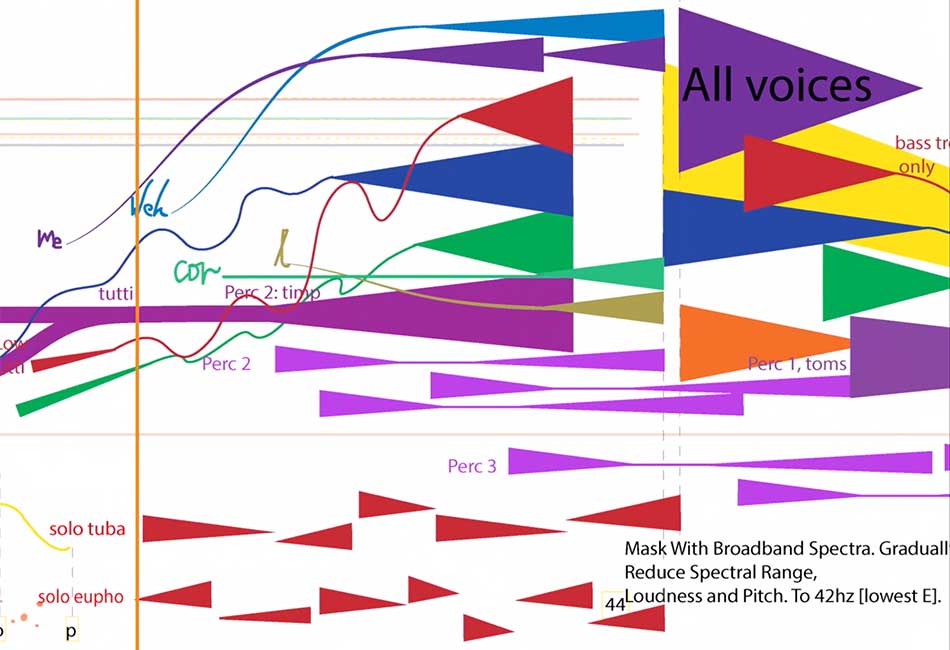
The image above is an excerpt from a section of the Speechless master score showing the red (brass), purple (percussion – in different shades of purple according to instrument), yellow (electronics), orange (harp, piano and bass guitars), green (wind), blue (cello/double bass) and four vocal parts (violet, navy, brown and lime) and text instructions.
Practice-led research allows for exploration and integration
As an academic whose work is founded in creative practice, Professor Hope’s interests interconnect four different areas in a compelling way.
“I'm interested in music innovation. I feel that music departments in public universities have an obligation to innovate what music is and can be in the future,” said Professor Hope.
“As an experimental artist working with digital notation, I was creating materials that required digital archiving. I noted that there were hardly any women working in either experimental music composition, digital notation or electronic music, let alone the digital archiving required to preserve this work for future artists to engage with,” she said.
“It made me realise that my field is not an equitable one. I decided to look at ways of mentoring young people who identify as women and showcasing their work. Both the music school and my music group signed up to the Key Change Pledge to ensure that fifty per cent of the music we commission and discuss is made by people who identify as women,” Professor Hope said.
Collaboration can span research and performance
Across all Monash faculties, the theme of collaboration is foundational for many aspects of teaching and research. Professor Hope understands just how much she has benefited from collaboration throughout her career as a musician and an academic.
“You can make music at home on your own, but it’s the relationships you make at university that can stay with you for the rest of your life. I still make music today with people I did my undergraduate degree with, as well as past students,” said Professor Hope.
“Decibel - the group that developed Decibel ScorePlayer is a music group and a research team that’s been around for 15 years. We’re split across two Universities, Monash here in Melbourne and the Western Australian Academy of Performing Arts at Edith Cowan University in Perth,” she said.
“This group has been key to my success as an academic, researcher, composer and musician. We publish CDs and papers that we create together, and I don’t think I’d be where I am now without the collaborative support of this team. Together, we established a really great research model that is also an important music ensemble,” she said.
This was recently recognised in the 2025 Art Music Awards, where Decibel received an APRA AMCOS Art Music Luminary Award. APRA AMCOS notes that this award “recognises organisations whose sustained commitment has transformed the Australian music landscape".
Advice for students from an award winner
As someone who has created her own pathway, Professor Hope knows that there is more than one way to study music. Between being a musician and a researcher, the opportunities for a music career are vast.
“As a music researcher, there is a myriad of opportunities for you to pursue. Not all musicians go on to play in orchestras, become film composers, or join world-touring bands. Research is essential for a flourishing community - it invests in the future of music. Modern academia presents a range of different modes of research methodology and publication. Artistic research, for example, can be undertaken and shared through the creation of compositions and performances with collaborators worldwide,” Professor Hope said.
“No matter what style of music you’re making, you’ll find a musical home here at Monash. We ask our students to be open-minded and be prepared to be challenged in ways that could be life-changing. At Monash, we’re interested in how the musicians we train go on to be custodians of a global musical future,” said Professor Hope.
Read Professor Cat Hope’s full academic bio here and learn more about her artistic work here.
If you’re interested in studying music at Monash Arts, you can find out more here.