
Monash University strengthens international ties with South Korean police to combat gender-based violence
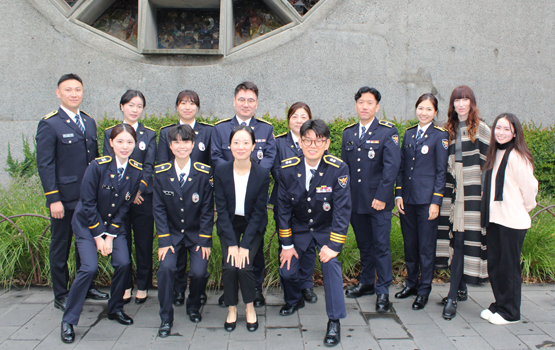
Monash University’s Faculty of Arts is hosting a delegation of 10 specialist officers from across South Korea for an intensive four week training program aimed at reducing domestic, family and sexual violence.
Funded by the Korean National Police Agency, the program is a joint initiative of Monash’s School of Languages, Literature, Cultures and Linguistics and the School of Social Sciences, with training to be delivered through the Monash Gender and Family Violence Prevention Hub. The program aims to bring together law enforcement and researchers to address the complex social and technological dimensions of gender based violence. The comprehensive curriculum includes a series of lectures, workshops, and visits to industry partners and relevant organisations across Melbourne.
Dr Hyein Ellen Cho, from the School of Languages, Literature, Cultures and Linguistics, said the training is designed to share Monash’s evidence-based research and translate it into real-world policing tools to combat gender based violence and support.
“In an increasingly digitally saturated society, new social challenges like the proliferation of technology-facilitated violence and surveillance are emerging globally and require the kind of cross-border innovation and institutional understanding we are building here.”
Over four weeks, from 25 August, the visiting delegation will have an overview of contemporary policing and combating gender based violence. They will hear from a range of social science and legal experts as well as be introduced to agencies on the ground tackling emerging issues to enhance community safety.
The program places a strong emphasis on policing vulnerable and diverse communities, addressing the specific barriers faced by older adults, Indigenous groups, and migrant women who may be isolated by regional distance or visa status.
Additionally, officers will receive specialised training in identifying perpetrator manipulation tactics, recognising the complex presentations of trauma, preventing the misidentification of victim-survivors, and learning how to embed lived experiences directly into frontline law enforcement training.
Dr Cho said that the program builds on Monash’s strength in working to combat gender-based violence across the Indo-Pacific. She hopes the intensive curriculum will provide the officers with the academic insights to incorporate directly into their work.
"By equipping them with specialised techniques to recognise perpetrator manipulation, understand trauma, and support marginalised communities, we are enabling them to refine frontline tactics in their own jurisdictions. This ensures they can return home with the practical tools needed to better protect and help victim-survivors, placing them firmly at the center of the law enforcement response."
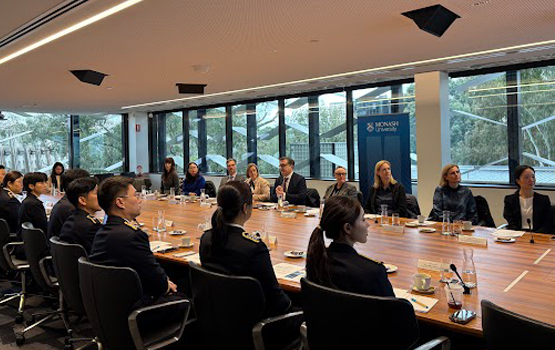
The Korean Police training delegation consists of subject-matter experts in various areas, including victim protection, specialised domestic violence investigations, and initial response to gender-based violence.
Senior Inspector Insup Song, leading the Korean National Police Agency delegation, has served as an officer for 20 years, with the last nine years specialising in crime victim support and protection.
“While our two countries have distinct cultural and legal contexts, gender-based violence is sadly a critical challenge we share. I am eager to learn how we can adapt these trauma-informed strategies and coordinated community models to strengthen our systems in Korea while also sharing any insights we may be able to offer our colleagues in Melbourne. I look forward to building on this mutual exchange in the years to come."
This theoretical training will be supported by immersive site visits across Melbourne and practical technology demonstrations, including innovative Virtual Reality training sessions. The delegation will tour Monash’s AiLECS Lab to learn about cutting-edge research into regulating online sexual abuse and child exploitation materials, alongside visits to the Victoria Police Academy, the Neighbourhood Justice Centre, and Sexual Assault Services Victoria to observe integrated justice models firsthand.
Through ongoing researcher and practitioner exchanges designed to deepen long-term capacity, the collaboration demonstrates how shared social challenges can drive regional policy innovation and cross-cultural understanding, delivering broader benefits across the Indo-Pacific and global community.