
Taking Care Seriously: How Monash Research is Informing the Future of Peace Operations
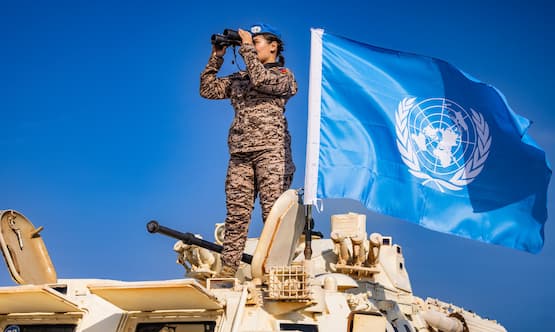
Peacekeeper in United Nations Mission in South Sudan (UNMISS), Gregorio Cunha 2023
Despite decades of reform efforts, underpinned by the United Nations (UN) Women, Peace and Security agenda, women still comprise only approximately 10 per cent of uniformed personnel deployed to UN peace operations. New research from the Monash Global Peace and Security Centre suggests one reason has been largely overlooked: caring responsibilities.
In the first study of its kind globally, the research demonstrates that caring responsibilities—particularly caring for children—shape recruitment, retention, training opportunities, career progression and deployment to peace operations across armed forces and police institutions worldwide.
Globally, women perform an average of 2.5 times more unpaid care work than men. In institutions that reward constant availability and unrestricted mobility, this disparity translates into a significant professional disadvantage. The result is not only fewer opportunities for women, but the loss of valuable skills, experience and leadership potential from peace operations.
The findings challenge the assumption that care is a private matter or a peripheral workplace concern. Supporting personnel with caring responsibilities is a strategic investment in capability, retention, well-being and mission effectiveness—and a necessary condition for increasing women's meaningful participation in peacekeeping.
A Global Evidence Base
Led by the Director of the Monash Global Peace and Security (Monash GPS), Associate Professor Eleanor Gordon, and funded by Global Affairs Canada as part of the Elsie Initiative for Women in Peace Operations, the three-year project investigates how caring responsibilities shape who can serve, who can deploy and who can lead in military and police institutions and UN peace operations.
The research engaged 553 participants including peacekeepers, other uniformed personnel and key stakeholders across 63 countries. The testimony of participants — the majority uniformed personnel spanning diverse ranks, contexts and operational environments — paints a remarkably consistent picture of maternal bias and marginalisation.
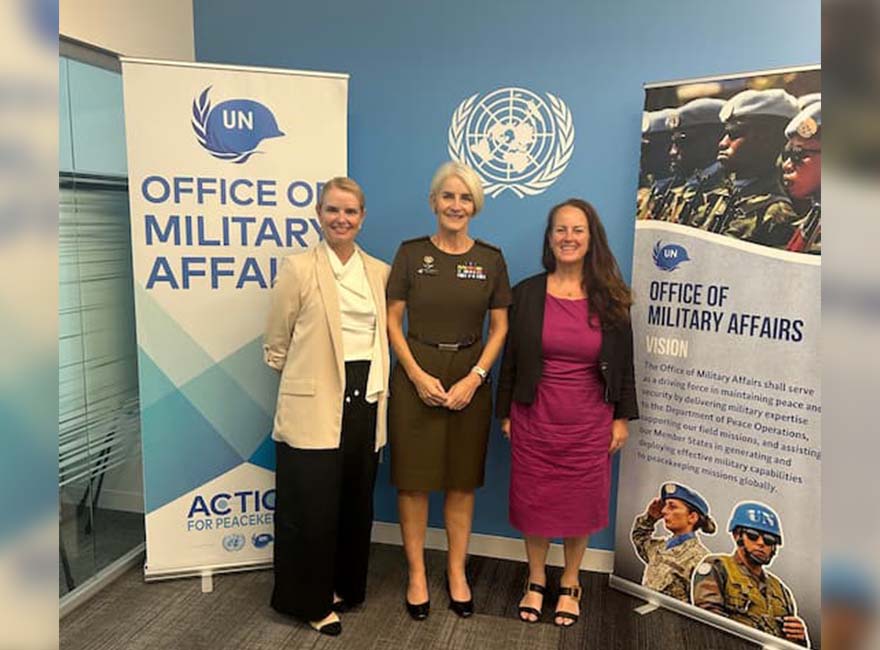
Lieutenant General Cheryl Pearce AM CSC, Acting Military Adviser to the UN Secretary-General, with Associate Professor Eleanor Gordon
and Llani (LJ) Kennealy of Monash GPS, UN HQ July 2026
Caring as a Structural Barrier
Among women surveyed, nearly half (47 per cent) reported that caring responsibilities had negatively affected their career progression. Similar proportions of women said caring responsibilities had also impacted training opportunities (38 percent) or deployment opportunities (39 percent) or caused them to leave or change roles within the security sector (45 percent).
Practical constraints – long working hours and limited access to affordable childcare – collide with workplace cultures that reward perpetual availability.
Maternal bias compounds these challenges: mothers can face assumptions that they are less committed, less capable, less deployable. Mothers can be denied deployment opportunities, presumed to be uninterested, or expected to be unable to cope with family separation (a known stressor on operations for all peacekeepers, not just women). A female peacekeeper in the United Nations Multidimensional Integrated Stabilization Mission in the Central African Republic (MINUSCA) described how opportunities to deploy were denied to her because of these assumptions:
… throughout my career, I think my command feels like they’re trying to accommodate me and feels like I should be home with my kids. I should be taking care of my kids so they’re not going to present me those opportunities as much as they would with people with no kids, or with fathers. (Interview with female military peacekeeper, MINUSCA, 22/10/2024).
These challenges are treated as personal matters to be privately managed. In reality, they are structural problems with measurable consequences for workforce capability and operational effectiveness. Organisations that do not address them lose experienced personnel, narrow their talent pools and undermine long-term capability.
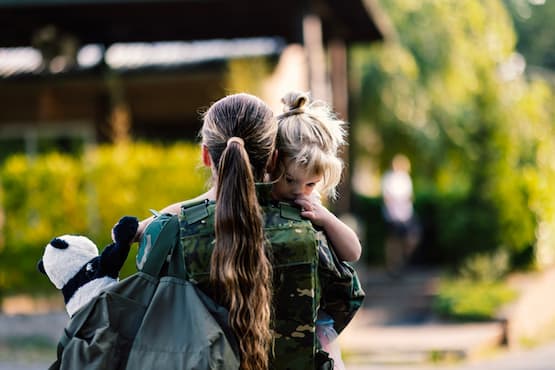
nimis69 via Getty
From Liability to Asset
A significant contribution of this research is reframing caring responsibility from operational liability to strategic asset. In sharp contrast to entrenched assumptions that carers are distracted or less capable, the evidence reveals that personnel with caring responsibilities bring distinctive qualities to peace operations — empathy, attentive listening, emotional intelligence, patience and sophisticated crisis management skills — honed through the daily practice of caring for others. As one participant observed:
I think there are enormous benefits for people who have the experience of care responsibility. I really genuinely think it makes them better professionals and provides them with skills that are underestimated in our society. We urgently need this, especially if we think about peace and security — skills like active listening, empathy, the ability to identify diverse needs and capacities. (Interview with female civil society actor, online, 17/04/24).
These skills are not incidental — they are central to the evolving demands of modern peacekeeping, which increasingly prioritises human security, community protection and civilian engagement over traditional military force.
The research also establishes a direct correlation between organisational support for personnel with caring responsibilities and broader workforce well-being. Seventy-one per cent of survey respondents agreed that organisational attentiveness to caring responsibilities is linked to staff well-being — with implications for performance, retention and safeguarding. When organisations are inattentive to care, they risk fostering workplace cultures where well-being is neglected, burnout goes unchecked, and negative coping mechanisms take hold — with documented consequences for safeguarding and mission integrity.
From Evidence to Impact
The project does not only identify challenges; it provides practical solutions. The project’s Final Report contains detailed, evidence-informed recommendations for the UN, Member States, security institutions and individual personnel, and is accompanied by a comprehensive Organisational Toolkit with 15 evidence-based tools for defence and police institutions — including templates for care audits and family care plans, bias interruption tools for selection panels, and deployment checklists.
The research findings have also been translated into a free online multilingual training course – Family Responsibilities and Care – developed in partnership with the Peace Operations Training Institute (POTI), with funding from Global Affairs Canada. It is available to everyone and provides practical strategies for balancing caring responsibilities and work, and guidance for individuals, leaders and organisations to build more inclusive, care-attentive workplace cultures.
All project outputs are available in English, French, Spanish, Bahasa Indonesia and Hindi at the bespoke project website – Caring for Peacekeepers. Project outputs are also featured on the UN’s Elsie Initiative Fund website.
Driving Policy and Institutional Change
The project's growing policy influence is reflected in the high-level launch of its outputs in New York on 30 July, hosted by the Permanent Mission of Canada to the United Nations and co-hosted by the UN Women's Elsie Initiative Fund (EIF) and Monash GPS.
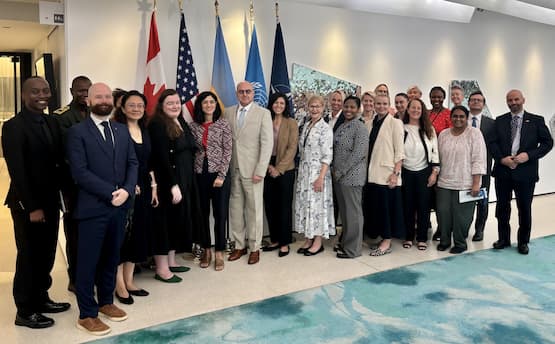
Senior UN officials, Member States and uniformed personnel who attended the high-level launch
The event included a keynote address by Lieutenant General Cheryl Pearce AM CSC, Acting Military Adviser to the UN Secretary-General, the most senior military officer in the UN, who said:
This essential research does not just identify challenges. It provides practical recommendations and tools that organisations can use to strengthen support for personnel with caring responsibilities, while improving organisational effectiveness. This is not only about increasing opportunities for women. It is also about ensuring that institutions are able to recruit, retain and develop the very best people, both men and women. It is about recognising that supporting our personnel is fundamental to operational readiness…
Today’s launch is therefore about more than the publication of a report. It is about providing practical resources that can inform policy, leadership and institutional reform across the United Nations, Member States and security institutions. I encourage everyone to engage with the research findings, explore the accompanying toolkit, policy briefs and training resource, and consider how these might apply within your own organisations.
This was followed by presentations by the Head of the Uniformed Women in Peace Operations Team in the UN Office of Coordination and Shared Services, Ana Garcia, and Selma Lofti, representing the UN Network for Uniformed Women Peacekeepers, Deputy Director of POTI, Elisabeth Rosenbaum, and the EIF Manager, Deborah Warren-Smith, who said:
This research really matters because it specifically shows that caring responsibilities are not simply private challenges that individual personnel – men and women – have to manage. It is in fact the institution's policies, practices and decisions that determine how these responsibilities have become barriers over many, many years.
The event brought together senior UN officials, Member States and uniformed personnel who discussed how the research can inform future policy and institutional reform.
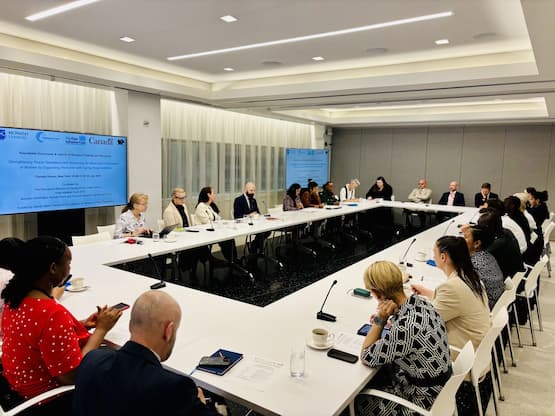
The high-level launch and roundtable discussion at the Permanent Mission of Canada to the United Nations
That momentum is already evident in the uptake of the project's practical outputs. Since the launch of the Family Responsibilities and Care training course in May 2026, over 1000 people, representing over 100 nationalities have taken the course with most participants rating it as ‘excellent’ (the rest ‘very good’ or ‘good’) – constituting one of the most popular courses POTI has delivered and filling a much-needed gap among security professionals and institutions. When asked to provide feedback, many commended the course for being ‘informative’, ‘practical’ and ‘useful’:
The course is excellent and addresses a highly overlooked topic in the security sector. It is very true that balancing family duties with professional demands creates hidden stress, and having an organization that acknowledges this makes a massive difference. The advice on self care and setting up solid family care plans before deploying is highly practical and useful.
Personally, I believe the key strength of this course is how it grounds the concept of well-being in reality; it frames work-life balance or support for caregivers not as a "favor" or an act of charity, but as what it truly is: a strategic necessity. This is clearly illustrated by the example of a staff member whose mind is preoccupied with anxiety about their home life—something that translates directly into tactical errors and security lapses in the field. Linking care to mission effectiveness is the text's greatest success.
Alongside the training, the project website has become an important global resource, bringing together evidence, policy guidance and practical tools in five languages. Stakeholders have described it as an "excellent repository" of accessible evidence and resources. The most senior military officer in the UN – Lieutenant General Cheryl Pearce AO CSC, Acting Military Adviser to the UN Secretary-General – described the work as 'excellent and meaningful', noting that 'understanding and addressing these barriers will hopefully see increased female participation across our missions'.
When UN personnel across headquarters and field missions were briefed on research findings in May, they described the research as 'long overdue'. One peacekeeper said that seeing these challenges validated their feelings and brought hope that change would follow. Others committed to becoming 'advocates for change' within the UN system.
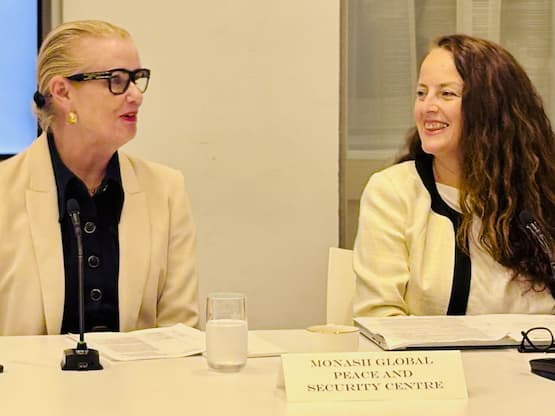
Llani (LJ) Kennealy and Eleanor Gordon representing Monash GPS and co-hosting the high-level launch
The project demonstrates not only why change is needed, but how it can be achieved. With practical tools, evidence-based recommendations and growing institutional engagement, the foundations for meaningful reform are already being laid.
Supporting personnel with caring responsibilities is not a peripheral concern or a soft workplace issue. It is a strategic investment in capability, retention, well-being and mission effectiveness. It is also a necessary condition for the meaningful participation of women in peacekeeping. Institutions that fail to adapt risk losing highly skilled personnel and weakening operational performance. Those that do adapt will be better positioned to meet the complex security challenges of the future.
It is a strategic investment in people, performance and mission success. This Monash-led research provides the evidence base — and the practical tools — to make it happen.
These successes were recognised when the project team was awarded the 2026 Dean’s Award for Excellence in Research Engagement and Impact on 05 August.