About us

Monash Vision Group (MVG) aims to harness this Australian-built and patented technology to create a new industrial ecosystem of neurotechnologies, positioning Australia at the forefront of the neural prosthesis revolution and fully maximising its commercial potential in a growing global market.

Our flagship project is Gennaris: a bionic vision system that aims to provide artificial vision to blind individuals. Since inception in 2010, we have been working to develop a clinically viable bionic vision system, and to demonstrate the safety and usefulness of this system in a small number of recipients with complete, bilateral blindness.

The core technology under development by Monash Vision Group involves a wireless implant that is designed to deliver patterned electrical stimulation to the brain. Up to 11 of these implants, each of which are around the size of a thumbnail, may be placed on the surface of the brain and programmed wirelessly to stimulate brain cells with tiny electrical pulses. When implanted on the visual cortex, these electrical pulses can be interpreted as visual information, providing the recipient with basic shapes and outlines that may assist with navigation, object recognition, and other basic everyday tasks.
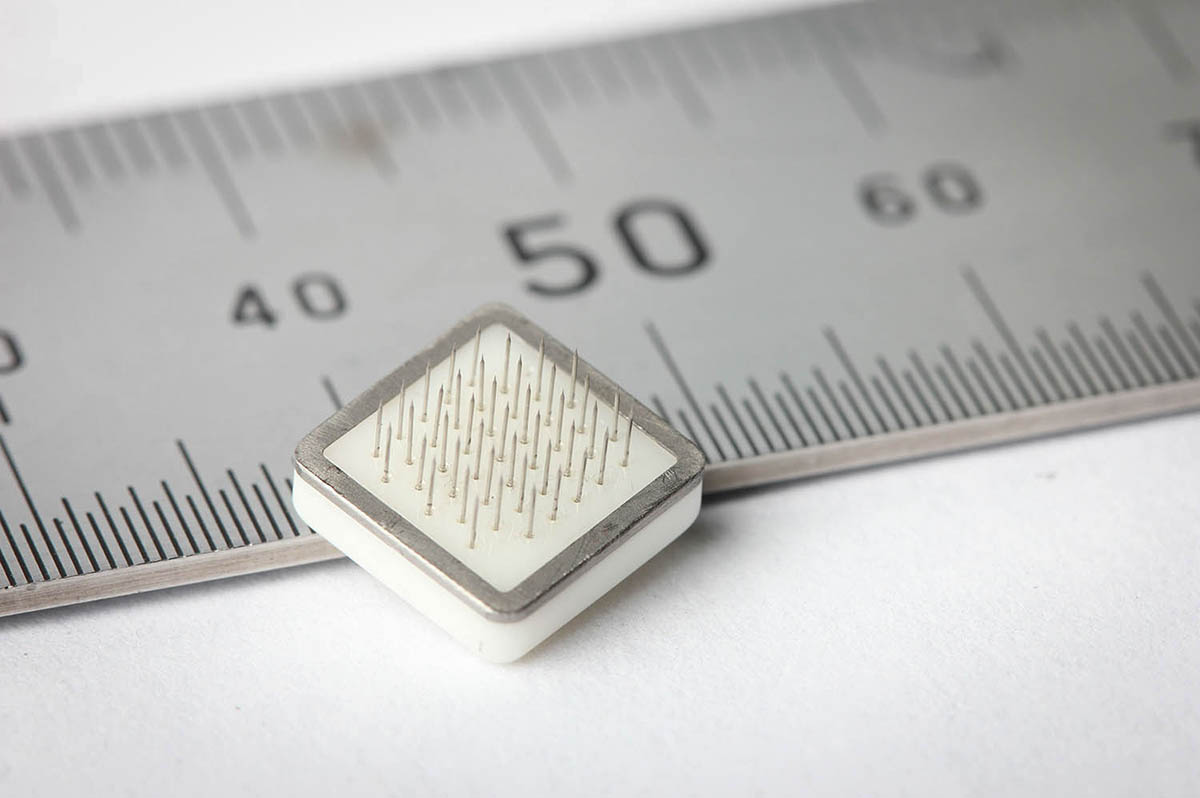
Caption: A single Gennaris implantable device, or 'tile', placed next to a ruler for size. This image is the property of Monash Vision Group.
Reproduction is forbidden without the express permission of Monash Vision Group personnel

The project is led by Professor Arthur Lowery with the involvement of a number of exceptional academics, including Professor Jeffrey Rosenfeld, Associate Professor Yan Wong and Professor Marcello Rosa. The technology has been evaluated in a series of preclinical studies conducted in the Department of Physiology at Monash University.

The project has been funded through the Australian Research Council Special Research Initiative (application number SR1000006), the National Health and Medical Research Council (application number 1075773), the BioMedTech Horizons program, Stage 1 funding from the Australian Government Department of Health's Medical Research Future Fund's Frontier Health and Medical Research, and generous philanthropic support from the Alan and Elizabeth Finkel Foundation, Drs Marc and Eva Besen, and Monash Engineering and IT Faculty Foundation.

At the time of writing, Monash Vision Group are applying for funding to conduct the First-In-Human trial of Gennaris in a small number of study participants. This trial will be based at the Clayton campus of Monash University, with the procedure performed at The Alfred Hospital. We are not currently recruiting participants for this trial.
Our history

Initial seed funding (ARC Special Research Initiative)

In 2010, Monash Vision Group applied for and received Australian Research Council (ARC) funding for a unique proposal to go ‘direct to the brain’, specifically to stimulate the brain’s cortex with electrical currents to produce the sensation of light (phosphenes). Most other groups around the world concentrated on stimulating the retina, rather than the brain.

The Special Research Initiative (SRI) grant from the Australian Research Council, which was created as result of the Australia 2020 Summit held in Canberra in 2008, provided the original funding of $8 million in 2010, and was supplemented with $1.9 million in 2013. This funding brought together key disciplines within Monash University, along with partners Grey Innovation, miniFAB, and Alfred Health. Together, we developed a full system, including camera system, vision processing algorithms, wireless transmission and miniaturised electronics within implant tiles, each supplying stimulation via 43 electrodes.

Monash Vision Group's submission was led by a team that included Professor Arthur Lowery (Project Director), Professor Marcello Rosa (Deputy Director and leader of the preclinical team), Professor Jeffrey Rosenfeld (Clinical leader), Dr Erol Harvey (Industry representative) and Dr. Elaine Saunders (project manager). During the 5 year SRI project, the creation and development of Gennaris was made possible by the critical contributions of:

Professor Ramesh Rajan, Professor John Forsythe, Professor Lindsay Kleeman, Professor Mark Armstrong, Dr Anand Mohan, Dr Horace Josh, Dr Chun Wang, Dr Jeanette Pritchard, Dr Collette Mann, Dr Cristina Ciornei, Dr Leo Lui, Dr Damien Browne, Dr Micah Atkin, Dr David Fitrio, Dr Nic Price, Dr Dennis Lui, Dr Philip Lewis, Dr Edwin Yan, Dr Saman Hagh Gooie, Dr Emma Brunton, Dr Titus Tang, Dr Erol Harvey, Dr Wai Ho Li, Dr Helen Ackland, Dr Mathilde Escudie, Andrew Stephens, Mike Smith, Alistair Webb, Peter Bettonvil, Graham Lyford, Rafał Wadowski, Simone Carron, Kieran John, Matthew Solomon and Warwick Fifield.

Click here to view annual reports that detail the MVG’s Special Research Initiative grant activities.

Development funding (NHMRC and philanthropy)

The years after the initial funding saw the development of safety studies for the implants, and also implantation techniques, including surgical techniques. Developing the manufacturing processes towards maturity, to increase yield and product lifetime was also a focus.

ARC funding was complemented by grants from the NHMRC for clinical trials for manufacturing process development, and generous funding from Dr Marc Besen AC and Dr Eva Besen AO and the Alan and Elizabeth Finkel Foundation.

Support has also been provided by Monash University and the Monash Engineering Foundation.

We thank those who have contributed and fostered our neurobionics work over this journey.

Commercialisation funding (MRFF and BMTH)

In April 2018, Monash Vision Group (MVG) received $500k funding from the BioMedTech Horizons program (MTPConnect) to bring manufacturing in-house. Using this funding, MVG was able to consolidate manufacturing in our Clayton-based laboratories and local service providers. This drastically decreased the cost of manufacturing our implants, improved manufacturing yield and allowed for the establishment of on-site quality management.

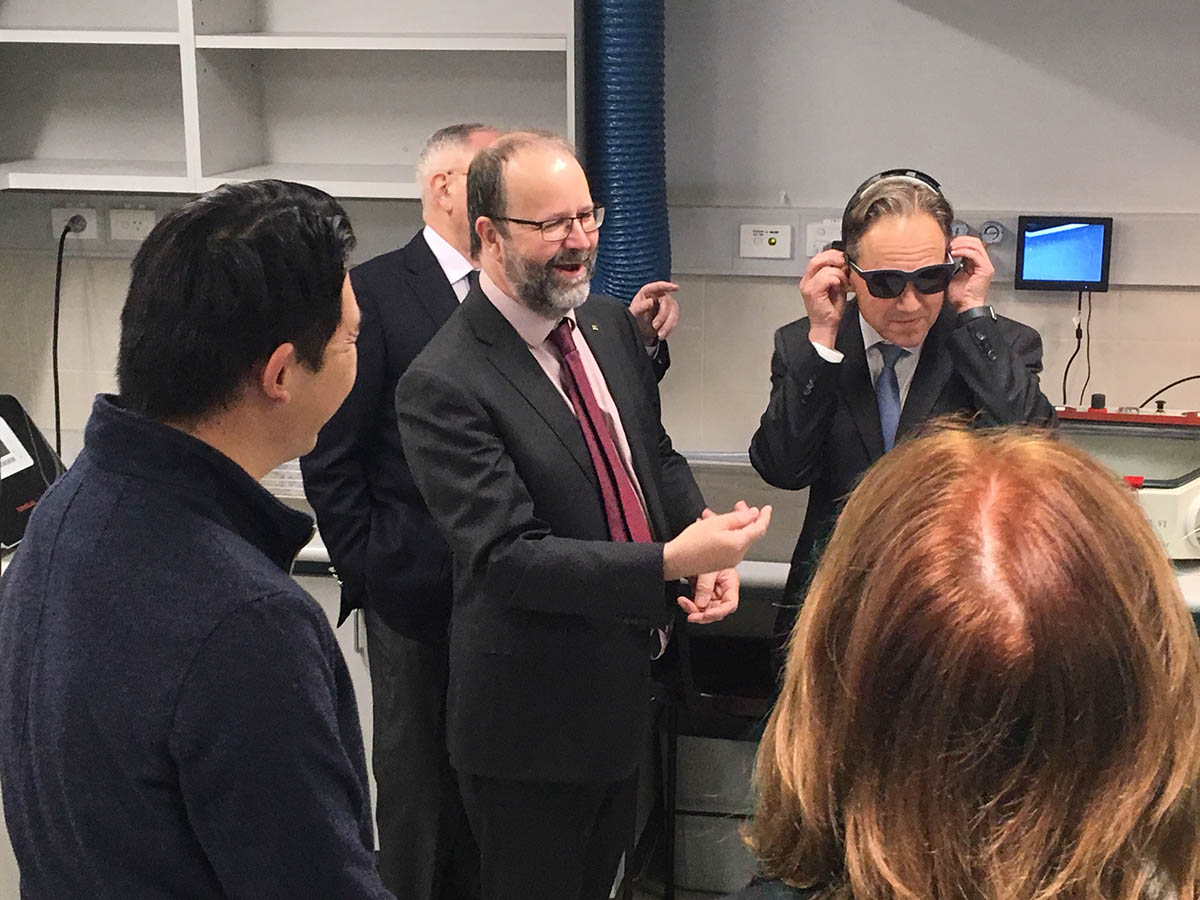
Caption: The Hon Greg Hunt MP, Minister for Health tries on the vision restoration headgear, Gennaris.

In June 2019, MVG received Stage 1 funding from the Australian Government Department of Health's Medical Research Future Fund's Frontier Health and Medical Research program for a project entitled 'Cortical Frontiers – Commercialising Brain-Machine Interfaces'. Stage 1 of the project involved conducting research directly with patients, clinicians and surgeons across Australia and internationally to explore unmet clinical needs and technology alignment. It also enabled further development of the medical device ecosystem required to deliver therapeutic opportunities in multiple clinical settings.