
Gemetallurgy (Minerals, Microbes and Solutions group)
Improving process efficiency, minimising the impact of deleterious chemical reactions, or extracting full value out of field- and laboratory-tests rely on an understanding of the key parameters that control the underlying processes. In many cases, this requires characterisation of the mineralogical, textural, and/or compositional changes of solids and solutions at various time and spatial (nm to m) scales. Monash offers an integrated platform with state-of-the-art instrumentation coupled with expertise to design effective analytical strategies.
Analytical capabilities include (but are not limited to):
- Routine measurements of major and trace elements in a wide range of materials from inorganic solutions to geological samples to surface and ground water samples.
- Direct in-situ analysis of minerals and other solids for their trace element and isotopic compositions via laser ablation ICP-MS.
- Electron-microscopy (imaging, semi-quantitative chemical analyses, MLA).
- Powder diffraction and quantitative mineralogy via Rietveld refinements.
- Predictive geochemical modelling of fluid-rock-(biota)-interactions.
- Enable access to National and International facilities for specific applications, for example, Australian synchrotron: megapixel chemical imaging at µm-resolution; imaging of chemical state (including oxidation state) of elements in solids and in solutions; in-situ process characterisation (chemistry and texture), from ambient to supercritical conditions.
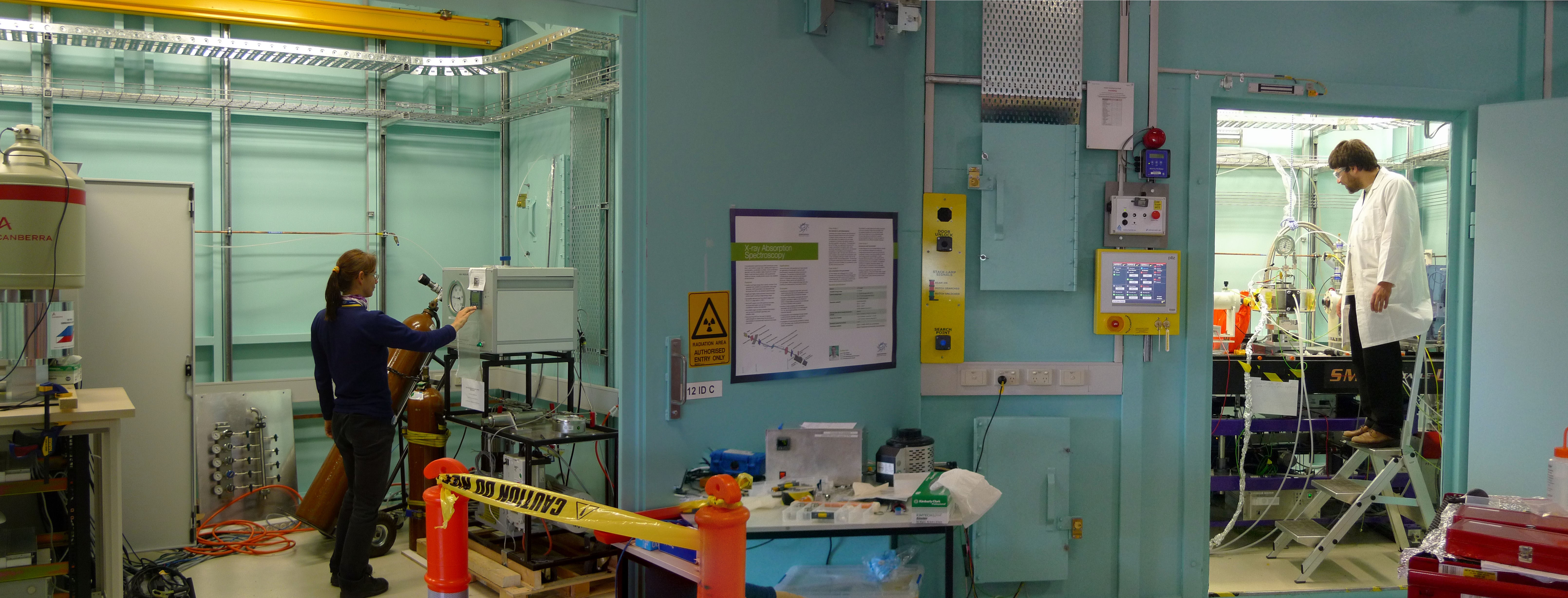
Operating the maESTRO autoclave system at the Australian Synchrotron. The system enables in-situ studies of hydrometallurgical process up to supercritical conditions, with real-time monitoring of solution composition and chemical state of dissolved metals.
On-going projects that are hiring PhD students with Engineering and/or Science (geology, geochemistry, physical and computational chemistry) backgrounds include:
Thermodynamics of Critical Minerals Across the Resources Value Chain
This project aims to support Australia's future as a bespoke, sustainable provider of critical minerals for the World's transition to a carbon-free economy by deciphering the complex physico-chemical processes that concentrate critical metals in the Earth's crust and in mineral processing plants.
This project will generate fundamental physico-chemical data and innovative experimental and modelling tools using interdisciplinary approaches across geochemistry, mineral engineering, and synchrotron sciences.
Expected outcomes include improved prediction of the behaviour of critical metals in geosystems.
This should provide significant benefits towards integrating the mineral value chain from exploration, to mining and metallurgy.
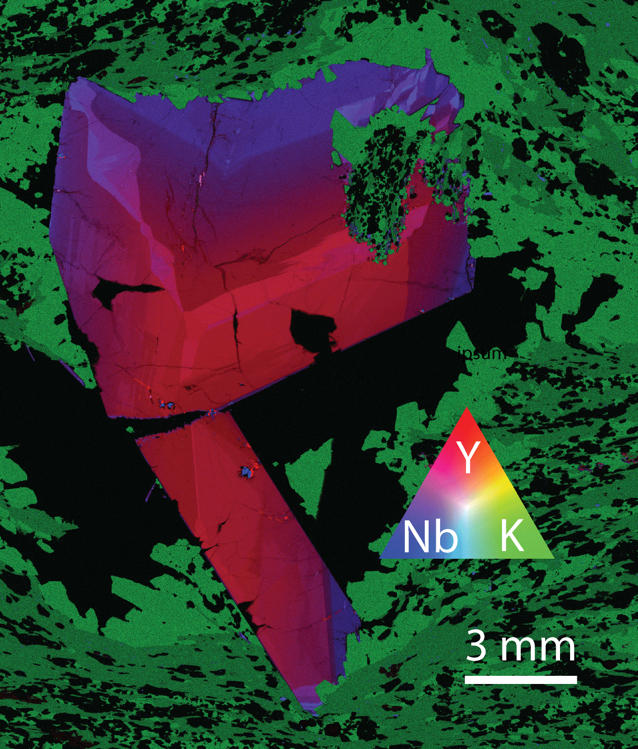
False-colour Synchrotron X-ray fluorescence image of the distribution of the critical minerals yttrium and niobium in a large crystal of titanite.
In the Driver's seat: role of trace elements in enabling crustal fluid flow
This project aims to systematically investigate:
- the role of trace elements in controlling the kinetics, product composition, and feed-back between fluid flow
- and the reaction interface, in fluid-driven mineral reactions.
This project expects to provide a framework for the integration of activator trace elements in:
- models of crustal fluid flow and their application in the recovery of base, precious, and critical metals
- using interdisciplinary approaches across geochemistry, mineral engineering and material sciences.
Expected outcomes include improved prediction of the transport of metals and fluids in geo-systems.
This should provide significant benefits towards integrating the mineral value chain from exploration to mining and metallurgy.
.
.
Unravelling multi-scale processes leading to high grade gold mineralisation
This project is supported by a number of mining companies in Victoria and Western Australia. The project aims to improve our understanding of how extremely high-grade gold occurrences form by deciphering the processes associated to metal transport and accumulation within the Earth’s crust. This project expects to generate new knowledge in the area of gold geochemistry using novel experimental programs, interdisciplinary approaches and by utilising advanced technologies. Expected outcomes of this project include reducing the unpredictability of high-grade gold occurrences and strengthening existing alliances with industry partners. This project should benefit the mineral industry partners by helping to discover high grade gold resources which is of great benefit to Australia.
Carbon-neutral copper: unlocking metal value through carbon sequestration
This project is supported by Newcrest. This project aims to explore how the concepts of reaction-induced porosity and coupled dissolution-reprecipitation reactions, which have had a profound impact in geosciences, can be exploited in the context of ore processing through carbon sequestration. The project's main outcomes are to generate a new process that maintains porosity in ore, and a combination of lixiviants, for effective Cu metal recovery and Fe capture. This project will benefit the mineral industry by providing an alternative to the current paradigm in Copper mineral processing that requires the destruction of the mineral hosting economic value, thereby developing sustainable mining technologies well suited for the increasingly complex ores being extracted in Australia.
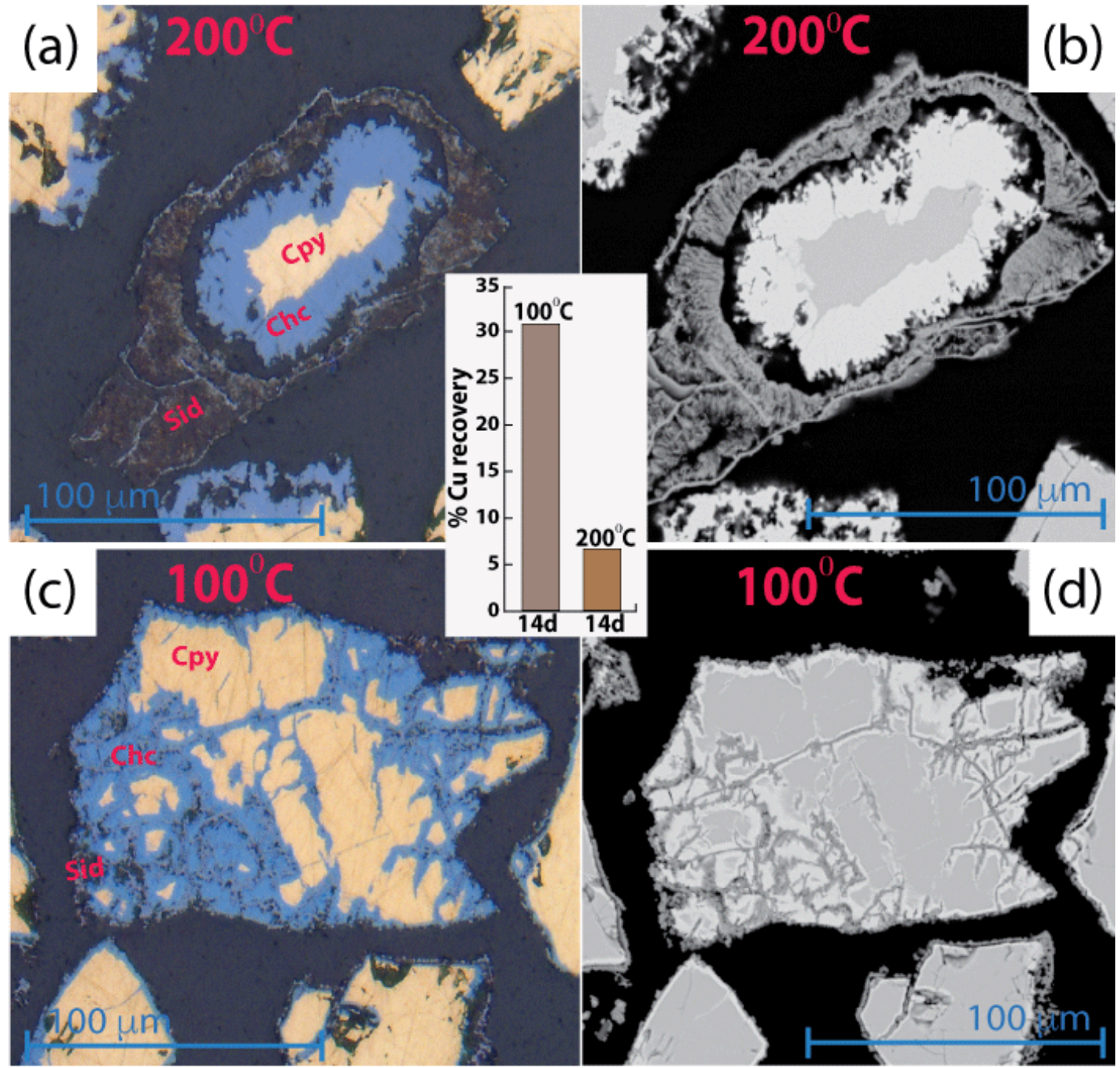
Can we combine copper recovery and CO2 scavenging? (a) Optical and (b) Scanning electron microscopy (SEM) of chalcopyrite replacement by siderite (FeCO3) at 200°C; (c) Optical and (d) SEM of Chalcopyrite replacement by siderite at 100°C for hydrothermal tests conducted in 14 days. Insert shows the increased overall %Cu recovery at lower temperature.