Geosynthetics
Soil cover systems are increasingly used to minimise environmental effects in mine rehabilitation works. These rehabilitation works involve a lot of capping processes. This capping process avoids the excessive seepage of water into the subsurface of the batter as the mines are eventually turned into a pit lake that will be completed post closure. The transformation of mine voids to a pit lake is a feasible option; however, there are still more questions concerning pit lakes' feasibility and long-term stability. Rehabilitated slopes need to have a suitable soil type and thickness in regards to the water balance performance of the soil cover.
Moisture exchange between the atmosphere and soil covers need to be investigated to optimise the cover hydraulic performance. Unsaturated soils control the water balance in a cover system and help understand the mechanisms influencing moisture exchange. On the other hand, Soil water retention behaviour varies with the relative humidity environment, overburden stress and initial density, moisture content, wetting and drying cycles. Unsaturated conditions and thickness of soil cover play important roles in controlling the water balance of soil covers and the percolation rates through these covers.
Classical water balance performance monitoring is based on the percolation rate measured by lysimeters in the field. However, measured percolation rates with lysimeters can be miscalculated because their lower boundary conditions block water flow in the soil and upward water flow by evaporation. These miscalculations can cause more complicated problems in the rehabilitation of batters. The issue is compounded by the excessive seepage of surface water runoff into the batters, thereby weakening the soil covers that can potentially trigger cover failures.
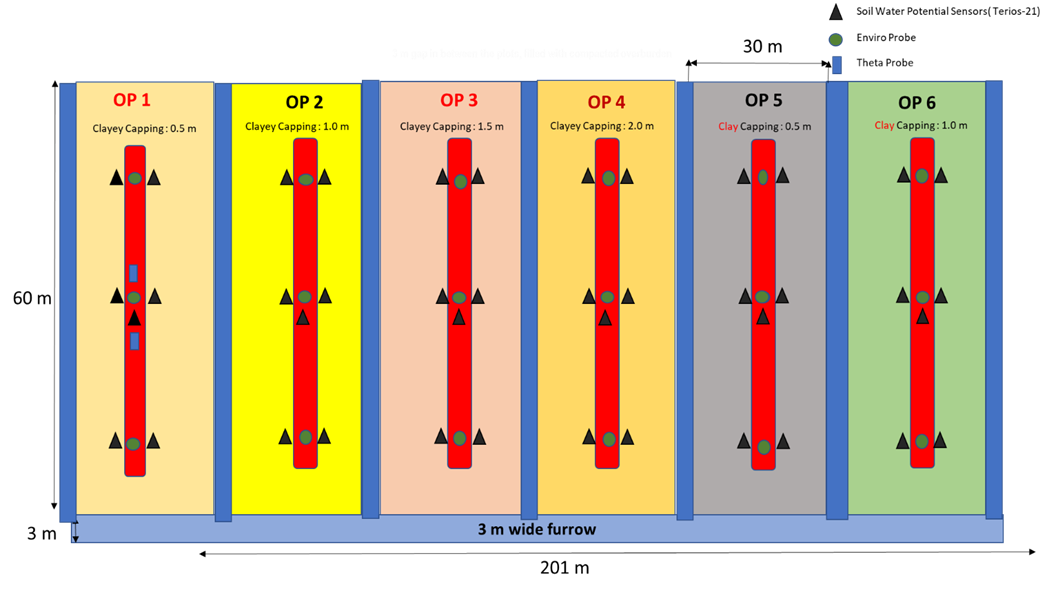
Nowadays, improved probes and sensors take the place of lysimeters. Highly accurate probes and sensors have been used to estimate field-measured water-balance data from monolithic unsaturated soil covers of various thicknesses in rehabilitation work at the Loy Yang Coal Mine, as shown in Figure 1. The Monash Rehabilitation Team conducted this research.
Numerous laboratory and field experiments are taking place to identify the optimum cover thickness that provides the best results of long-term hydraulic performance. Six field test plots with different cover thicknesses (0.5,1,1.5,2 m) were constructed to identify the optimum thickness. Concurrent with the fieldwork, laboratory tests are conducted to establish the soils unsaturated properties and their hydraulic and chemical properties. Eventually, an accurate water balance model will be developed and validated against the instrumented soil covers.