Unsaturated soil mechanics, soil-climate interactions
The mine tailing ponds can be considered a serious environmental hazard if not properly maintained and taken care of. Leaching of hazardous chemicals and erosion are common problems that are encountered with mine tailing ponds and as a result a knowledge of its physical and chemical structure is very important.
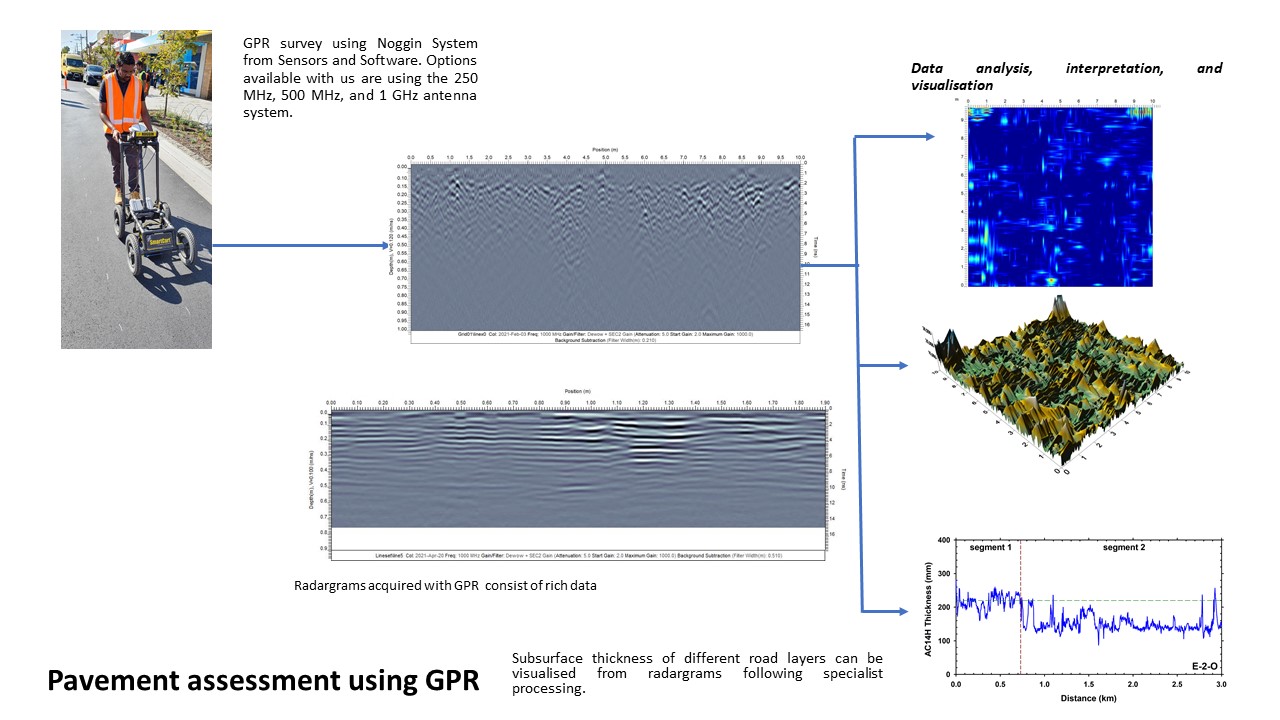
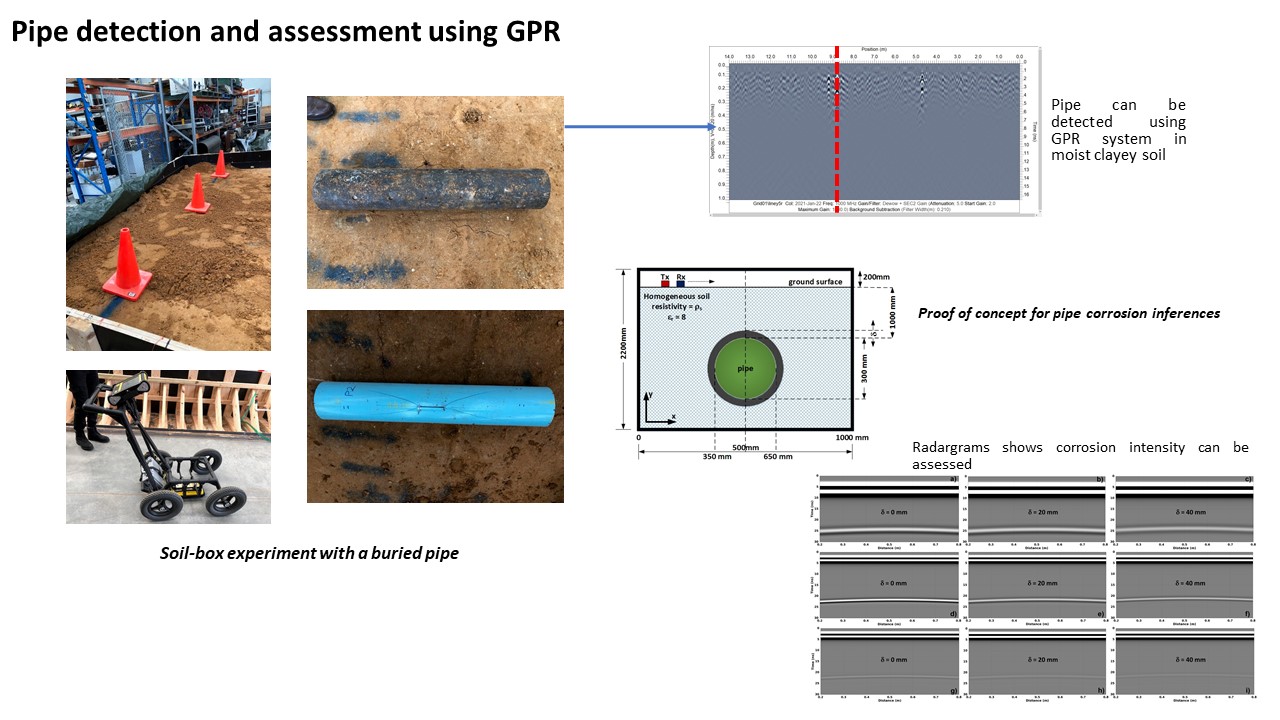
- Amongst the several geophysical techniques, the GPR (Ground Penetration Radar) and electrical resistivity tomography (ERT) methods are commonly seen as an appropriate technology for monitoring the behaviour and properties of mine tailing ponds. The ability of the ERT technique to identify the subsurface strata and anomalous regions, and the subsequent validation of soil samples by geochemical analysis provides a sound basis for assessment and monitoring of these important structures. We are pursuing the ERT technique, amongst other geophysical methods, to be utilised at field scale level. Previously, we have undertaken several GPR and electrical resistivity profiling works and developed laboratory capability in the measurement of resistivities of soil samples. We are experienced with GPR and ERT data acquisition, data processing, and inversion to retrieve subsurface information and validate it with complimenting geochemical analysis.
- We have worked on pipelines, road pavements and mine slope monitoring using various techniques. Another area we have expertise is on intelligent soil compaction to achieve the required density in landfills, embankment construction etc.
- We have also developed fibre optic sensing for strain measurement of structural components. With the ability to combine GIS with fibre optic sensor location, the localised strain and deformation can be measured. Strain threshold can be set to provide an alarm signal. Applications include:
- Distributed static strain measurement up to 10 km of sensing length.
- Distributed static and dynamic strain measurement (up to 20 Hz) with a 10 m sensing length.
- FBG capability for static and dynamic strain measurement (up to 2000 Hz).
- We have applied fibre optic sensing to pipelines for leak and condition detection and mine slope monitoring.