
Revolution in Food Technology
Monash University and Australia’s leading food companies drive new products and processes for global markets.
There is a quiet but momentous revolution happening on the farms, in the processing plants, and in the marketing groups of Australia’s premium food companies – and it is being guided and major universities. While United States – China tensions continue to grow, Australia is positioning itself as a preferred supplier to Asia, not on the basis of cost, but of taste and quality.
Behind the trade behemoths of wheat and wool, it is often missed that the Australian dairy industry is the nation’s third-largest rural industry, with an annual sales value of A$13.5 billion. For the last few decades, it has been export-oriented, with Australia punching well above its weight in representing six per cent of the world’s dairy trade. Further, the industry has significant room to grow as the tastes of consumers continue to expand. Dairy and associated foods are rightly becoming one of Australia’s most exciting economic stories. What is less known is that it is also one of our most accomplished collaboration stories.
Monash University’s Australia – China Joint Research Centre in Future Dairy Manufacturing (ACJRC), in which the University of Queensland is a major participant, and Food and Dairy Graduate Research Industry Partnerships (GRIP),are at the forefront of advancing Australian food and dairy products into new markets.
The opportunity: China

Poster presentations from cheese symposium in Beijing, October 2018
Australian food and dairy products are well recognised for their superior taste and quality. The demand for premium dairy and food products is growing rapidly in Asia, specifically among the Chinese middle class. As disposable income increases, so does a taste for Western food, and a greater focus on food safety standards, making Australian dairy products the cream of the crop. The Australian dairy industry is thus faced with the challenge of responding to this demand in a scalable and sustainable way.
At present, dairy powders comprise more than 40 per cent of the Australian products on the market, with these mostly being for export to Asia. There is growing demand for ‘added value’ products, such as infant formula and protein powders – over the last few years, there has been a 614 per cent growth in infant formula production, a 208 per cent increase in skim milk powder production, and an 88 per cent increase in cheese production. Australian exports of infant formula alone to greater China are valued at more than US$325 million, with increased demand stemming from the 2008 Chinese milk scandal in which melamine was found in infant formulas.
As Chinese demand for Australian food and dairy continues to grow, the industry must also evolve.
Monash University programs – partnerships with producers and innovators
Monash University has been at the forefront of food and dairy innovation, with the ACJRC and GRIP allowing for innovative new practices and products to be developed.
The ACJRC works in collaboration with Soochow University, and the China National Cereals, Oils and Foodstuffs Corporation (COFCO) – the largest cereal and grain company in China. The parties are undertaking specific research projects together, with Dr Xiaoming Hao, director of the Nutrition and Health Research Institute (a research arm of the COFCO), stating that its decision to collaborate with Monash Food & Dairy was based on ‘the international reputation of Monash University’s chemical engineering research’ and its ‘strong relationships with many Australian food companies, especially in the R&D area’.
Monash University’s GRIP is focused on supporting the value chain of the dairy and food industry by way of novel material usage; product manufacturing; big data optimisation; sustainable practices in water, energy and waste management; and intensive collaboration with food producers like Lion and Bega.
Successful partnership with Bega
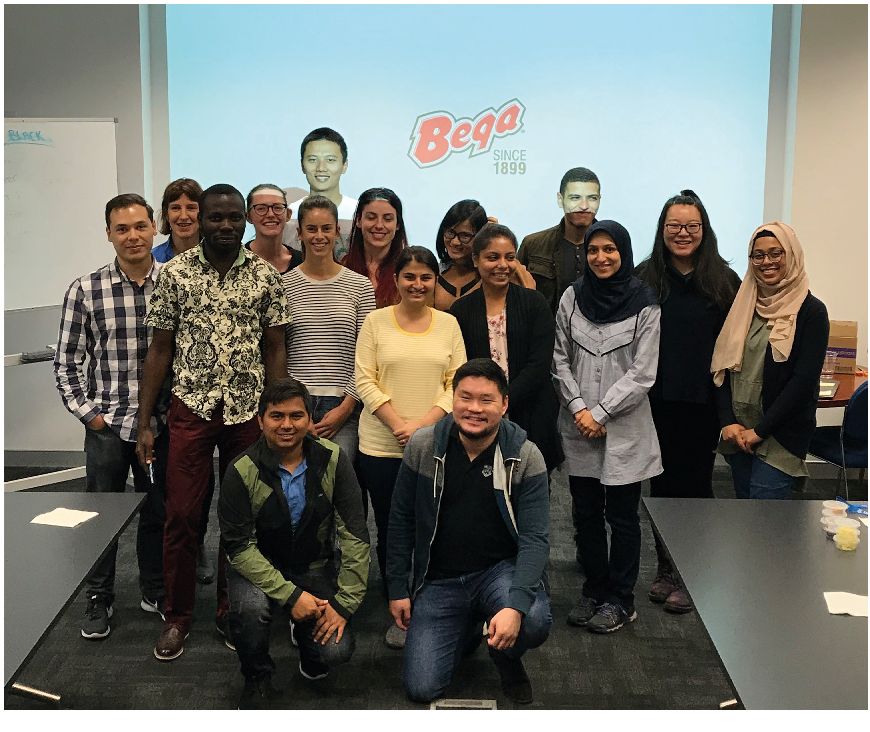
GRIP students at Bega
Monash University’s partnership with Bega has been a component of the Australian company’s innovation strategy. Bega’s innovation group worked closely with the university to use new drying technologies to extend the life and improve the quality of powdered dairy products, and process improvements in cheese manufacturing.
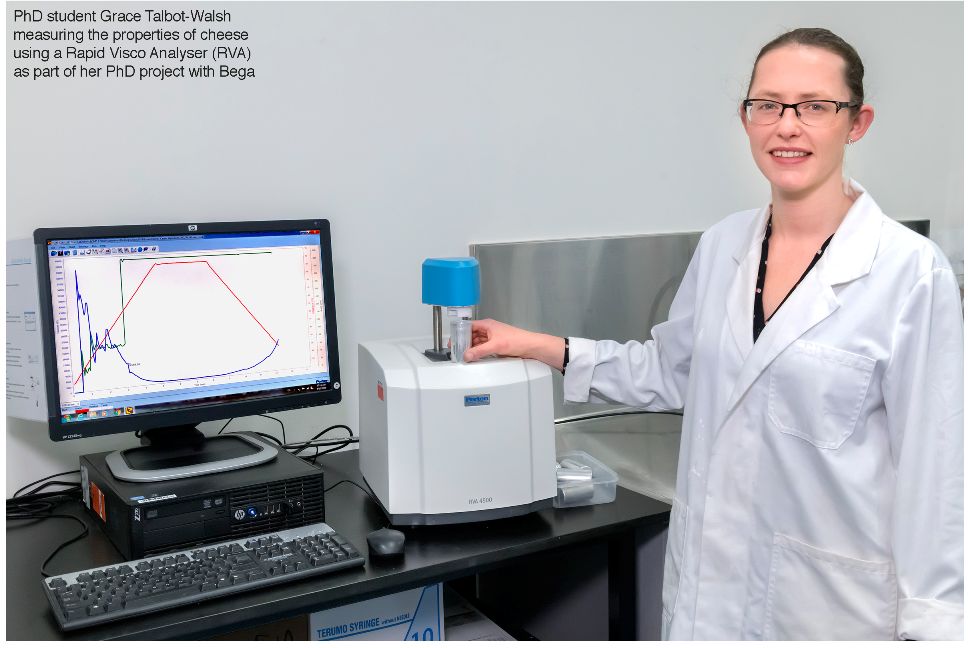
Monash has created a ‘smart drying program’, in which a manufacturer can test how a product would dry and how long it would last under various conditions at a small scale, prior to investing in, and rolling out, the new product or process at a commercial level. Spray-drying has been commonly used by the sector for decades to make popular products, such as powdered infant formula, but Monash’s use of a small-scale drying machine, X-ray diffraction and infra-red technology allows it to not only significantly cut the cost of trialling the spray-drying of new products, but also to monitor fundamental changes in the properties of the powdered products during storage that are caused by heat or moisture. Monash has also developed modelling algorithms to let it test how the materials in a powder will react in different conditions.
Professor Cordelia Selomulya, who has led the project at Monash, said that a more targeted approach to spray-drying helped manufacturers to produce
higher-quality powders, as well as leading to energy savings. In Bega’s case, the partnership has led to several important improvements in the drying
process to improve energy use and product quality. Monash also conducted research on cheese to modify formulations and technology, in order to optimise production and reduce salt.
Karren Bathurst, Group Research and Innovation Manager at Bega, credited Selomulya’s drive and determination with making the collaborative program, which provided students and industry benefits, so successful. ‘At Bega, we promote collaborative research with academic organisations,’ Bathurst says. ‘We have now worked with the Monash University teams, led by Cordelia, for five years. Working with the students is mutually beneficial – their research has provided us with real benefits in improving our processes and identifying new product opportunities, and the students receive practical experience in Australian dairy and manufacturing businesses. We hope that by supporting this program, students will decide on careers in food and dairy manufacturing.’

Ceramic Membrane Machine
The future: innovation in product, safety, and energy cost
The university – industry partnership has played a major role in the development of the Australian dairy industry over the last decade, transforming it from a minor player on the world export stage, focused primarily on one product – milk powder – into a diverse, innovative, and rapidly growing sector with a portfolio of high-quality nutritional products. There is more to come: Australian food and dairy products can continue to improve in myriad ways. Opportunities include sophisticated new packaging, which exploits barrier protection to increase shelf life; disposable sensors for tracking and quality control; and process improvements, such as sustainable wastewater management and energy-use minimisation. The industry also envisages the potential re-use of waste streams to expand the product range, such as acid whey, permeate, milk minerals and lactose derivatives, providing both nutritional and consumer taste benefits for new market segments.
As importantly, the university– industry partnerships that underpin this growth and diversification are robust and fruitful, while also developing a new generation of food technologists for Australia. They are focused on export markets, as well as domestic consumers, and have built outstanding partnerships in the region – particularly with China.
The partnership between Monash University, the University of Queensland, and a host of Australian dairy and food operators has achieved substantial national recognition, including as the winner of a prestigious BHERT Award for collaboration between business and universities in 2018. It is rightly regarded as one of Australia’s most important collaborations, and also serves as an exciting model for all export-oriented industries.