
Monash–MIT Dual Degree in Engineering

Why choose this dual degree
Start your engineering studies at Manipal Institute of Technology, Manipal and complete your final two years at Monash University in Australia. Graduate in four years with two internationally recognised engineering degrees.
Study journey
The study pathway is designed to provide a clear transition from MIT Manipal to Monash University.
Step-by-step pathway
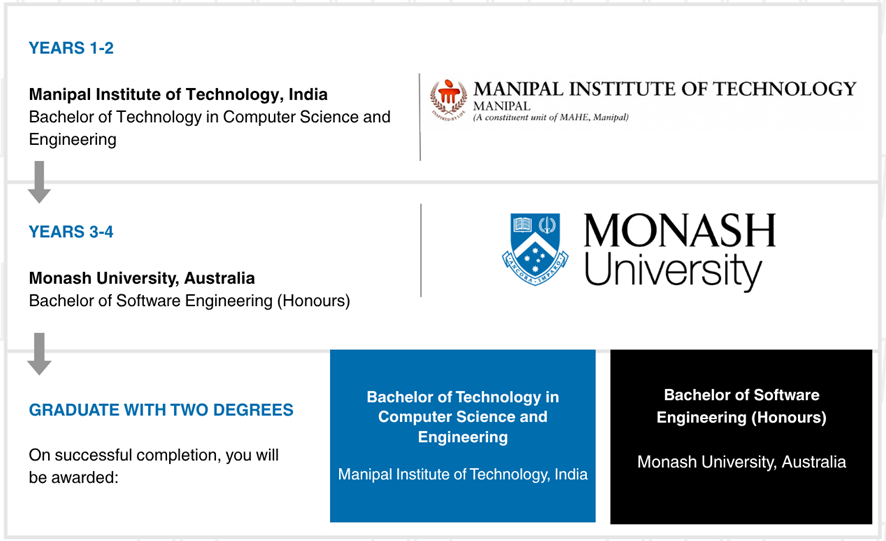
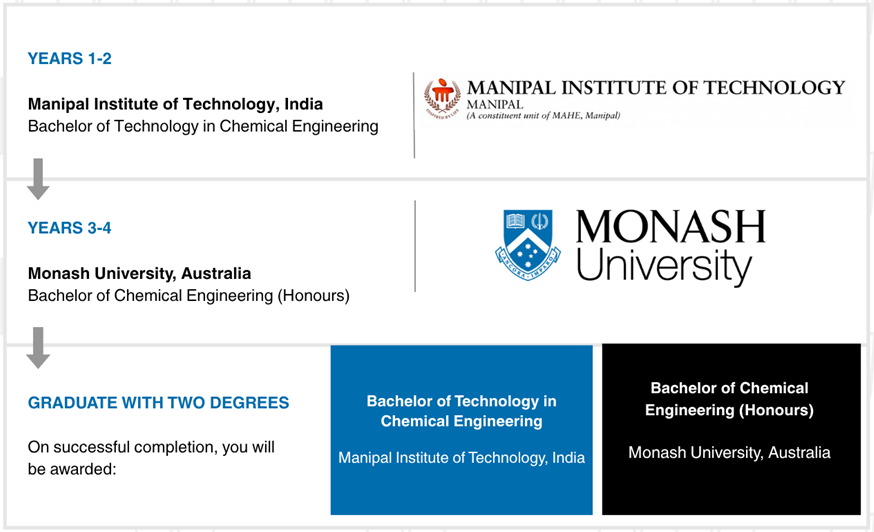
- Step 1: Start at MIT Manipal — Complete the first two years of your engineering program.
- Step 2: Transfer to Monash University — Complete the final two years at Monash (subject to meeting entry requirements)
- Step 3: Graduate with two engineering degrees from two reputed universities.
How does it work?

Next steps
To transfer to Monash under this dual degree pathway, students must successfully complete the first two years of the relevant MIT program, achieve the required academic standard, complete the approved equivalent units, meet Monash English language requirements, and satisfy Australian student visa requirements.
How to apply to MIT
Applications for this program are managed through MIT Manipal / MAHE. To apply, students can submit an online application through the official MAHE admissions portal and refer to the admissions pages for eligibility, admission process, fees, and program information.
For enquiries and information on how to apply:
Office of Alumni, Public and International Relations,
Manipal Institute of Technology, Manipal
intl.mit@manipal.edu
Transfer to Monash requirements:Academic requirements
Applicants must achieve a final Cumulative Grade Point Average (CGPA) of 6.0 (on a 10 point scale) in all pre-approved units completed at MIT, Manipal as specified in the agreement to be eligible for entry into the Monash program.
English language requirements
Students must meet Monash University English language requirements of an overall IELTS score of 6.5 with no band less than 6.0 (or equivalent).
English language requirements – Admissions
Supporting line: Detailed academic and English language requirements will be provided at the time of application.
The 2026 annual tuition fee for Monash’s Bachelor of Engineering (Honours) is A$59,600. Tuition fees may change in future years, so students should always check the latest official fee information before applying. More information can be found on the following Monash pages.
Overseas Student Health Cover (OSHC)
Study Grant:
Eligible MIT–Monash dual degree transfer students will be automatically assessed for an International Study Grant of A$10,000 per year for up to two years.
At Monash, student teams, clubs and societies help students apply their learning in practical settings, build hands-on skills, and work on real-world challenges across disciplines.
For Software Engineering, opportunities include student-led work in AI and digital innovation, including projects in medical imaging and healthcare technology. For Chemical Engineering, opportunities connect to sustainability-focused and advanced engineering challenges in areas such as water, carbon capture and sustainable systems.
These experiences also support career development through collaboration, competitions, and industry engagement.