Monash Art, Design and Architecture Graduate Exhibition 2025
Monash Art, Design and Architecture Graduate Exhibition 2025
Australian cities are facing a double crisis: a housing shortage and historically low industrial land vacancy. In the rush to rezone industrial areas for higher-yield residential development, we’re displacing essential services, diverse employment, and the infrastructure that underpins equitable urban life.
But what if industrial land wasn’t a casualty of development — what if it was the starting point?
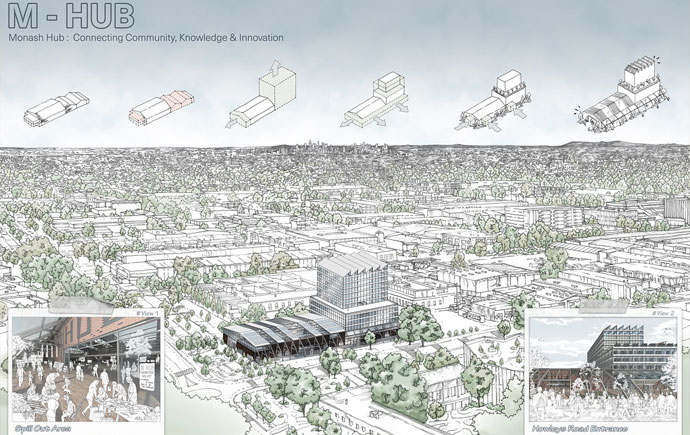
This studio explored key, current questions around development – how can we design new, inclusive urban models that combine housing, employment, and community uses without compromise?
Across the semester, Architecture and Urban Planning and Design students collaborated to; Investigate the social and spatial value of industrial land; Develop medium-density, mixed-use building proposals on real sites across Melbourne, and; Create design guidelines to inform future inclusive planning policy.
With sites in Tottenham, Footscray, Clayton, Collingwood, and Darebin Creek, students explored strategies that moved beyond the Activity Centre model — embracing the messy, transitional spaces where community, industry, and infrastructure intersect. The studio reframed industrial land as a driver of inclusive, resilient, and productive cities — not just a space to redevelop, but one to reimagine.
Studio Leaders: George Mellos / Andrew Reynolds