
Net Zero buildings


Alan Finkel Building for Technology and Design
Supporting 1,200 postgraduate students, the five storey building houses more than 30 learning spaces, including an interactive tiered collaborative space accommodating 360 people. The application of Passive House building standards and the design of the building as a living laboratory is defining next practice in building design, teaching and learning practices.
An Australian first, Monash's Technology and Design Building is the first climate active certified carbon neutral construction service. To reach carbon neutral, energy efficiency initiatives were implemented on site, all emissions produced from fuel and energy use were calculated and carbon credits were purchased to offset those emissions.
Designed as a smart, all-electric building and financed by climate bonds, the Technology and Design Building enables the exploration of new energy possibilities to help solve tomorrow’s challenges for the benefit of current and future generations.

Biomedical Learning and Teaching Building
Designed and built to achieve a five-star rating on the Green Star Design and Build rating scale, the BLTB will also play an integral role in the University’s pledge to reach net zero carbon emissions by 2030.
Designed for high energy efficiency and storage, and using high performance Passive House principles, the BLTB is Monash’s first all-electric building.
It features a hybrid 1MWh battery on the roof, the largest behind–the-meter commercial battery in Australia. The building will connect to the Monash Microgrid, which will serve as a working model for a 100 per cent renewable-powered smart city.
As well as helping the University manage how and when renewable energy is used on campus, the BLTB serves as part of the living laboratory. Where technology, business models and regulatory regimes can be tested, and solutions to today’s energy challenges unlocked, in close collaboration with the energy industry, government and regulators.
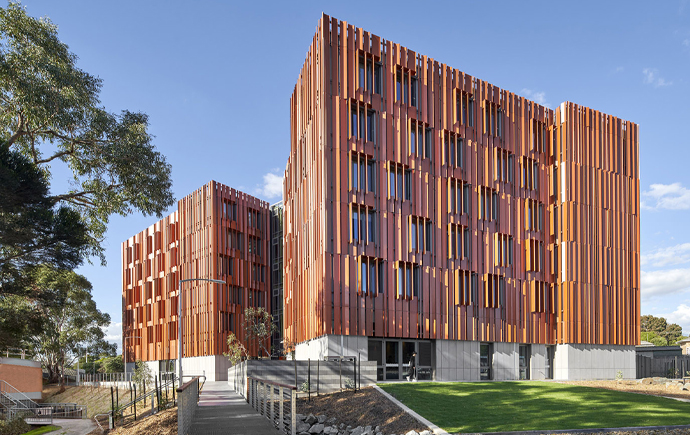
Gillies Hall
Gillies Hall, our new six level, 150-bed residential accommodation complex on the Peninsula campus is the first large-scale building in the country to achieve Passive House certification. Gillies Hall was the recipient of a Premier's Sustainability Award in 2019.
Combined with a cross-laminated timber (CLT) structure, the building sets a new benchmark for sustainable design and construction. The use of CLT is expected to have halved the carbon emissions associated with construction relative to a concrete structure, and will remain as a carbon store for the life of the building.
Expected to be over three times more efficient than existing residential halls, the building is the first large scale building in the southern hemisphere to achieve Passive House certification, leading the way in the industry for Passive House standard.

30 Research Way
Passive House design principles were piloted during the renovation of an asbestos-clad warehouse originally located at 30 Research Way. One of the first large commercial buildings in Australia to apply these principles, this building was transformed into a creative, comfortable and productive office space with low energy demand.
The rigorous world-class Passive House design building standard is the equivalent of international excellence in energy efficiency, comfort and ecologically responsive design.
The design addresses energy efficiency through a super-insulated, airtight and thermal bridge free envelope, high efficient electric heat pumps and a heat recovery ventilation system that provides a constant supply of 100% outside air. This also ensures optimum thermal comfort for building occupants which facilitates a productive workplace.
A 70 kWp rooftop solar array generates almost 70% of the building’s energy requirements, while eastern and southern facing double-glazed windows create a bright, daylight filled office space. Mechanical external blinds on the north help manage solar heat absorption and glare throughout the year.
The building has water efficient fittings, low volatile organic materials and finishes and clearly labelled landfill, recycling and battery recycling bins. The reuse of the existing structural steel frame and concrete slab significantly reduced material embodied energy of the project and all asbestos was carefully removed and the site decontaminated.
Staff wellbeing is addressed with its open plan office design, the provision of sit-stand desks, natural daylight, views to native landscapes from all desks.
This project pioneers applying Passive House to sustainable building upgrades and shows how existing carbon intensive building materials can be successfully reused to create energy efficient and productive spaces for people and planet.
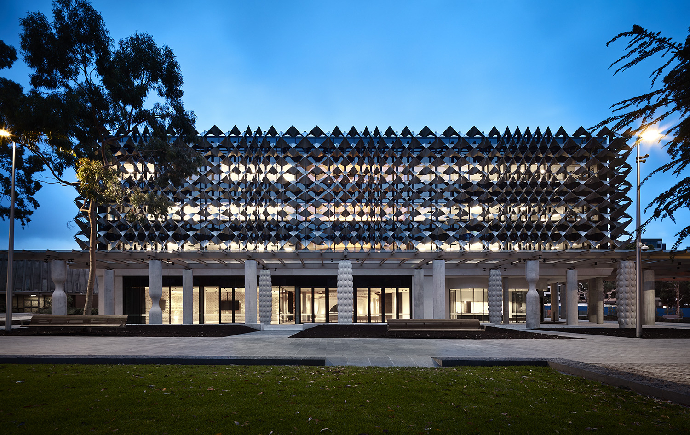
Chancellery
The new Chancellery places a high emphasis on sustainability, and draws on elements of the Net Zero initiative with rooftop solar panels, an all-electric thermal plant and water sensitive urban design. The construction of the building delivers a flexible, sustainable and enduring addition to the University's central precinct at Clayton campus.
Inspired by Passive House principles, the new Chancellery building was designed in accordance with building-science principles governing thermal insulation, high-performance windows, mechanical ventilation heat recovery, airtightness, and thermal bridge-free construction.
The building has been designed in accordance with the Monash University EcoAccord, a design tool containing the University’s built environment aspirations, and incorporates Passive House principles.