
Successfully transitioning back to study

Successfully returning to university, whether to begin or continue your undergraduate or graduate studies, requires an understanding of academic expectations, learning about what has changed since you left, and careful management of your time. Whether you are coming back after a long break, transitioning from work or family responsibilities, or moving directly from one level of study to the next, this resource will guide you through the key considerations that support a smooth and confident journey in higher education.
It is normal to feel a mix of excitement, uncertainty, or even self-doubt during this transition. Many students worry about keeping up academically, managing time, or balancing study with work and personal commitments. Acknowledging these feelings is an important first step, as is understanding that you are capable and able to access a wide array of support.
Remember that you have chosen your program, whether undergraduate or graduate, because it aligns with your interests, values, and long-term goals. Keeping this purpose in mind can help you stay focused and motivated throughout your studies, especially during challenging periods.
Essential tips to a smooth university comeback
View








The next two sections will guide you on:
- the factors that you should consider as you embark on this academic journey
- the skills/strategies you need to succeed in academia
Factors that shape your university experience
Starting university is an exciting and transformative chapter in life. It opens doors to new knowledge, personal growth, and future opportunities. However, success does not happen by chance. It requires careful planning and consideration. From personal motivation to academic expectations, financial planning and personal wellbeing, understanding these factors will help you navigate challenges and make the most of your experience.
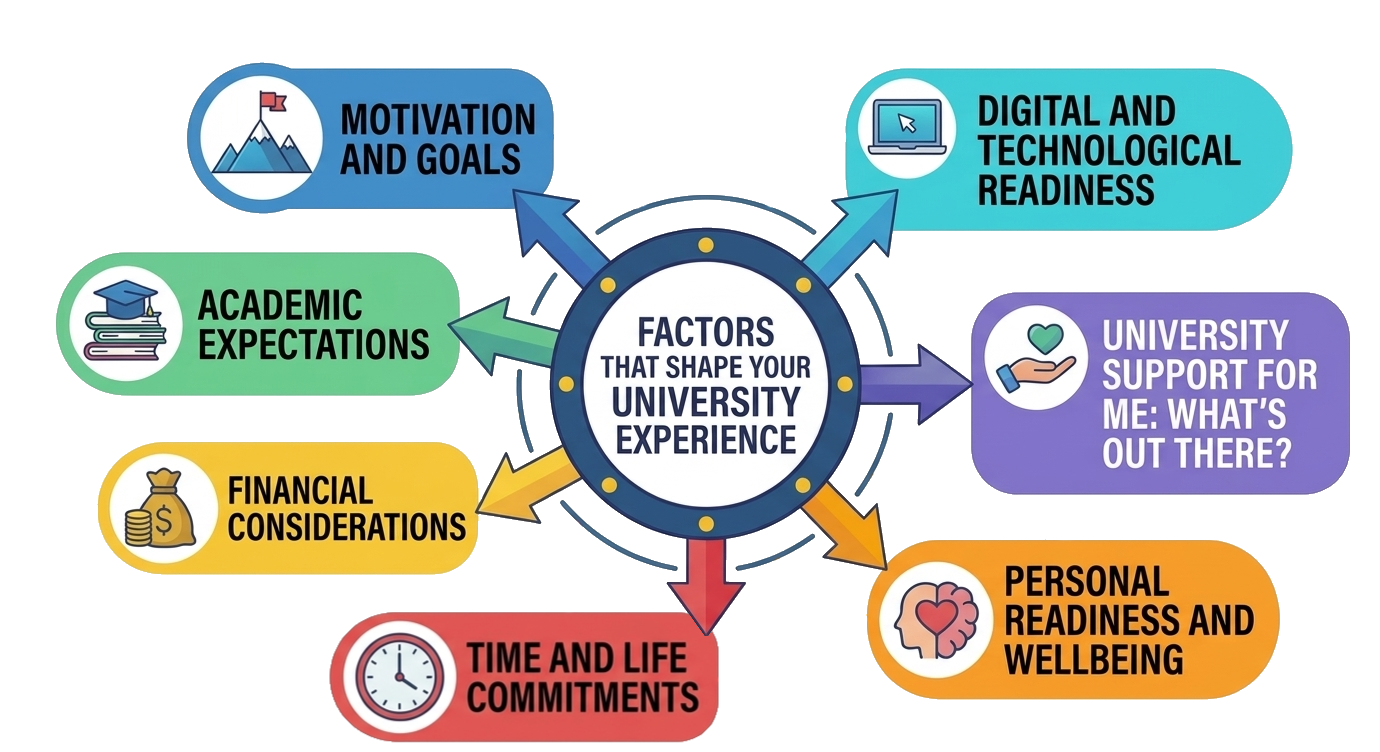
 Motivation and goals Motivation and goals
|
|
Academic expectations |
|
Financial considerations |
|
Time and life commitments |
|
Digital and technological readiness |
|
 University support for me: What's out there? |
|
 Personal readiness and wellbeing Personal readiness and wellbeing
|
|




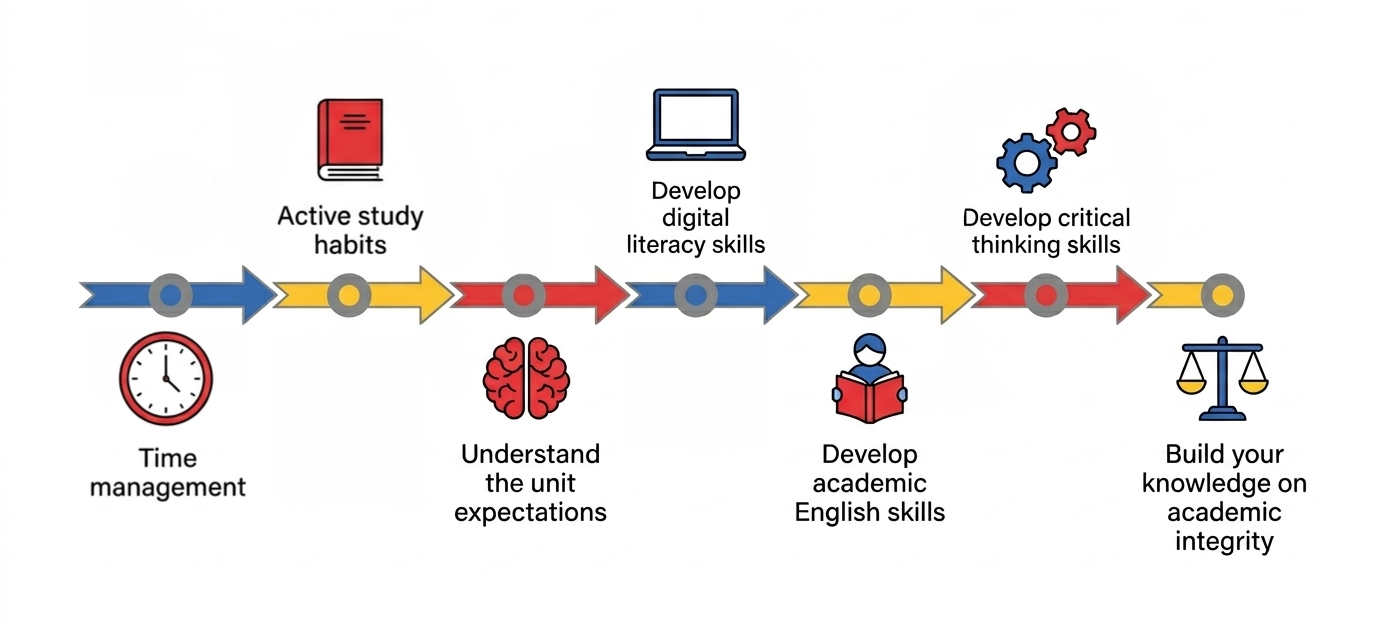
Smart toolkit for academic success
| Explanation | |
|---|---|
| Time management | Balancing studies with other responsibilities, such as work or family, can be challenging. Create a realistic schedule and plan your time effectively to accommodate your coursework, research, and personal life. Check out this resource to deepen your understanding on how to manage your time. |
| Active study habits | Active study habits involve engaging purposefully with your learning rather than passively reading or memorising content. Read more effectively by asking questions, highlighting key ideas, and linking new information to what you already know. It also involves taking meaningful notes that summarise ideas in your own words, rather than copying large sections of text. Most importantly, active study requires regular review of materials throughout the semester, which helps consolidate understanding and reduces reliance on last-minute cramming. By studying consistently and actively, you develop deeper comprehension, retain information more effectively, and feel more confidently prepared for assessments. |
| Understand the unit expectations | This means gaining a good grasp on what is expected of each unit. At university, students are generally expected to engage from 10 to 14 hours per week for each academic unit. The key information related to each of your units will be outlined on Moodle. Explore the resource What is Moodle? to gain a comprehensive understanding about the weekly topics, the reading list, pre-lecture reading and activities. You might also expected to attend lectures, workshops, labs and tutorials. Research suggests that there is a strong correlation between class attendance and academic success (Nieuwoudt, 2020). Attending lectures and tutorials will allow you to interact with your peers and lecturers, ask content and assessment related questions and more importantly assist you to understand the content better. Along with the above, an essential component is gaining a thorough understanding of your assessments. Understanding assessments requires a strong grasp of both the task details and the grading criteria, as they are intricately interconnected. |
| Develop digital literacy skills |
A major part of your study practice will involve an online platform. You might find that study practices have drastically changed since the first time you attended university.
Returning to study and adjusting to digital learning platforms can feel overwhelming. Strong digital literacy supports the development of effective study habits. Knowledge of digital platforms is essential, as they are embedded in almost every aspect of academic study. Throughout your academic journey, digital platforms play a central role - from working collaboratively with peers and lecturers online, to watching pre-recorded lectures, using artificial intelligence responsibly, preparing video presentations, and completing weekly quizzes. Please keep in mind that building digital literacy is an ongoing process that involves a combination of foundational knowledge, practical skills, and a proactive approach to staying informed in the ever-changing digital world. The page Enhance digital capabilities has a range of skill sets that you might find handy as you are preparing for the transitioning to the new study environment. |
| Develop academic English skills |
Whether you are a native speaker or a second language speaker of English, you must have a strong grasp on the skills of writing and speaking English in an academic way. You will need these skills when listening to your lectures, writing your assessments and preparing for and delivering your presentations. Academic English refers to the language and writing style used in academic settings, such as universities, research institutions, and scholarly publications. It is characterised by its precision, formality, objectivity, and adherence to established conventions. Depending on which stage you are at, you might need to brush up or significantly improve your academic English skills. |
| Develop critical thinking skills |
Critical thinking is a vital skill for university success, as it trains you to question established knowledge and engage in furthering human understanding of the world through the interactive influence of education. At university, you are expected not only to think independently, but also to critically
analyse and synthesise existing studies within your field.
A sound critical thinking ability will assist you to demonstrate research skills, analytical acumen, and active participation in classroom discussions. You can learn more about what critical thinking is by exploring our resource on Learn HQ. |
| Build your knowledge on academic integrity |
Upholding academic integrity is a fundamental part of participating in higher education. It reflects a commitment to ethical behaviour in learning, requiring students to produce their own work, acknowledge the ideas of others, and engage with their studies in an honest and responsible manner.
Understanding the importance of citing sources, avoiding plagiarism, using AI ethically and upholding the standards of fair and honest collaboration contributes not only to individual success but also to the overall integrity of academic institutions. Please explore this resource on maintaining academic integrity to learn more. |
Check your understanding
View
References
Nieuwoudt, J. E. (2020). Investigating synchronous and asynchronous class attendance as predictors of academic success in online education. Australasian Journal of Educational Technology, 36(3), 15–25. https://doi.org/10.14742/ajet.5137