
Writing effective emails at university

Why is email important?
Email remains an important form of communication, and is usually the preferred way for the government, banks and other institutions to convey important information. At Monash, it is the main way that the University will communicate with you as a student.
It is also an important means for you to communicate formally and officially, and this is needed here at university and also in your current and future workplace.
Knowing how to communicate effectively using email will assist you in conveying your message clearly and achieving your goals at university. It can also aid you when you apply for jobs and when you are in the workplace communicating with your supervisor, colleagues and clients.
This resource will explain how to structure a professional looking email that is clear and suitable in length, tone and politeness.
 Tips for writing emails that get results
View
Tips for writing emails that get results
View






Email structure
In the academic context, an email’s purpose is usually to inform, inquire or request something. Your email’s structure should reflect therefore set out to achieve that purpose in a methodical way. Just like letters (from which email evolved), the standard structure of an email usually follows this basic model.
Length matters
The email above is not only well-crafted with a clear message and expected outcomes, but it is also a suitable length. An email that is much shorter or longer than this one may be viewed negatively by the recipient. The person you’re writing to may receive a hundred emails a day, and as a result may have limited time and patience. They may be quick to judge the content, and by extension you. You can avoid this by getting the length just right.
An email that is too short may lack sufficient context for the recipient. They may need to guess some of the details they require to fully understand, and their guess may result in a misunderstanding. Alternatively, they may decide not to reply, as they are too busy to follow up with you and ask for more detail.
Conversely, an email that’s too long may fall into the TLDR category. In other words, the email is too long so I’m not going to read it, or read all of it. You may have included too much unnecessary detail, or there may be too much repetition that should be removed.
Make the email subject clear
The subject line in an email is really important. It should tell your reader exactly and concisely what the email is about. If the email remains in the recipient’s inbox for them to read later, they need to know what it’s about and why it wasn’t deleted. For that reason alone, the subject line remains important long after the email is sent.
Check these email subject lines for clarity and quality
Instruction: Take a look at the following subject lines, and select the drop down option that best describes the quality of each one.
Make sure your email goes to the right people
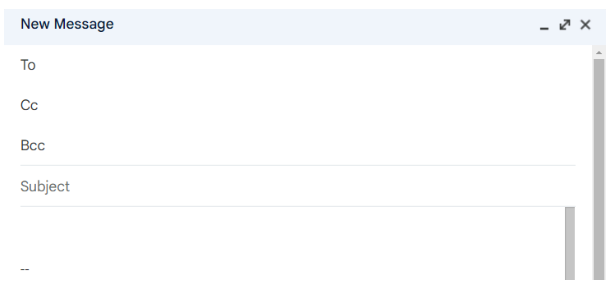
When typing an email, the main and most important recipient should always be listed first in the ‘To’ section. Use Cc (carbon copy) to include anyone else who also needs to receive your communication. For example, if writing to your unit's Chief Examiner, you should probably cc your tutor/teaching assistant as a professional courtesy. Another example would be when you email your tutor about a group assignment, ccing your group mates.
Only use Bcc (blind carbon copy) if you need someone to see the message without identifying the other recipients. It’s rare to need this function, but sometimes professional situations require it. One example might be when your tutor wants to email your class and members of another class, but wants to protect everyone’s privacy by not sharing each member’s email address. In this case, each email address would be added to the Bcc section, and each person would receive the same message without seeing who else received it.
Politeness matters too
In both the university and workplace contexts, email is usually quite formal in style and tone, unless you are corresponding with someone with whom you already have a friendly relationship. This means there are certain things you should and should not do when writing emails at uni or work. An example of this is the way emails begin and end. Your opening salutation will vary according to its recipient.
Addressing an email recipient
If you are writing for the first time to your main teacher in a unit of study, it’s best to address them by their full title, e.g.
Dear Associate Professor Jeske,
If they reply and sign off using their given name, e.g.
Regards and best of luck,
Diana
you can take it as an invitation to address them as Diana from now on when you correspond with them.
Concluding an email
There are numerous different ways to conclude an email, but they can be categorised into a limited range of formality, from very formal to very informal.
Formal sign offs include:
| Example 1 | Example 2 | Example 3 | Example 4 |
|---|---|---|---|
Yours sincerely, Kim | Yours truly, Kim* | Regards, Kim | Respectfully, Kim** |
* You can use this if the relationship is formal and it's the first time you are writing to the person.
** This is quite formal, and can be especially suited to emails in which you are discussing a grievance or other serious issue.
Somewhat formal, but moving towards familiarity or friendliness may include:
| Example 1 | Example 2 |
|---|---|
Kind (or Warm) regards, Kim | Thanks and regards, Kim |
Informal - a collegiate and friendly relationship is already established.
| Example 1 | Example 2 | Example 3 |
|---|---|---|
Thanks! Kim | Cheers, Kim | See you soon, Kim |