
Writing about theory

About theory
In academia, theories can be models, ideas, concepts, or frameworks that are used to explain or anticipate certain social and natural phenomena. They often build upon or even contradict established principles and understandings within a field and express current knowledge within a specific area. Theories tend to be abstract, and are therefore not always readily observable in daily life. For that reason they can be presented in words, numerical formulae, or in visual formats.
Writing about theory can be difficult because it requires expressing abstract concepts and connecting them to specific evidence or ‘real world’ examples.
 Top tips for writing about theory
View
Top tips for writing about theory
View


Why does writing about theory matter
Theories are critical in your journey into academia because they show your reader that you have engaged with evidence and are able to apply it in your writing. We write about theories mainly for the following two reasons:
- To provide a basis for understanding how and why things work.
- To show that your work is based on established ideas.
In academia, you will be introduced to a range of theories. You are expected to demonstrate your understanding of these theories by applying them to real world situations in your academic writing.
To do this you can summarise, analyse, and apply.
What does application of theory mean?
Theory is a lens through which learning and research take place. Application of theory means all the ways in which theory underpins learning or research. In research, this includes the choice of rationale, aims, and research questions. It includes the methodological stance and choice of research tools, as well as the chosen framework for analysis and interpretation.
Application of theory encompasses how the theory is related to the assignment, thesis, or paper you are writing. As a student, the application of theory usually requires critical analysis to situate the theory in your writing context. Rather than describing what a theory is in detail, assignments usually require you to apply the theory to your context, link it to practice, and demonstrate your understanding.
Remember, when the theory is contextualised in your writing, the readers become engaged and want to know more.
The following example illustrates theory before connecting it to experience and practice or application. Depending on what you are writing, you can always reverse this order. Consider the concepts you have already introduced and how you can use them to introduce new ones. Consider the relationship and importance of theory and practice or application as you make the connection.
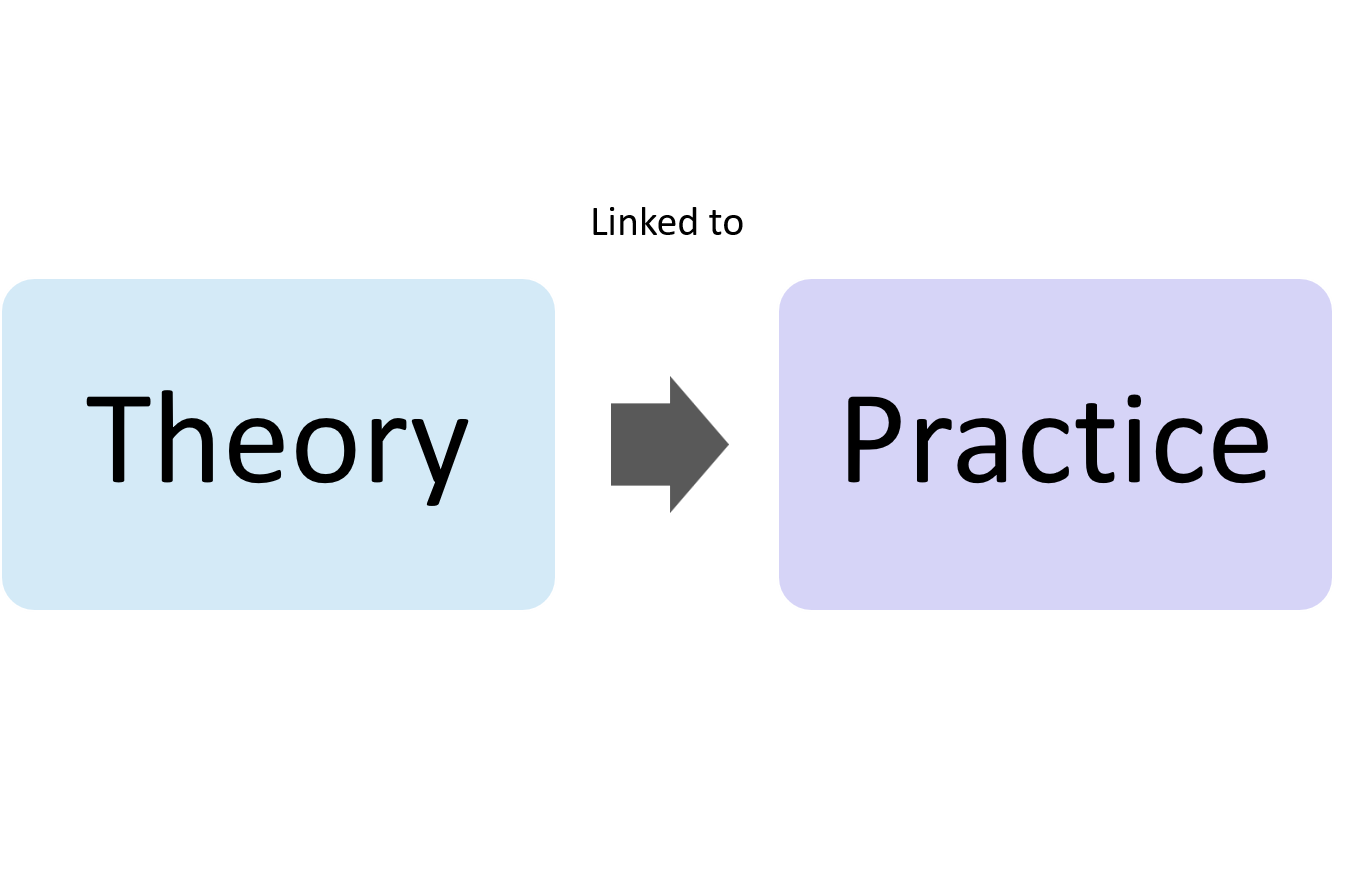
Bowlby’s Attachment Theory (1969)
(linked to)
Child development affected by the closeness of the bond between mother and child
(Theory) Bowlby’s (1969) attachment theory argues that child development is affected by the closeness of the bond between mother and child. Bowlby (1969) claimed that even short spells away from the mother during infancy could have profound effects upon a person later in life. (Connecting sentence) This became known as ‘maternal deprivation theory’. (Practice) According to this theory, the relationship with the mother during an early ‘critical period’ gives the developing child an ‘internal working model’. This model then forms the foundation of all future relationships the child (and later the adult) forms.
Legend: Theory; Connecting sentence(s); Practice.
Sometimes, you might need to use multiple connecting sentences while situating multiple and differing theories. Have a look at the following example:

Bowlby’s Attachment Theory (1969)
(linked to)
Child development affected by the closeness of the bond between mother and child
(linked to)
Ainsworth (1978) ‘Strange Situation’ experiment
(Theory) Bowlby’s (1969) attachment theory argues that child development is affected by the closeness of the bond between mother and child. Bowlby claimed that even short spells away from the mother during infancy could have profound effects upon a person later in life. (Connecting sentence) This became known as ‘maternal deprivation theory’. (Practice) According to this theory, the relationship with the mother during an early ‘critical period’ gives the developing child an ‘internal working model’. This model then forms the foundation of all future relationships the child (and later the adult) forms. Theory Although Bowlby’s (1971) theory of maternal deprivation has been largely discredited, Aisnworth (1978) built on Bowlby’s ideas about exploratory bases and separation anxiety in her now widely known ‘Strange Situation’ experiment. (Connecting sentence) Findings based on the Strange Situation would appear to support Bowlby's idea. (Theory) Ainsworth (1978) suggested the ‘caregiver sensitivity hypothesis’ as an explanation for different attachment types.(Practice) Ainsworth's (1978) maternal sensitivity hypothesis argues that a child’s attachment style is dependent on the behaviour their mother shows towards them. Theory John Bowlby (1969) believed that attachment was an all or nothing process. (Connecting sentences) However, research has shown that there are individual differences in attachment quality. Indeed, one of the primary paradigms in attachment theory is that of the security of an individual’s attachment (Ainsworth, Bell & Stayton, 1970).
Legend: Theory; Connecting sentence(s); Practice.
Resource: Adapted from Cottrell, S. (2019). The study skills handbook. Bloomsbury Publishing, p. 332.
