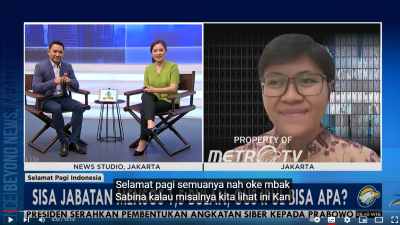
Sabina Puspita media interview: Presidential cabinet reshuffle
Jakarta, 13 September 2024
Following Indonesia’s President Joko Widodo’s recent appointment of Saifullah Yusuf, commonly known as Gus Ipul, as the new Minister of Social Affairs, Metro TV conducted a live interview with Herb Feith Centre’s Deputy Director and Monash University, Indonesia’s Assistant Professor of Public Policy and Management, Dr Sabina Puspita. Why has Widodo appointed Gus Ipul given so few days left?
Highlights:
- Gus Ipul will be one of the ministers in Indonesian modern political history with the shortest term–only 38 days left from Widodo’s administration.
- The appointment was held after the previous Minister of Social Affairs, Tri Rismaharini from the ruling PDI-P party, resigned to run for the coming gubernatorial race in East Java.
- There is no guarantee for Gus Ipul to continue as minister in the upcoming administration of president-elect Prabowo Subianto, but Gus Ipul is entitled to pension funds.
- Widodo claims that the scale of work which the Ministry of Social Affairs has is large and without a definitive minister appointed by the head of state, large scale works would be hard.
- The media and public sentiment indicate scepticism of the minister’s ability to work effectively and criticism of Widodo’s allegedly increasing clientelistic tendencies toward the end of his term.
- Gus Ipul is also the secretary general of Nahdlatul Ulama (NU), Indonesia’s largest Muslim organisation; and so, the public outcry is largely due to people’s distrust in both NU and the President, following recent news of Widodo’s newest policy which enables religious organisations such as NU and Muhammadiyah to operate mining concessions.
- Sabina commented on managing the national Integrated Social Welfare Data (DTKS) as the most pressing issue for Gus Ipul to address–given recent social aid delivery debates around the previous election and now towards upcoming regional elections.
- She further emphasised the need to check the accuracy of the data to ensure aid is delivered to the correct, targeted population; because vulnerable populations such as domestic care workers (who are mostly women), for example, are still not protected by the national social security system under Gus Ipul’s ministry.