
Current Projects
 Koneksi - Climate Resilience in Eastern Indonesia
View
Koneksi - Climate Resilience in Eastern Indonesia
View

Koneksi Project: Developing a Model of Future-proofing for Climate Resilience by Engaging Communities (MoFCREC)
Eastern Indonesia is a priority area for climate change intervention due to risks of extreme climate-related natural disasters; and Lombok, Makassar and Sumbawa are at high risk of experiencing increased extreme rainfall events such as flooding and drought. Rainfall changes have numerous associated knock-on impacts for vulnerable communities. This project will bring together an interdisciplinary team to develop a scalable Climate Change Resilience Toolkit.
Read the latest updates
Read about the final workshop that was held in Bali.
Find out about the final stakeholder workshops, Koneksi visits and strong media amplification of the early findings.
Find out about data analysis in Makassar, consultations in Lombok and DFAT recognition of the project's commitment to equitable partnerships in Kupang:
“This project, supported by KONEKSI, exemplifies a commitment to equitable partnerships and community-driven solutions in addressing climate challenges”. DFAT Media release
Read about the Lombok's geography and the nature of initial discussions with different grassroots groups as the project starts to take shape
Discover more about the initial workshops in Jakarta and Makassar as the project launches in Indonesia.
Background
Climate change effects are unevenly distributed throughout communities based on socio-structural factors. Exposure to the effects of both heat and flooding increases the likelihood of illness and care-related responsibilities, reduces access to clean water and high-quality foods, and influences the type and availability of work among already marginalised groups. The three groups identified as the most vulnerable to climate change - who will be the focus of this project - are people with disabilities, women (including all who identify as women) and older people.
Overview
This project, jointly led by Assoc Professors Sharyn Davies and Ika Idris, will establish an interdisciplinary team to identify knowledge-based climate change resilience solutions for inclusive and sustainable policies and technologies. Deep and enduring relationships will underpin the research, and will direct and inform the outcomes of the project.
A co-designed model to understanding gender equality, disability and social inclusion (GEDSI) and climate resilience will be developed by exploring local understandings of, and capacity around, strengthening climate resilience, with a focus on health, wellbeing, and future-proofing communities and environments.
Through collaboration with a range of stakeholders and communities in Indonesia and Australia, the project seeks to equip policy and change-makers with tools to enhance their understandings of GEDSI, resilience and climate change through a human rights lens to identify and understand opportunities for intervention.
The project aims to grow early skills and capacity of early career researchers and Indonesian Postdocs to drive innovative research agendas on climate resilience in Indonesia along with the establishment of a collaborative interdisciplinary research team to address climate resilience in Indonesia and Australia. Outputs will be co-designed with a view to scalability and applicability to other parts of Indonesia.
Outputs
A resource tool kit and the Model of Future-proofing for Climate Resilience by Engaging Communities (MoFCREC) will be developed to support climate resilience and future-proofing environments for vulnerable communities. The team will convene workshops to identify key priorities and set a locally-informed research agenda, and later in the project to disseminate preliminary findings and identify key community messages.
The outcomes will be shared via International conference presentations, peer-reviewed academic articles and accessible reports, along with public communication material, government briefs and a strategic action plan for future work on GEDSI and climate resilience.
Outcomes
Through the establishment of an enduring interdisciplinary, innovative research network, to include policy makers, academics and practitioners, communities and local groups, a joint agenda for strengthening climate resilience opportunities and solutions will be developed and made widely available.
This project will provide capacity-building opportunities for early career scholars and other future thought leaders in the area of climate change and community resilience. Development of reports and policy briefs will also equip policy and change-makers with understandings of GEDSI, resilience and climate change.
Links to the digital Toolkit will be published here.
The Model of Future-proofing for Climate Resilience by Engaging Communities (MoFCREC) project, which was one of 30 projects selected from a field of over 700 applications, is funded for 12 months.
Partners
- Monash University, Australia; and Monash University, Indonesia
- Hasanuddin University (Indonesia)
- The South Sulawesi Women’s Legal Aid Institute (Indonesia)
LBH APIK Sulsel - The Indonesian Disability Movement for Equality (Indonesia)
Pergerakan Difabel Indonesia untuk Kesetaraan - Indonesian Ministry of Women and Children Affairs (Indonesia)
KemenPPPA - DP3AP2KB of Nusa Tenggara Barat Province (Indonesia)
- Regional Development Planning Agency (Bappeda) of Nusa Tenggara Barat Province (Indonesia)
- Garamin (Indonesia)
- Australia-Indonesia Centre (Australia)
- ReelOzInd (Australia)
- 360Info (Australia)
External Advisor
- The National Commission on Violence Against Women
Komnas Perempuan
Acknowledgement
The Developing a Model of Future-proofing for Climate Resilience by Engaging Communities (MoFCREC) project is supported by the Australian and Indonesian Governments through KONEKSI and implemented by Monash University with Monash University, Indonesia.
This project has been funded by the Department of Foreign Affairs and Trade Australia through KONEKSI. The views expressed are the authors’ alone and are not necessarily the views of the Australian Government.
 Islamic Bureaucracies and Pious Publics in Turkey and Indonesia
View
Islamic Bureaucracies and Pious Publics in Turkey and Indonesia
View
Islamic Bureaucracies and Pious Publics in Turkey and Indonesia
Researchers:
Julian Millie, Monash Indonesian Studies, Herb Feith Centre
Banu Senay, Macquarie University
Lian Choon Wang, Monash Business School
Everyday Islamic practices in Turkey and Indonesia are increasingly being influenced by Islamic bureaucracies, namely the Indonesian Ministry of Religion and Turkey’s Diyanet. This project, funded by the Australian Research Council, compares the two bureaucracies of these two large Islamic democracies, and asks whether they together constitute a global, state-based, political move towards bureaucratisation.
These institutions have been growing over recent decades, and have influences of various kinds, although these differ in the two countries. In Indonesia, for example, the Ministry’s main effort is directed to education. The Diyanet has extensive programs for providing Islamic officials for communities outside Turkey. Of course, both bureaucracies have political effects, giving approval and resources to some communities and variants, while marginalising others.
Joining Julian and Banu in this research is economist Liang Choon Wang, from the Monash Business School, who applies his expertise to the budgetary aspects of the two bureaucracies.
The team held a recent meeting at Monash Malaysia, where collaborating scholars from a number of universities attended: Universitas Islam Negeri Sunan Gunung Djati; Universitas Indonesia; Utrecht University; Free University of Amsterdam; Zurich University.
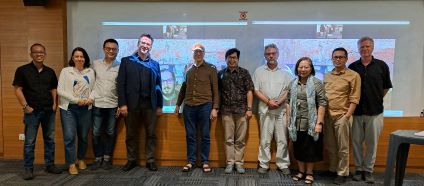
Left to right: Rus’an Nurdin, Banu Senay, Liang Choon Wang, Julian Millie, Dominik Mueller, Martin van Bruinessen, Moch. Fakhruroji, Thijl Sunier, Maznah Mohammad, Dede Syarif, Chris Houston.
Photo by Julian Millie.
 Bridging Vulnerabilities: A Comparative Study on Transit Refugee Women
View
Bridging Vulnerabilities: A Comparative Study on Transit Refugee Women
View
Bridging Vulnerabilities: A Comparative Study on Transit Refugee Women and Domestic Care Worker Women in Indonesia
Researchers
Dr Sabina Puspita, Herb Feith Centre, Monash University Indonesia
Dr Gabriela Fernando, Monash University, Indonesia
Anak Agung Istri Diah Tricesaria, Herb Feith PhD candidate, Monash University, Australia
Dr Jessica Watterson, Action Lab, Momnash University Australia
Overview
This year-long research project focuses on two of the most vulnerable groups in Indonesia - domestic care worker women and transit refugee women. The millions of domestic care worker women and thousands of transit refugee women in Indonesia may differ in their citizenship status, but the majority of both groups are susceptible to violence, trafficking, poverty, and poor health conditions.
Through a comparative approach, this project aims to identify the similarities and differences between the two groups, and make recommendations that can address their economic wellbeing and resilience. It also aims to promote better health outcomes for these groups and the communities that interact with them.
Outcomes
Since its inception in 25 August 2023 to date, Sabina and Gabriela have published an article on Indonesian domestic workers' struggle for better legal protection to raise public awareness of the issue during International Women's Day on 8 March 2024 (360info.org). The article has been republished by multiple news media online (Eco-Business; EastMojo; Press Trust of India; Ova). Sabina was also quoted by Indonesia's major news media company during a press conference for Indonesia's Bill on Protection of Domestic Workers (Kompas).
Funder
Monash University Indonesia Seed Funding and Action Lab, Monash University, Australia
 Australia Awards: Climate Resilience Fellowship Program
View
Australia Awards: Climate Resilience Fellowship Program
View
Herb Feith Centre is awarded the delivery of an Australia Awards in Indonesia program in 2025.
Project team
Led by Sharyn Davies, and supported by Miya Irawati, Welmince Djulete and Yulisna Sari Mutia.
Overview
Eastern Indonesia is a priority area for climate change intervention for the Indonesian and Australian governments due to the risks of extreme climate-related natural disasters (DFAT, 2020; Katalis, 2022). This project builds on our Australian and Indonesian government-funded KONEKSI project.
The Climate Resilience Fellowship program will fund six fellows from Eastern Indonesia to visit Australia for a three week period in May - June, 2025, with activities in and around Melbourne. These activities and outputs will play a crucial role in addressing climate change resilience through an interdisciplinary and intersectional approach with GEDSI focus:
Program activities
- Capacity Building and Training,
- A two-day panel discussion;
- Networking and collaboration by connecting with Climate Change Communication Research Hub at Monash
University in Australia; - Community Engagement by study tours to learn best practices from indigenous communities in Australia;
- Advocacy and Communication by developing an advocacy plan and educational material for public awareness campaigns and advocacy.
Outcomes
Outcomes of the program include
- The creation of a sustainable network comprising policymakers and local partners dedicated to enhancing climate resilience;
- Capacity-building opportunities for policymakers and local partners to become champions in climate change resilience;
- The development of policy briefs, toolkits, and educational materials for digital awareness campaigns, equipping fellows with knowledge of climate change resilience.
Funder
Department of Foreign Affairs and Trade - Australia Awards, Indonesia
 Online Community Assistance Ecosystem to Aid Disabled Stroke Survivors
View
Online Community Assistance Ecosystem to Aid Disabled Stroke Survivors
View
Digital Care Frontier: Empowering Women, Enhancing Digital Strategy of Stunting Prevention
This ground breaking project aims to explore and enhance the Indonesian government's digital strategy for stunting prevention by focusing on women’s empowerment and social inclusion. The research, conducted in Padang, (Sumatara), Grobogan (Java), and Manggarai (Flores Islands), will evaluate the effectiveness of stunting-prevention apps like AyoCeting and ATASI, and their impact on women and marginalized communities.
By engaging caregivers, care workers, and health cadres, the project seeks to understand the challenges these groups face in using digital technologies for childcare. The goal is to make these technologies more accessible and empowering for women, families with disabilities, low-income households, and those with limited literacy.
This project represents a critical step towards more inclusive and effective digital health interventions, fostering sustainable policies and technologies that empower women and marginalized communities in Indonesia and beyond.
Methodology
Fieldwork: Comparative studies in Padang, Grobogan, and Manggarai.
Data Collection: Surveys, visual recordings, and UI/UX ethnographic research.
Stakeholder Engagement: Focus groups and interviews with app developers, government officials, and hard-to-reach communities.
Anticipated Outputs:
Evidence to inform policy and improve digital stunting-prevention tools.
Reports, academic articles, op-eds, films, campaigns, exhibitions, and seminars to raise awareness.
Collaboration with Yayasan Kesehatan Perempuan for policy advocacy.
Impact
Shifting the perspective on digitalization from a mere e-government tool to an empowerment catalyst.
Providing actionable insights for digital health strategies beyond Indonesia.
Resources and Budget
24-month project with a well-calibrated budget, leveraging expertise, connections, and resources from partnering organizations.
Significant budget allocation for empowering women and marginalized groups, conducting capacity-building activities, and ensuring effective research dissemination.
Partnerships
Led by the Center for Gender and Sexuality Studies, Universitas Indonesia, and Sharyn Davies from Monash University.
Collaboration with Yayasan Kesehatan Perempuan and other local and international NGOs, ensuring extensive stakeholder engagement and advocacy.
Funder
This project is funded by Koneksi, Department of Foreign Affairs and Trade.
 Koneksi: Digital Care Frontier: Enhancing Digital Strategy of Stunting Prevent
View
Koneksi: Digital Care Frontier: Enhancing Digital Strategy of Stunting Prevent
View
Digital Care Frontier: Empowering Women, Enhancing Digital Strategy of Stunting Prevention
This ground breaking project aims to explore and enhance the Indonesian government's digital strategy for stunting prevention by focusing on women’s empowerment and social inclusion. The research, conducted in Padang, (Sumatara), Grobogan (Java), and Manggarai (Flores Islands), will evaluate the effectiveness of stunting-prevention apps like AyoCeting and ATASI, and their impact on women and marginalized communities.
By engaging caregivers, care workers, and health cadres, the project seeks to understand the challenges these groups face in using digital technologies for childcare. The goal is to make these technologies more accessible and empowering for women, families with disabilities, low-income households, and those with limited literacy.
This project represents a critical step towards more inclusive and effective digital health interventions, fostering sustainable policies and technologies that empower women and marginalized communities in Indonesia and beyond.
Methodology
Fieldwork: Comparative studies in Padang, Grobogan, and Manggarai.
Data Collection: Surveys, visual recordings, and UI/UX ethnographic research.
Stakeholder Engagement: Focus groups and interviews with app developers, government officials, and hard-to-reach communities.
Anticipated Outputs:
Evidence to inform policy and improve digital stunting-prevention tools.
Reports, academic articles, op-eds, films, campaigns, exhibitions, and seminars to raise awareness.
Collaboration with Yayasan Kesehatan Perempuan for policy advocacy.
Impact
Shifting the perspective on digitalization from a mere e-government tool to an empowerment catalyst.
Providing actionable insights for digital health strategies beyond Indonesia.
Resources and Budget
24-month project with a well-calibrated budget, leveraging expertise, connections, and resources from partnering organizations.
Significant budget allocation for empowering women and marginalized groups, conducting capacity-building activities, and ensuring effective research dissemination.
Partnerships
Led by the Center for Gender and Sexuality Studies, Universitas Indonesia, and Sharyn Davies from Monash University.
Collaboration with Yayasan Kesehatan Perempuan and other local and international NGOs, ensuring extensive stakeholder engagement and advocacy.
Funder
This project is funded by Koneksi, Department of Foreign Affairs and Trade.