
What is Maternal Spindle Transfer and Pronuclear Transfer?
Maternal Spindle Transfer (MST) and Pronuclear Transfer (PNT) are two assisted reproductive technology (ART) techniques used in mitochondrial donation.
Through the mitoHOPE Pilot Program at Monash University, researchers are studying MST and PNT in Australia for the first time, made possible by the introduction of Maeve’s Law.
The aim is to understand whether these techniques can reduce the risk of mitochondrial disease being passed on genetically, and to pilot the introduction of a clinical trial designed to determine the safety and effectiveness of the procedure.
The program also builds on the extensive PNT research and experience developed at Newcastle University in the UK.
The science behind mitochondrial donation
Most of our genetic information is stored in the nucleus of our cells. This is called nuclear DNA (nDNA) and it comes from both biological parents. It contains the instructions that help our bodies grow, develop and function, and influences traits such as our height, hair and eye colour.
Our nDNA is organised into 46 chromosomes, and arranged in 23 pairs. We inherit one set from each biological parent. Each chromosome contains genes, which carry instructions for how our bodies work.
Our cells also contain structures called mitochondria, which produce much of the energy our cells need. Mitochondria have a small amount of their own genetic material, called mitochondrial DNA (mtDNA).
Changes in mtDNA can cause serious mitochondrial diseases, affecting many parts of the body, including the brain, muscles, heart, eyes and kidneys.
Because mtDNA is usually passed on through the egg, a woman who carries these changes can pass them on to their child. This is because the egg provides the mitochondria that remain in the developing embryo, while sperm contributes nDNA.
Mitochondrial donation aims to reduce this risk. It combines the nDNA from the intended parents with healthy mitochondria from a donor egg.
This means the intended parents provide the embryo’s chromosomes and nuclear genes, while the egg donor provides the healthy mitochondria.
How Maternal Spindle Transfer works
With MST, the egg’s chromosomes are transferred before fertilisation.
The intended parent’s unfertilised egg contains chromosomes contained within a structure called the spindle. The spindle helps to align the chromosomes in preparation for fertilisation.
The mitoHOPE embryologists remove the spindle and its chromosomes from the egg and transfer them into a donor egg with the nDNA removed.
The egg donor’s healthy mitochondria remain in the egg.
The egg is then fertilised with sperm from the other intended parent.
This creates an embryo with the intended parents' nDNA and the donor’s mitochondria.
MST technique
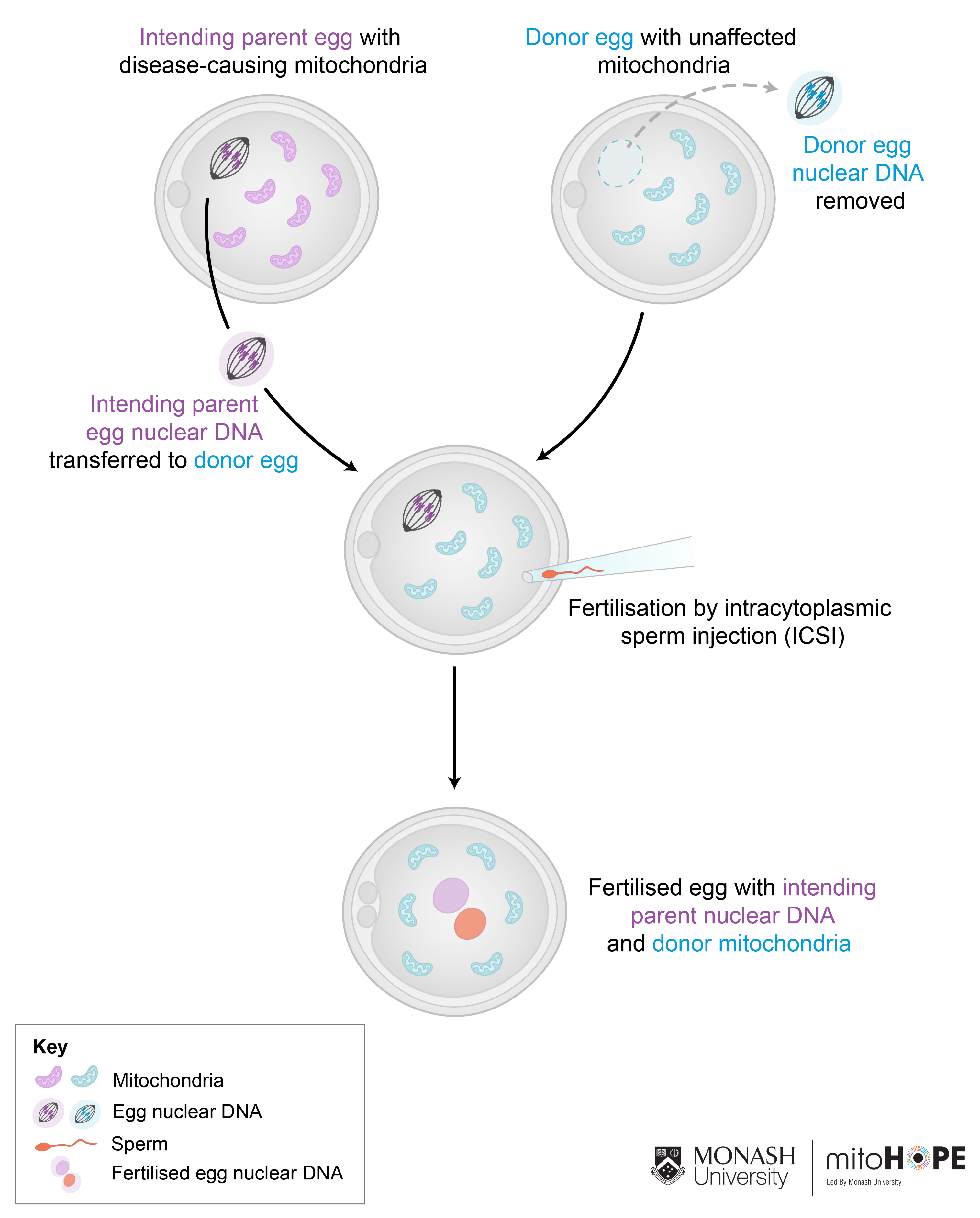
Illustration by Jazmine Yuson, PhD student at Monash University
How Pronuclear Transfer works
With PNT, the transfer takes place after fertilisation.
An egg from the intended parent is first fertilised with sperm from the other intended parent.
After fertilisation, the egg’s DNA and the sperm’s DNA are each contained in a temporary structure called a pronucleus. The two pronuclei contain the 23 chromosomes from the egg and the 23 chromosomes from the sperm. They remain separate for a short time before coming together as the embryo begins to develop.
A donor egg is also fertilised.
The donor’s pronuclei are removed, while the donor’s healthy mitochondria remain.
The pronuclei from the intended parents are then transferred into the fertilised donor egg.
This creates an embryo with the intended parents’ nDNA and the donor’s mitochondria.
PNT technique
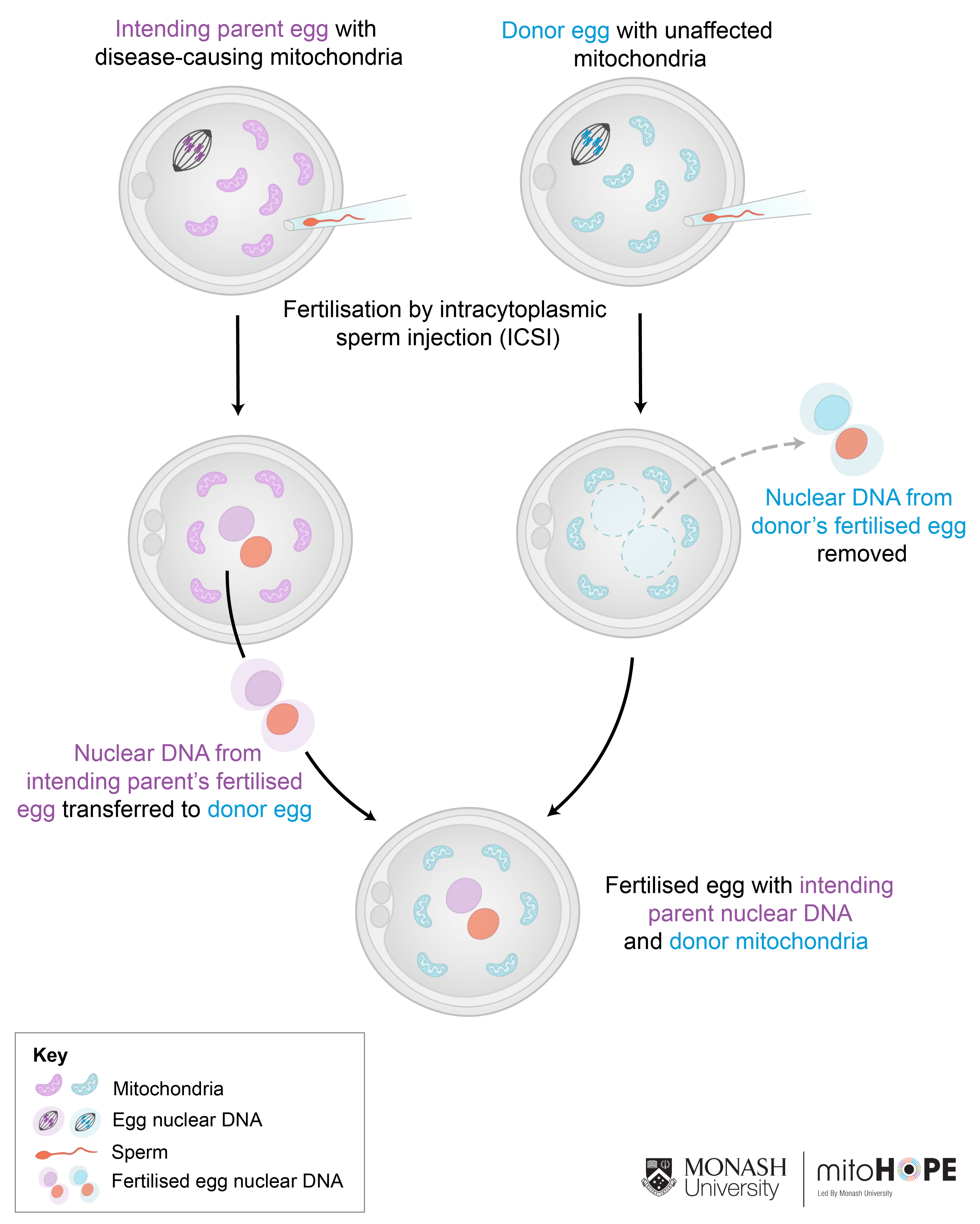
Illustration by Jazmine Yuson, PhD student at Monash University