
Research
A central challenge in neuroscience is understanding how the brain’s cellular and molecular diversity gives rise to cognition and behaviour, and how these mechanisms differ across species and break down in disease. Our lab develops theoretical and computational approaches that integrate neuroimaging, mathematics, psychology, and evolutionary biology to uncover the fundamental principles linking brain structure, dynamics, and function across scales in health and disease.
Our research program is built on the three key pillars detailed below.
Multiscale brain organisation
We study how cellular and molecular diversity gives rise to brain-wide dynamics and behaviour by developing computational models that integrate multimodal data across scales, from cells to whole-brain networks. Some of the questions we tackle include:
- How does brain structure constrain brain function across scales?
- How do cellular and molecular properties shape large-scale brain dynamics?
- How does cognition emerge from the brain’s multiscale organisation?
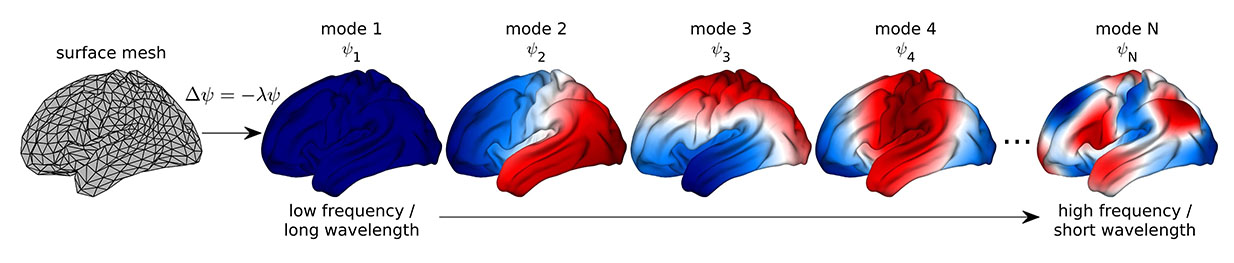
Understanding how the geometry of the brain constrains function. The figure shows the eigenmodes of cortical geometry related to the resonances of brain dynamics across different frequencies. Source: Pang et al. (2023, Nature)
Mechanisms of brain disorders
We study how disruptions in brain structure and dynamics give rise to neurological and psychiatric disorders by building computational models that link local circuit alterations to system-level dysfunction. Some of the questions we tackle include:
- How do local changes lead to whole-brain dysfunction?
- What computational principles are shared across brain disorders?
- How do disruptions produce disease progression and variability?
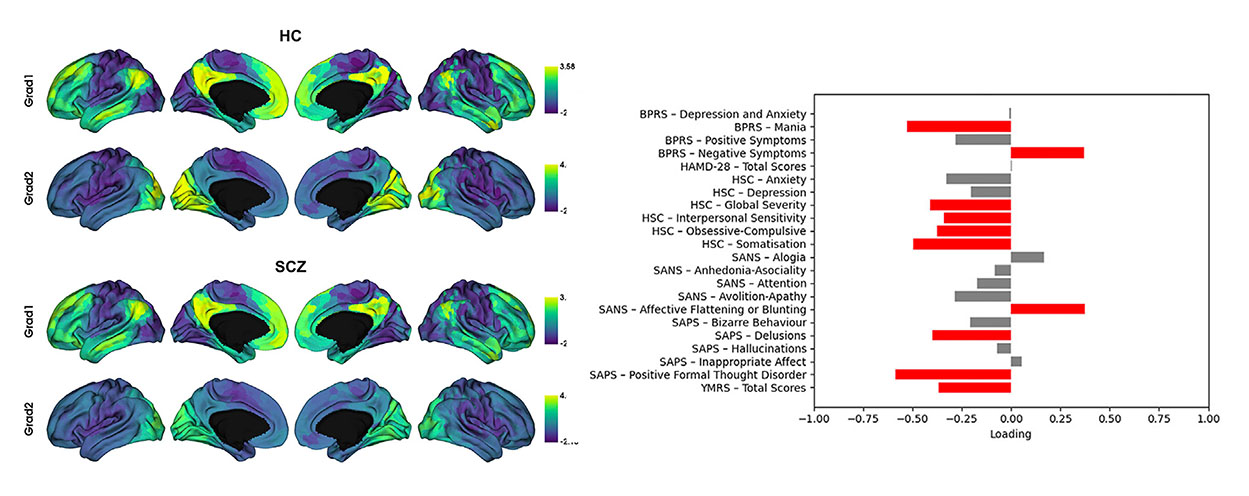
Understanding disruptions of functional hierarchical architecture in schizophrenia. The figure shows (LEFT) the spatial topography of the first two dominant axes of functional organisation in healthy controls and patients with schizophrenia and (RIGHT) that disruptions in functional organisation are associated with clinical symptoms. Source: Holmes et al. (2023, Biological Psychiatry: CNNI)
Principles of brain evolution
We study how evolutionary diversity shapes conserved and species-specific principles of brain organisation by integrating comparative datasets with computational modelling across mammals (e.g., mice, monkeys, cetaceans). Some of the questions we tackle include:
- What features of brain organisation are conserved across species?
- How has evolution shaped differences in brain structure, dynamics, and behaviour?
- What can species diversity reveal about human brain function and dysfunction?
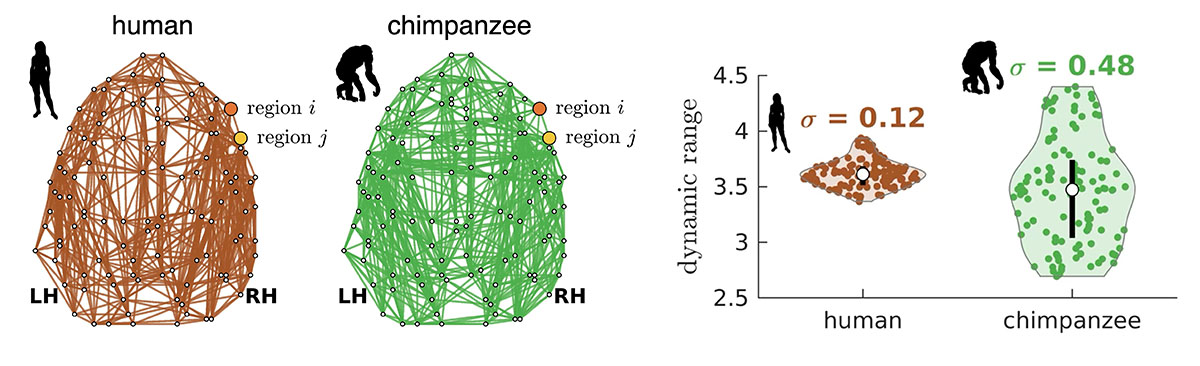
Understanding the evolutionary shaping of brain function. The figure shows (LEFT) a comparison between the structural networks of humans and chimpanzees, our closest living primate relative, and (RIGHT) how differences in network architecture led to differences in neural dynamic range that regulates regional activity excitability to external modulations. Source: Pang et al. (2022, eLife)