
Australia’s Psychedelic Research and Readiness for Clinical Trials
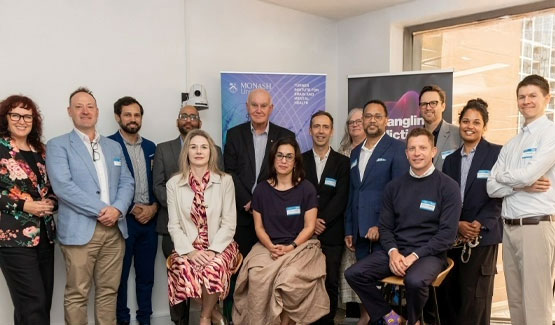
Left to right: Back: Natasha Mitchell, Prof Mark Bellgrove, Micheal Raymond, Prof Adeel Razi, Prof John Skerritt AM, Prof Antonio Verdejo-García, Dr Ieva Ozolins, Prof Kevin Jones, Professor Christopher Davey, A/Prof Shalini Arunogiri, Dr Devon Stoliker. Front: Professor Susan Rossell, A/Prof Gill Bedi and A/Prof John Gardner.
Monash hosts thought leading conversation on mental health innovation
The Turner Institute for Brain and Mental Health and Wellcome Leap, are collaborating to accelerate high-impact neuroscience - to deliver safe, effective, and scalable mental health treatments.
Late last year, (December 2025), the Turner Institute partnered with Wellcome Leap to bring together leading researchers, clinicians, ethicists, policy makers, and lived-experience advocates to discuss how Australia can lead globally in developing safe, evidence-based psychedelic-assisted therapies.
Expertly facilitated by Monash Alumni and journalist Natasha Mitchell, the event explored the future of psychedelic-assisted therapies for mental health and addiction, highlighting Australia’s unique regulatory position and global leadership in research. This event was a step toward a national roadmap for psychedelic-assisted therapies that Australia can lead.
Setting the scene on Neuroscience
Professor Mark Bellgrove (Director, Turner Institute) and Professor James Whisstock (Deputy Dean, Research, Monash University) highlighted Monash’s neuroscience leadership and infrastructure, including advanced imaging and AI platforms. They talked about the University’s commitment to bold, evidence-driven innovation in mental health, emphasising that psychedelic science is not about hype, but about rigorous research, ethical frameworks, and collaboration to deliver real solutions for the community.
Mark Chevillet and Professor Kevin Jones from the Wellcome Leap outlined global strategies for accelerating high-impact research, emphasising Australia’s unique regulatory position and the need for rigorous science and ethical governance.
“If we get this right, we can help build treatments that are scientifically rigorous, ethically grounded, and accessible in real clinical settings. If we get this wrong, we risk harming patients and eroding public trust.” Professor Jones said.
Keynote: Lived experience at the centre
Michael Raymond, an Australian Defence Force veteran and CEO of Heroic Hearts Project Australia, delivered a keynote that grounded the day in lived experience. Michael spoke candidly about his journey through PTSD, treatment-resistant depression, and the limitations of conventional care. After exhausting standard treatments, Michael turned to psychedelic-assisted therapy overseas as a last resort. A decision that proved transformative.
“These therapies have helped save my life. It’s really motivated me, and challenged me to get up and do things like this… and speak in front of you about these tough experiences.”
Research shaping the future
Monash researchers Professor Adeel Razi and Professor Antonio Verdejo-Garcia introduced Turner Institute’s cutting-edge work in computational neuroscience and addiction. Their teams are developing generative brain models, deep phenotyping, and precision approaches to understand how brain dynamics link to behaviour - laying the foundation for personalised mental health interventions.
2030 and beyond- research, regulatory frameworks and philanthropy
Rapid-fire presentations showcased the breadth of Australian research from the Turner Institute, Swinburne University of Technology, Turning Point, Orygen, Monash Bioethics Centre. Together they explored the question: What do we want Psychedelic Research to look like by 2030 and how can we get there?
A dynamic panel featuring Professor John Skerritt AM, Dr Ieva Ozolins, Professor Chris Davey, and Professor Suresh Sundram, tackled regulatory frameworks, clinical governance and equity of access.
Philanthropy was also highlighted as a key driver for research-enabled clinics that deliver subsidised care while collecting outcomes data - a model that could democratise access and accelerate evidence generation.
Looking ahead
Universities, health services, regulators, and philanthropic partners must work together to build infrastructure that supports rigorous trials, ethical governance, and equitable access.
“Collaboration is key,” This city, Melbourne, is a hub for research. And philanthropy provides this ‘extra juice’ that allows us to really lean into innovation, discovery, and advancing new treatments, areas, and care options” said Professor Mark Bellgrove.
Psychedelic-assisted therapies are not a panacea, but with careful science and strong safeguards, they represent one of the most promising frontiers in psychiatry. The question is no longer if Australia will lead, but how fast and how well we can turn promise into practice.
Learn more about the Turner Institute for Brain and Mental Health and its research programs: monash.edu/turner-institute
About Monash University
Monash University is Australia’s largest university with more than 80,000 students. In the 60 years since its foundation, it has developed a reputation for world-leading high-impact research, quality teaching, and inspiring innovation.
With four campuses in Australia and a presence in Malaysia, China, India, Indonesia and Italy, it is one of the most internationalised Australian universities.
As a leading international medical research university with the largest medical faculty in Australia and integration with leading Australian teaching hospitals, we consistently rank in the top 50 universities worldwide for clinical, pre-clinical and health sciences.
For more news, visit Medicine, Nursing and Health Sciences or Monash University.
MEDIA ENQUIRIES