
Monash-King's College London Symposium: Redefining the future of digital education in large student cohorts
Innovation in online education is a cornerstone of the strategies of both Monash Psychological Sciences and the Institute of Psychiatry, Psychology and Neuroscience King’s College London (KCL). Each are leading their institutions to redefine the future of digital education.
To unite innovators in online education in Australia and beyond – across Psychology, Neuroscience, Information Technology, Public Health, Engineering, and Education – Monash and KCL joined forces to host the inaugural Monash-King's College London Symposium: Redefining the future of digital education in large student cohorts.
Hosted by Professor Sue Elliott AM – Deputy Vice-Chancellor and Vice-President (Education) and Professor Kim Cornish, Head, School of Psychological Sciences, the Symposium was held at the Monash Law Chambers, Melbourne. The event began with a cocktail reception and welcome address by Professor Sue Elliot on Thursday 22 February 2018.
The event was opened by Associate Professor Matthew Mundy, Director of Education, Monash Psychological Sciences and warmly supported by Professor Kim Cornish and Professor Zlatko Skrbiš, Senior Pro Vice-Chancellor (Academic).
The symposium covered the themes of Technological innovation and advances in online education, Challenges and opportunities for innovation in online teaching and Student-centred education.
Dr Kyle Dyer, Academic Lead for Online Education at Kings Online at KCL delivered a keynote address, highlighting the rapid development in online education and the innovations achieved and needed in the future to keep up the pace.
The Symposium closed with an engaging panel session. The audience asked the leading digital educators, senior faculty and education specialists on their panel burning questions on the current state of online education and the future of this growth area.
The Symposium was followed by a series of workshops led by pioneering researchers at Monash University and King’s College London at Monash's new Learning and Teaching facility.
Workshop attendees gained new strategies to maximise the benefits of online tertiary education, including implementation of innovative online learning platforms for large student cohorts, such as the Monash Psychology Research Portal. The Portal supports the Monash Psychology Graduate Diploma of Psychology – Advanced, an online course with a substantial research component. The Portal is a highly innovative, fully integrated and centralised resource environment that allows researchers and research students, including fourth-year psychology students, to conduct their research projects fully online.
Attendees also gained strategies to build a sense of community in online education to facilitate learning, ideas for how to implement research evidence-based strategies to enrich the student experience, and strategies to engage academics in online education.
"Digital education has an exciting future, providing us with a number of opportunities, but also some interesting challenges," said Professor Sue Elliot. "This collaboration between online educators and researchers at Monash University and Kings College London represents a powerful partnership, with the scope to drive innovation forward in this area."
“I couldn’t be more proud of Monash Psychological Sciences leadership in online education – particularly with respect to managing research projects online and maximising student experience and engagement,” Professor Kim Cornish, said. “We look forward to the future innovations highlighted in our Symposium and will continue to work closely with KCL to provide leadership to the sector in online education.”
For more information on Monash Psychological Sciences online education practice and research please contact Associate Professor Matthew Mundy, T: 03 9905 1035, E: Matthew.Mundy@monash.edu.
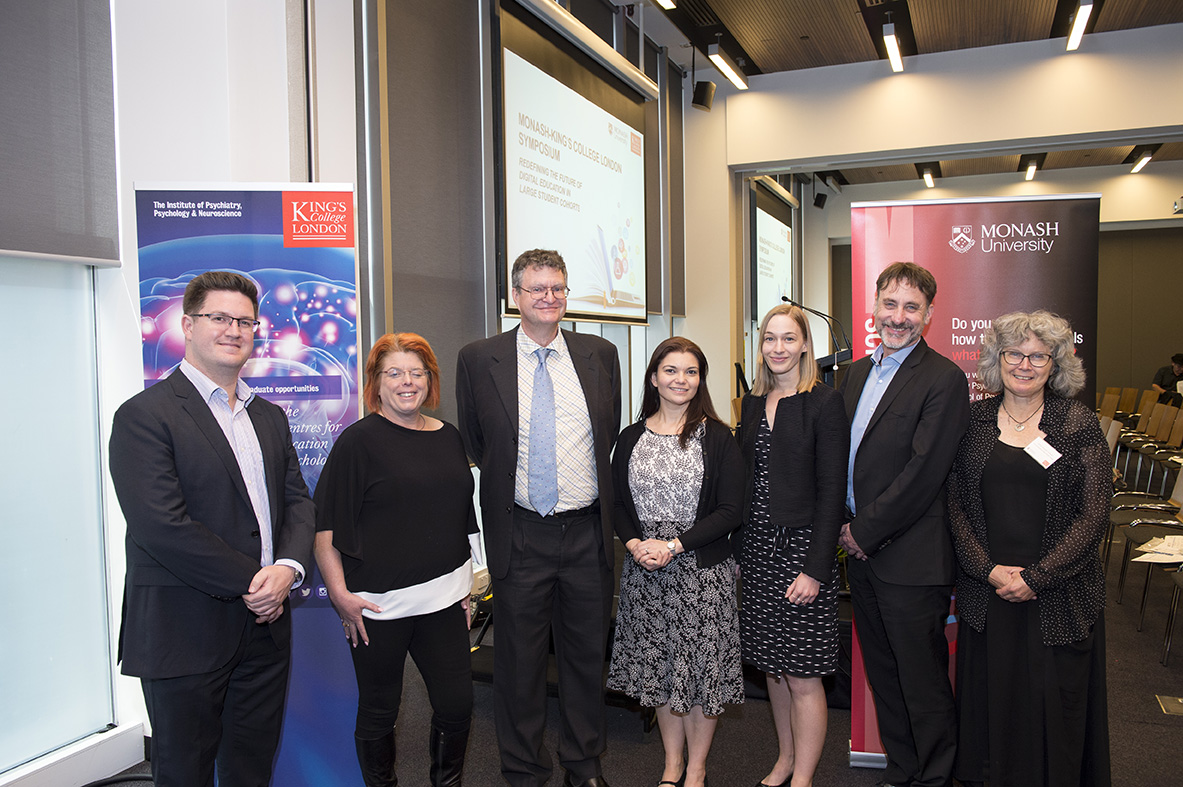
[Left to right] Associate Professor Matthew Mundy, Professor Kim Cornish, Dr Stephen McKenzie, Dr Gisele Dias, Louise Braithwaite, Dr Kyle Dyer and Associate Professor Jacquelyn Cranney