
Monash researchers use AI to identify early signs of cardiovascular disease in routine mammograms in a world-first clinical trial
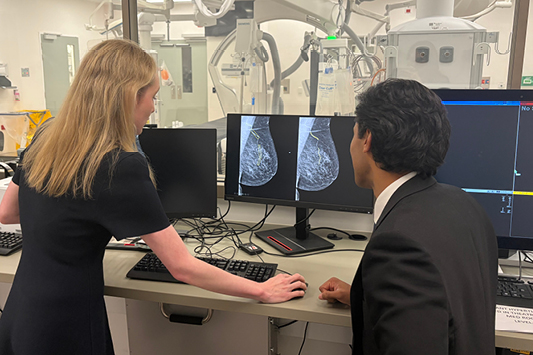
The Victorian Government is providing a $500,000 grant to Monash University and Monash Health researchers for a clinical trial using a novel AI tool to identify early signs of cardiovascular disease in routine mammograms.
The Deputy Premier of Victoria and Minister for Medical Research, The Honourable Ben Carroll, visited the Victorian Heart Hospital, a partnership between Monash University and Monash Health, to announce the funding as part of the latest round of Victorian Medical Research Acceleration Fund (VMRAF) grants.
The project will trial using AI-based detection breast arterial calcification (BAC) on screening mammograms in partnership with BreastScreen Victoria.
BAC is a visible but currently unreported finding on routine screening mammography, and is strongly associated with hypertension, diabetes, coronary artery disease, stroke and cardiovascular mortality.
The project is led by Dr Esther Davis, Women’s Heart Health lead at the Victorian Heart Hospital and Monash University’s Victorian Heart Institute, and Associate Professor Nitesh Nerlekar, Victorian Heart Institute Deputy Director, Clinical Research.
Dr Davis said leveraging routine breast screening appointments at BreastScreen Victoria for cardiovascular risk assessment has the potential to identify thousands of women who would otherwise remain unaware of their heart disease risk.
“Heart disease in women is underdiagnosed and, as a result, undertreated,” Dr Davis said.
“This research aims to couple the power of AI with information gained through routine population-based breast cancer screening to identify the risk of heart disease in women.
“We want to meet women where they are already engaging in their health and provide earlier treatment to improve cardiac outcomes."
Associate Professor Nerlekar said the trial aims to demonstrate how artificial intelligence can be integrated into existing healthcare pathways, identifying women at increased risk of heart disease without requiring additional appointments or imaging.
“By integrating a validated AI algorithm into existing mammography workflows we have an opportunity to identify signs of cardiovascular disease without disrupting the core purpose of mammography: breast cancer detection,” Associate Professor Nerlekar said.
The Victorian Heart Hospital is committed to delivering precision cardiovascular care through innovative technologies, digital health and data-driven approaches that improve outcomes for all Victorians.
The Victorian Government’s investment through the VMRAF enables promising research to progress more rapidly from concept to clinical implementation, benefiting patients sooner.
"Victoria is home to some of the world's best medical researchers and we’re backing them to deliver the breakthroughs that will change and save lives," Minister Carroll said.
“We’re helping grow a sector that not only saves lives, but also supports jobs, innovation and our economy.”
BreastScreen Victoria Chief Executive Rita Butera said the clinical trial will begin in July.
“This collaboration reflects a shared commitment to improving women’s health,” Butera said.
“By combining our expertise, we can explore new ways to identify health risks earlier and connect women with the care they need.”
Find out more: https://www.monash.edu/vic-heart-institute/research/tim-tam-study
The project has also received funding from the National Health and Medical Research Council, National Heart Foundation and Victorian Department of Health.