Mascot and flag
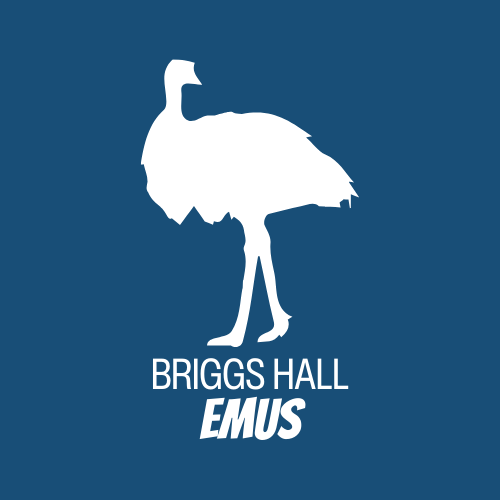
The mascot for Briggs Hall is the emu, the dreaming totem of Geraldine Briggs. Our colours are blue, green, and silver and, like the emu, we hold our head up proudly, wearing our colours on special occasions and to support our fellow emus at sporting events.
Briggs Hall's History

Mrs. Geraldine Rose Briggs (Aunty Gerry)
Born: 21 January 1910, Warangesda Aboriginal Mission, NSW
Died: 11 August 2005
Briggs Hall is named in honour and recognition of Mrs Geraldine Briggs AO (Aunty Gerry)
Aunty Gerry had tribal connections to the Yorta Yorta tribe on her mother's side and the Wiradjeri tribe through her father. Her ancestral totem is the emu. She was born on the Warangesda Aboriginal Mission in NSW in 1910. Her great grandfather was Barkabillie tribal leader of the Ulupna Clan of the Yorta Yorta tribe. Aunty Gerry was raised on the Moonacullah Aboriginal Reserve near Deniliquin and Barham in NSW. As children, she and her sisters spent time on their grandfather George Middleton's farm near Cummeragunja Aboriginal Reserve on the banks of the Murray River near Barmah.
Aunty Gerry had thirteen children, but lost four. She also raised her husband's brother's three children after their parents died. Her house was often full of other children and family members; she always managed to make room when needed.
Aunty Gerry had a lifetime of involvement in Aboriginal community affairs. She always said that the thing that initially motivated her to get politically involved was the treatment of Aboriginal people under the Aborigines Protection Act and the living conditions on Aboriginal Reserves.
Over the years Aunty Gerry held many positions in the struggle to improve the living conditions for Aboriginal people. She was a member of the first Aboriginal delegation to Canberra to meet with Prime Minister Lyons. After the death of her husband in 1969, she continued her involvement in Aboriginal affairs. Aunty Gerry maintained that many of the Aboriginal community services were established through the efforts of Aboriginal people, particularly Aboriginal women, who worked to improve the conditions of Aboriginal families at the local level as well as on the national level.
Aunty Gerry was State Secretary of the Federal Council for Aborigines and Torres Strait Islanders and a member of the Victorian Aboriginal Affairs Advisory Committee. She was the President and founding member of the National Aboriginal and Island Women's Co-operative and a founding member of the Uniting Council of Aboriginal Women. The women ran hostels for homeless and 'at risk' youth, visited prisoners and were involved in lobbying and fundraising. The women were instrumental in the establishment of the Victorian Aboriginal Health Service, the Victorian Aboriginal Legal Service and of many organisations that are today delivering services to the Aboriginal community.
In 1991 Aunty Gerry was awarded the Order of Australia for her work in the Aboriginal community.
(Acknowledgement: This text was provided by Ms. Lois Peeler, daughter of Aunty Gerry)