
Madeleine Neaves
QUANTIFICATION AND ESTIMATION OF INERTIA IN POWER SYSTEMS WITH HIGH PENETRATIONS OF INVERTER-BASED RESOURCES
Madeleine Neaves
PhD Candidate, Faculty of Engineering, Monash University (Zema Scholar)
Supervisors: Dr Mehdi Ghazavi Dozein, Dr Terrence Mak
Research interests: Power system planning, power system operation, mathematical modelling, machine learning.
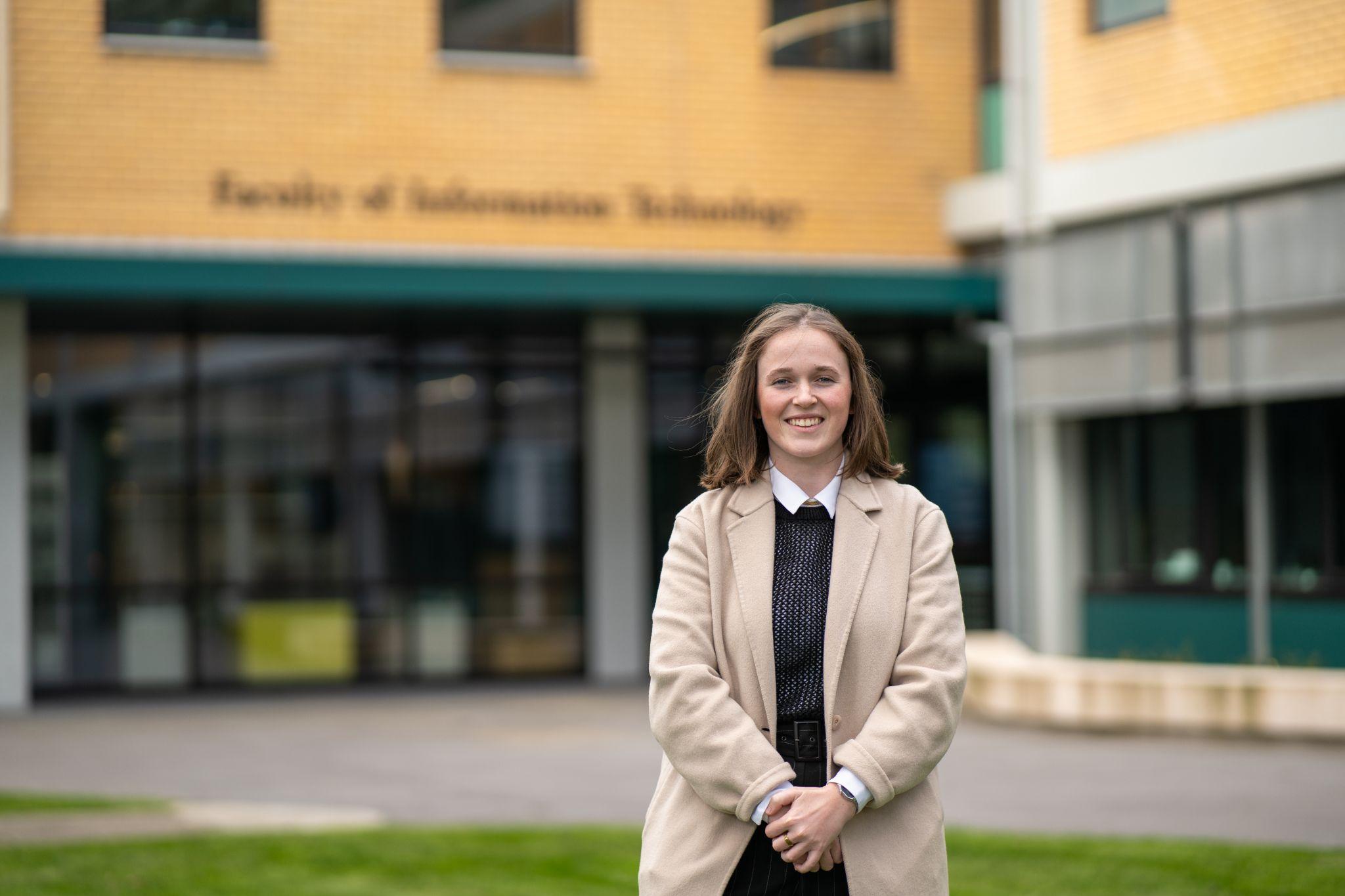
Madeleine holds a Bachelor of Software Engineering and a Bachelor of Science (Mathematics) from Monash University, with a focus on quantitative modelling, optimisation, and data analysis. She has worked in the energy sector on battery modelling and optimisation, where she developed an interest in how modelling is interpreted and used in decision-making.
Her perspective has been shaped by international engagement, including her selection as an ASEAN-Australia Young Leader in 2024, overseas study in China, and participation in international climate forums. Through discussions with delegates across Southeast Asia on climate and energy challenges, she came to understand the leadership role Australia can play in advancing understanding of high-renewables power systems.
This has led her to pursue doctoral research focused on emerging power systems, with a focus on the gap between how systems are modelled and how they operate in practice. Her work is motivated by the need to better understand the dynamics of Australia’s rapidly evolving electricity grid, and how this can inform energy system planning both domestically and internationally.
Research Aims
Madeleine’s research examines how electricity systems behave as they transition to high shares of renewable energy. Traditionally, grid stability has been maintained by large synchronous generators, whose rotating mass provides an inherent response to disturbances. As these generators are displaced by inverter-based technologies, system dynamics are changing in ways that remain only partially understood, raising questions about how grids will perform under stress.
In response, solutions such as synchronous condensers have been proposed, increasing the projected cost of the energy transition. This has become a dominant framing of the challenge in Australia. However, latest evidence suggests that existing system resources, including inverter-based technologies such as batteries, provide more stability support than is currently recognised, challenging the assumption that additional infrastructure is required.
Madeleine’s work aims to improve understanding of power system inertia in modern electricity grids, ensuring that decisions around system design and investment are informed by a more accurate representation of system behaviour under high renewable penetration.