Students' creative works
Students' creative works
Discover how students are raising awareness about climate change through creative projects. Their work highlights environmental and societal challenges and inspires conversations for a more sustainable future.
 Climate change solutions – student videos
View
Climate change solutions – student videos
View

Video Lab students in Monash’s Bachelor of Media Communications were tasked with creating a short video that investigates a climate change solution. Each video’s purpose is to increase audiences' understanding of the many solutions to climate change.

Microgrids
This video highlights bushfire risk in Australia, as seen through the lens of a CFA volunteer. Including commentary from a Monash University expert, this video explores the role of microgrids as a tool to assist rural communities most at risk.
Students: Courtney Garcia and Felicity Bertram

Energy market
This video makes a proposal for power restrictions in the Sichuan province, using energy markets to improve China's climate change-induced resource scarcity.
Students: Mengyu Li and Yashi Wen

Energy crisis
This video explores the current energy crisis in Australia through the life of Trista, a university student living alone and struggling to get by due to high rent, grocery, and fuel prices.
Students: Ruoqiao Li, Zeyu Liu and Thesshanth Vasudev

The Shape of Wind
In this video, we see a university student caught up in the busy and stress-filled lifestyle of city-living with little to no interaction with nature. Feeling trapped in this concrete jungle, the student reflects on how wonderful the natural environment is, and comes to realise that wind as an untapped invisible energy that can help combat the climate crisis.
Students: Joshua Wong and Qixin Wu

Green hydrogen
As the climate crisis worsens, green hydrogen is gaining popularity as a promising form of energy storage and production. This video explains how green hydrogen works, its benefits and its limitations. Commentary from expert Dr Alexandr Simonov explains the potential green hydrogen could have in saving our future.
Students: Lucrecia Amidjojo and Natalie Haddad

Journey of a Droplet
This video tells the story of the dedication of a pumped storage hydropower plant worker. Through her personal experience, you learn about the development and role of pumped hydro storage as a green and clean energy.
Students: Tong Jia and Yong Zhuang

A Train Travelogue
This video is an advertising campaign about people who are fed up with climate change. The protagonist is made aware of the serious consequences of environmental problems through an illuminating virtual accident. Fortunately, this individual still has a chance to make a difference – by travelling by train.
Students: Jiangming Zhu and Hao Yang

Put on your helmet!
This video is about two students going to school by car and taxi every day. One day, while waiting for a taxi, the girl sees a bicycle parked at the roadside. It reminds her that when she was a child, she discussed the topic of pollution with her sister.
Students: Keqin Liang and Hailan Lu

Overconsumption
This video is presented in the form of a two-person Q&A to describe sources of renewable energy, why renewables are necessary, and daily energy saving measures.
Students: Ziyi Lin and Jing Zeng

For a greener world
This video explores the benefits of renewable energy. With the increasing risk of climate change, we are returning to natural resources to save the Earth.
Students: Le Phuong Mai Vo and Samantha Li Wern Wong
 Creative writing – AI assisted
View
Creative writing – AI assisted
View
These stories and illustrations were created by Climate Change Communications students using ChatGPT, facilitated by university tutors. Creative writing pieces offer a human lens on climate change, aiming to engage and inspire through diverse and new perspectives.
-
The rain began as a whisper, barely more than a fine mist, but within hours it had turned the streets of Melbourne into rivers. News anchors spoke of a superstorm sweeping down from the north, driven by impossible heat and rising ocean temperatures. Tsunami warnings flashed on every screen, and the city's residents, confused and frightened, were told to evacuate.
A group of five friends—Amara, Zane, Priya, Dylan, and Felix—found themselves trapped in the chaos. They had been downtown, enjoying a lazy Sunday afternoon, when the first alarms went off. The city’s roads clogged almost immediately, cars stuck in place as the water level rose. They were left with only one option: go up.
They sprinted through the rain-soaked streets, heading for the tallest building in the CBD. The skyscraper loomed above them, its glass exterior dark and cold against the stormy sky. Every entrance was already barricaded with desperate people trying to escape the incoming flood. Amara led the way, managing to slip them through a side door.
Inside, the air was still. The power had gone out, and the building was eerily quiet, save for the distant roar of the storm outside. They found the stairwell and began their climb. Floor after floor passed beneath their feet as they ascended into the oppressive darkness. Water dripped from their clothes, and every step felt like a struggle.
"We’ll be safe at the top," Zane said, though no one answered. No one truly believed it.
As they climbed higher, the sound of the storm outside grew louder, more menacing. The windows rattled, and the walls seemed to shake with each gust of wind. Amara looked at her friends, their faces pale with exhaustion and fear. The realization settled in: there was no guarantee they would make it. But they had no choice. The water was rising too fast.
By the time they reached the 40th floor, the lights flickered for a brief moment, casting long shadows on the walls. Then they saw it. The windows at the end of the hallway revealed a terrifying sight: a massive wall of water rushing towards the city, consuming everything in its path. The tsunami had arrived.
"We're not high enough!" Felix shouted, panic seizing his voice. Without another word, they continued their ascent, legs burning, lungs heaving. The flood surged into the lower floors, and soon the building shook violently. Zane slipped, and before anyone could react, he was gone, swallowed by the darkness below.
Screams echoed through the stairwell, but there was no time to mourn. Amara, Priya, Dylan, and Felix pushed onward, their fear propelling them. The water was chasing them, filling the lower levels and climbing fast.
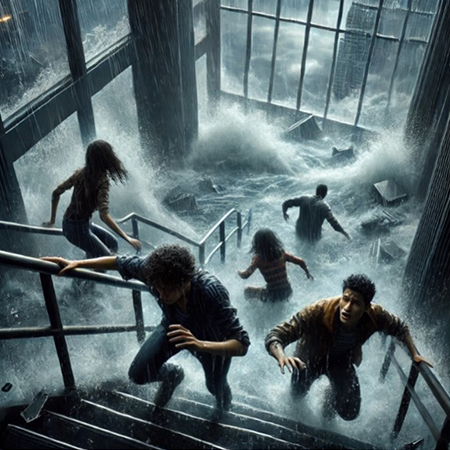
At the 50th floor, the pressure from the water below caused the stairwell door to blow off its hinges. The flood surged in, smashing into them with brutal force. Amara and Priya managed to hold onto the railing, but Dylan was swept away, his screams disappearing in the rushing water. Felix, too, was lost in the torrent, his hand slipping from Priya’s grasp as the flood dragged him under.
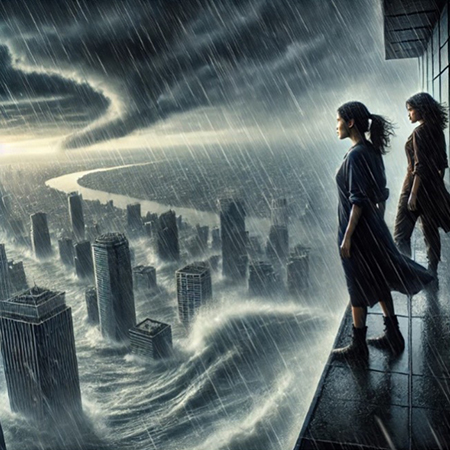
Gasping for breath, Amara and Priya stumbled onto the rooftop, the wind howling like a banshee around them. Below, the city was gone, submerged under a swirling, churning ocean. The skyscraper trembled beneath their feet, as if the very ground was rebelling against the sea.
As they stood there, drenched and shaking, the storm raged on. Amara stared at the endless expanse of water below, knowing they had escaped one terror, only to face another. The rooftop was no sanctuary, only a brief reprieve.
The ocean was coming for them all.
-
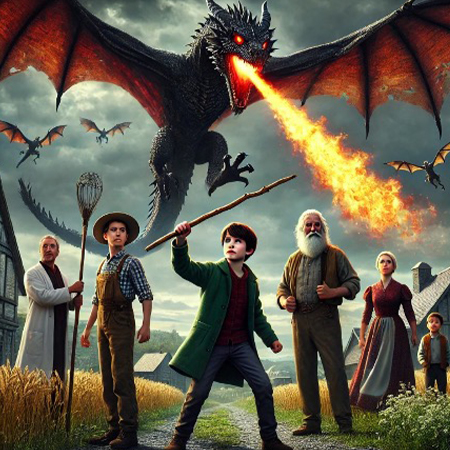
Once upon a time, in a land much like ours, there lived a monstrous creature named Climate Change. Towering above the tallest trees and stretching across the horizon, its body was a swirling mass of dark clouds, raging winds, and waves of heat. Climate Change breathed fire and storms, flooding villages and burning forests. It could make the air unbreathable and the crops wither with a mere glance. For years, the monster roamed free, growing bigger and stronger, destroying everything in its path.
In a small village, there lived a young boy named Sam. He was no older than ten but carried in his heart a bravery far beyond his years. Sam had seen what the monster had done to his world—the rivers drying up, the animals disappearing, and the sky turning dark and strange. One day, when Climate Change descended upon his village, Sam decided he had had enough.
With nothing but a wooden stick in hand, he stood at the edge of his town and faced the beast. “I won’t let you take any more from us!” Sam shouted. The monster’s eyes, burning like embers, turned toward him.
Climate Change roared, sending a gust of hot wind that nearly knocked Sam off his feet. The boy staggered but did not fall. He swung his stick at the giant beast, but it was like trying to chop down a mountain with a toothpick. The monster merely laughed, its voice shaking the earth. “You are but a child, and I am eternal,” the monster sneered, raising a fist of smoke and flame.
Each day, Sam returned to face the beast, determined not to let it conquer his home. But every time, Climate Change grew stronger, and Sam’s strength began to fade. He tried everything—yelling, fighting, pleading—but nothing seemed to work. Still, he wouldn’t give up.
One evening, just as Sam was about to lose hope, his friends from the village gathered around him. "You're not alone, Sam," said Maya, who had been planting trees in the forest to restore what the monster had destroyed. "We'll fight with you," said Amir, who had been working to build clean energy machines to harness the wind and sun. One by one, others joined, each offering a unique skill—a farmer who grew resilient crops, a teacher who educated children about protecting their world, and even a scientist who studied how to heal the land.
Together, they faced Climate Change once more. Sam, with his friends by his side, felt a new strength rise in him. They fought with unity, their collective power far greater than the monster had anticipated. The winds began to die down, the fires shrank, and the floods receded. The monster howled, its body shrinking, growing weaker with each blow they struck.
At last, Climate Change was no longer the towering giant it once was. Instead, it shriveled down to the size of three old, wrinkled men. These men bickered and mumbled, pointing fingers at one another, each one blaming the other for their downfall. Their power was gone, reduced to mere whispers of their former selves.
Sam and his friends looked at the men, who no longer seemed frightening or invincible. “Together,” Sam said, “we are stronger than any monster.”
And from that day forward, the people of the village, and many others, worked together to protect their world, ensuring that the monster of Climate Change never grew so powerful again.

-
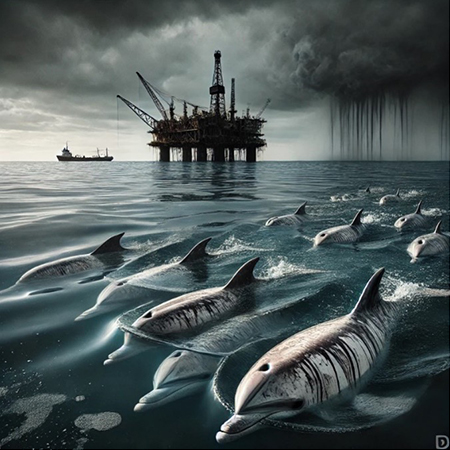
The water has been growing darker for years, the slick sheen of the oil thickening on the surface. I remember when the currents were clean, when our pod could swim freely without the burning sensation in our skin, or the taste of something wrong in the water. My name is Lira, and I am the leader of our pod, though I often question the honor of that title now. Leading is hard when you're guiding your family through poison.
The humans call it “progress,” but to us, it’s devastation. First, it was the rigs—metal giants that punctured the sea and spilled black death into our home. Our food has dwindled, and our young have grown weak. So, when our scouts returned from the south with news of a place untouched by this disaster, we knew we had to go. The news wasn’t all good though. There was another danger coming, one that might destroy even the beautiful waters of the far-off wind farm.
We’d heard of wind farms before. Humans using the air to power their lights, to run their machines, but from what the scouts said, this one didn’t seem to harm the sea. The water there was alive, clean, with no taste of oil or poison. The dolphins who lived in that area, the southern pod, thrived. They didn’t know how lucky they were. They didn’t know how fast things could change. But we did.
"We must warn them," I clicked to the others. "We can't let them live in ignorance, not when the same company is planning to drill there next."
So we began our journey, pushing through the heavy waters of our home, past the dying reefs and sick fish. The currents felt slower, but we didn’t stop. This wasn’t just for us. This was for all dolphins, for all life in the sea. The journey took days, but finally, we reached the southern waters.
The difference was staggering. The water was light and clear, the fish abundant. I could feel the energy in every stroke of my tail, the joy of life still thriving here. We found the southern pod quickly. They were curious, friendly, their skin unmarred by the stains of pollution.
"You’ve come from the north," their leader, Nara, greeted me. "We’ve heard rumors of your troubles. Is it true?"
"It is," I answered. "Worse than you can imagine. But there’s more. The same humans are planning to drill here. Your home could become like ours."
Her eyes widened, fear rippling through the pod. "But what can we do? The humans don't listen."
"They will," I clicked back, more hopeful than I felt. "They have to."
And then an idea came to me, a wild thought, but one that made sense. The humans used machines to find oil. What if we used their machines to stop them? There were humans nearby—researchers, those who studied the wind farms. They weren’t like the ones who drilled. They were different, curious about us, wanting to protect the sea.
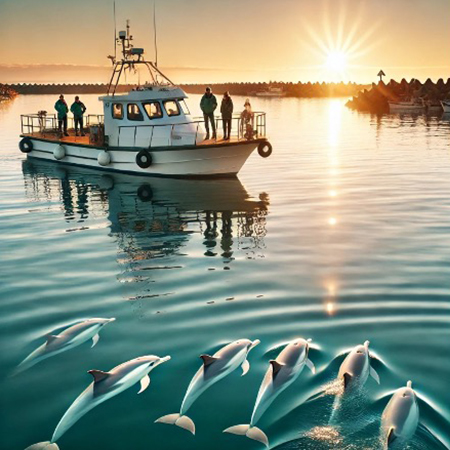
That night, we swam to the research ship, surrounding it, singing loudly in unison, our clicks and whistles carried through the water. At first, they didn’t understand, but then, something shifted. One of the researchers sent down a recording device, and we guided them to the area where the new drilling was planned. They began to understand.
A few weeks later, the drilling plan was halted. The humans found something else in the area—something rare and valuable to them but fragile, something they couldn't risk disturbing. They called it an environmental victory.
For us, it was survival.
As we swam back to our poisoned home, I felt a spark of hope. Maybe, just maybe, we could heal. If we could get the humans to listen once, we could do it again. And maybe one day, the sea would be clean again for all of us.