
Sports as a communications platform for environmental issues
Funded by the Australian Research Council, this project explores sport as a communications platform for environmental issues and sustainability.
Sport’s immense popularity, visibility and reach affords it a potentially game-changing ability to communicate environmental issues to mass audiences. This is the first project of its kind to investigate media sport as a ‘platform’ for environmental communication. It investigates in-depth the range of environmental messages communicated by media sport, and how these messages reflect and negotiate the dilemma of promoting environmental awareness through popular events and activities that also generate their own significant ecological footprints.
Research team
This research has examined how sport media communicates environmental and sustainability messages – and how it balances raising awareness with the reality that sporting events often carry significant ecological impacts.
We have worked with sport media professionals, environmental advocates, policymakers and journalists to deliver new insights into how environmental issues are framed and understood through one of Australia’s most powerful cultural platforms: sport.
Why sport media?
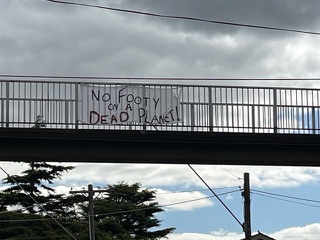
Sport occupies a unique position in public life. Major events like the Australian Open or AFL Grand Final attract mass audiences and are increasingly used to showcase environmental responsibility. At the same time, sport is resource-intensive – involving travel, infrastructure, energy use and waste. This creates tensions in how environmental claims are made and received.
What we have done
- analysed the environmental and sustainability messages promoted across a wide range of sports
- investigated the strategies, values and dilemmas that underpin these messages
- provided case studies and commentaries to inform industry practice, policymaking and public debate.
Impact
The project will strengthen Australia’s capacity to communicate effectively about environmental change by:
- identifying how sport media can foster greater environmental awareness
- supporting industry and government to develop credible, impactful sustainability communication contributing internationally to media, communications and sport research on the relationship between culture, industry and nature.
Case studies
-
London, Liverpool, Wolverhampton, United Kingdom, March 2022
In mid-March, protesters from Just Stop Oil interrupted four matches in the English Premier League:
- Arsenal vs. Liverpool at Emirates Stadium, London
- Everton vs. Newcastle at Goodison Park, Liverpool
- Wolverhampton vs. Leeds at Molineux Stadium, Wolverhampton
- Tottenham vs. West Ham at Tottenham Hotspur Stadium, London
In each instance, protesters invaded the pitch during play and attempted to attach themselves to goalposts, wearing T-shirts emblazoned with their concise message. Most matches were delayed as security removed the protesters. In videos later uploaded to YouTube, the activists – all young people – identify themselves and offer testimony explaining their actions.
Just Stop Oil and Contemporary Climate Protest
As one of many relatively new protest groups, Just Stop Oil is part of an environmental movement committed to highly disruptive nonviolent civil disobedience tactics including to convey their message. While many of these groups operate in similar ways, and some of them have also targeted sports events, the frequency of Just Stop Oil’s protests since early 2022 and the media attention they have garnered has seen them become the most prominent. The group is opposed to fossil fuel licensing and production in The United Kingdom, and is funded entirely through donations. A prominent funder and defender is Dale Vince, founder of green energy company Ecotricity and chairman of Forest Green Rovers FC, who play in the EFL League Two.
Just Stop Oil emerged as an offshoot of Extinction Rebellion, a larger, international coalition of climate action groups originating in the UK. Extinction Rebellion founder Roger Hallam describes the logic behind “civil resistance model” of protest, and the rationale for disrupting high profile events by positing that “Conventional campaigning has failed to bring about the necessary change” and despite decades of donating to NGOs and “going on A-to-B marches” emissions have increased for the last thirty years. In this context, he argues, breaking the law becomes necessary because it “creates the social tension and the public drama which are vital to create change.” Just Stop Oil’s civil disobedience is aimed toward disrupting business as usual, and has frequently been directed toward cultural institutions. Activists have recieved media attention after staging roadblocks and gluing themselves to famous paintings. However they have also targeted oil and gas infrastructure, and in the weeks after the EPL many activists were arrested after blockading English oil terminals.
Just Stop Oil’s EPL protests were hugely influential. Prior to March 2022, disruptive climate protests at sports events were few and far between, but in the months following as Just Stop Oil continued, also protesting at the British Grand Prix, other likeminded groups across the world began emulating their tactics. Some examples:
- A French group named Dernière Rénovation, who demand energy-efficient building renovations, disrupted the Tour de France and the French Open.
- A protestor from a group named End UK Private Jets interrupted a Laver Cup match between Stefanos Tsitsipas and Diego Schwartzman and set himself on fire.
- In Australia a protestor from Fireproof, a group demanding government action to counteract fire risks ecacerbated by climate change, invaded the pitch with a flare at a National Rugby League game between the Cronulla Sharks and Wests Tigers.
Why the EPL?
It is a straightforward conclusion that EPL matches were targeted for disruption because football is immensely popular, football matches are culturally prominent, and thus guarantee a media audience. During court proceedings following Just Stop Oil’s EPL pitch invasions a protestor told the court “We came up with the idea of how do we get the most eyes on that name, Just Stop Oil, and of course, in this day and age, football is the biggest cultural phenomenon there is.”
But fossil fuels are deeply embedded in the regular operations of the EPL (and of European football generally) and, following Just Stop Oil’s stated goals, this too makes it a worthy target for activists. It could even be said that football, via sponsorship arrangements, is as vital a part of the fossil fuel industry’s infrastructure as any industrial facility. Research from The Athletic indicates that sixteen of the twenty-five largest fossil fuels companies in the world “have been actively involved in the sponsorship or ownership of football clubs and competitions within the past two years” leading up to 2022 and, beyond this, multiple Premier League clubs “boast sponsors which contribute significantly to global emissions, including airlines, fossil-fuel funding banks, and cryptocurrency companies.” Another significant fossil fuels issue facing football (and especially the Premier League) is the sport’s outsized carbon emissions from travel, including from frequent short-distance flights within the United Kingdom.
-
London, United Kingdom, September 2022
During an international test cricket match between England and India at Lord’s Cricket Ground in London a banner is unfurled in the stands that reads “Bruce: Fossil Fuels are just not cricket.” The group behind the banner is Mothers Rise Up, and their message is directed to Bruce Carnegie-Brown, Chairperson of Lord’s-based Marylebone Cricket Club and also Chairperson of Lloyd’s of London, an insurance market that underwrites the fossil fuels industry. This action was part of a weekend of cricket themed protests, organised by Mothers Rise Up, that also included staging a cricket match outside of Lloyd’s headquarters.
Mothers Rise Up Targeting Cricket
Originating in 2018, Mothers Rise Up an important counterpoint to Just Stop Oil and reflects a different strain of contemporary climate protest. All of Mothers Rise Up’s protest actions are imbued with a sense of playfulness or fun, and while they have protested at top tier sports events other actions have utilised the game in ways more aligned with recreational sport or sport as a communal pastime. Cricket has been a focus for the group since late 2021 as they have campaigned consistenly for Lloyd’s to stop underwriting fossil fuels, and their protests help to demonstrate how cricket is a crucial sport for climate change and related environmental issues.
Fun and creativity are important aspects of contemporary climate activism. Outlining Extinction Rebellion’s civil resistance model, Hallam clarifies “it has to be fun ... The artistic communities need to be on board: it’s a festival” Most Mothers Rise Up protests targetting Lloyd’s and Bruce Carnegie-Brown have included artistic elements, for example a flash mob recreating a scene from Mary Poppins, and creating an advent calendar with cricket-themed dioramas featured in a social media campaign addressed directly toward Carnegie-Brown.
- Xeena Cooper/XR Cricket Club?
Targetting Lloyd’s, in concert with other groups and campaigns including Extinction Rebellion, has overwhelmingly been successful for Mothers Rise Up. Though Lloyd’s has been has been significantly slower than other insurers in withdrawing cover for fossil fuels, in July this year reporting in the Sydney Morning Herald credited sustained “pressure from environmental campaigners” as a reason for Lloyd’s withdrawing from Adani’s Carmichael coal mine in Queensland, Australia.
Cricket and Climate
Cricket has also been a notable focal point for similar anti-fossil fuels protests elsewhere in recent years. In 2020 Greenpeace protestors dressed as movie superheroes invaded the field and climbed a floodlight pylon to unfurl a banner during an international match in South Africa. Their protest was directed toward South Africa’s national electricity supplier. The same year in Australia protestors from the group Stop Adani, which opposes coal mining by Indian company The Adani Group in Australia, campaigned on the opening day of a match between Australia and India. Some protestors invaded the field at the Sydney Cricket Ground while across Australian cities others gathered to stage theatrical matches.
Cricket is a crucial sport at the intersection of sport and environment for a number of reasons, exemplifying many of the environmental issues faced across the sporting world. It is uniquely vulnerable to the effects of climate change, being played outside and in parts of the world that are exposed to environmental extremes such as cyclones, flooding, and extreme heat: Australia, India, and the Caribbean. This vulnerability extends to professional athletes: for example, in 2018 England test captain Joe Root was hospitalised, suffering illness after playing in record-breaking Sydney heat.
Within cricket, various people have both highlighted the effects of climate change and worked to mitigate them, and this has presented problems where fossil fuels are sponsors for the sport. Tanya Aldred, a sports reporter for over twenty years, has consistently covered cricket’s climate issues for several years. Cricketing great Shane Warne, reacting to a report by The British Association for Sustainable Sport (BASIS) has urged cricket to be “proactive, not reactive” in addressing climate change.
As a current elite professional cricketer and captain of Australia’s test cricket team, Pat Cummins has been outspoken about climate change. Via an advocacy organisation Cricket for Climate, he has enlisted other cricketers to advocate for climate action and launched an initiative to install solar panels at Australian community cricket clubs. However, this has led to percieved tension with Cricket Australia’s major sponsor Alinta Energy, an electricity and gas retailing company. Late last year Cummins declined to appear in promotional material for the company and it was widely reported that this “soured” the partnership and contributed to Alinta withdrawing sponsorship. All of this serves to illustrate that fossil fuels’ place in cricket is rapidly becoming untenable.
-
Sydney, Australia, October 2022
During the National Rugby League (NRL) Grand Final in Sydney’s Olympic Stadium a climate protestor invades the pitch and, demonstrating unusual athleticism, evades security for some time, even ripping down padding from a goalpost. He is later identified as former NRL player Mark McLinden. McLinden had a bike lock around his neck and was attempting to emulate the actions of the Just Stop Oil EPL protestors from earlier in the year. Though McLinden hasn’t claimed affiliation with any organisation, he wore a t-shirt that read “END COAL GAS & OIL FOR OUR KIDS” and featured an Extinction Rebellion symbol.
Prior to this protest McLinden had cultivated an active social media presence as an activist, including creating music videos, designed to become viral, that engage directly with environmental issues and climate politics.
Athletes Speaking Out
McLinden is one of many current and former professional athletes, including Cummins, using their profile and platform to engage with climate change and environmental issues, including speaking out against the continued use of fossil fuels. This is undoubtedly part of a widespread global phenomena, and a 2021 Neilson report identified the continued rise of athletes as influencers as a major trend, but Australian athletes in particular lead the way in addressing environmental issues.
This is in no small part due to the work of former professional Rugby Union player David Pocock, who in 2014 (during his playing career) joined an anti-coal campaign in New South Wales and locked himself to mining equipment. Nearly a decade later, Pocock has co-founded FrontRunners, an organisation that supports athletes and sporting organisations to engage and advocate on climate and environmental issues, and also been elected as an independent senator in Australia’s Federal Parliament after campaigning on progressive climate action.
Following his protest McLinden described Pocock as “inspiring” and reflected on the way that politics and protest offered different, but aligned, ways of addressing the climate crisis. Frontrunners, co-founded by Pocock and his wife Emma, who has a wealth of experience working on political campaigns, as a researcher, and in policy and communications, is one of several similar organisations globally pioneering ways to help athletes embrace sport’s capacity for advocacy and social responsibility by campaigning on climate issues, having organised and supported multiple campaigns in Australia since 2020. Beyond Australia, EcoAthletes is a US-based group with a similar remit. Endorsing the organisation, Climatologist Dr Michael Mann states that EcoAthletes “can play an important role in elevating awareness of the climate crisis among millions of fans, ultimately influencing those fans to demand positive climate action”. Though these organisations and the athletes they represent are not necessarily activists, and may not vocally support disruptive climate protests, their climate action goals are similar. As they speak out and build momentum, they create significant issues and reveal obvious tensions where fossil fuels companies are invested in sporting organisations.
-
Adelaide, Australia, January 2023
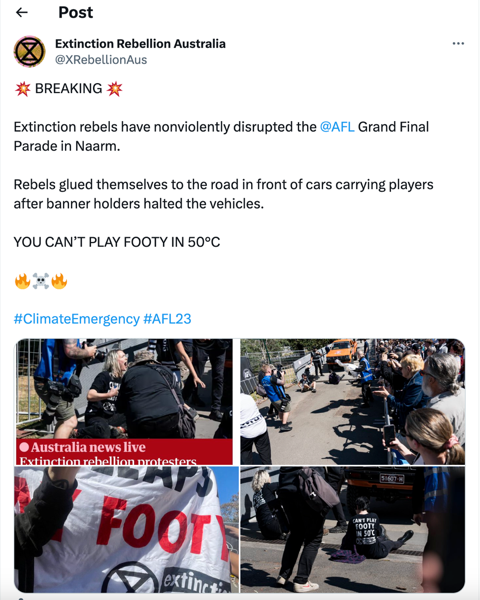
Throughout the entire week-long duration of the Santos Tour Down Under in Adelaide, South Australia, Extinction Rebellion protestors carry out a series of actions that, while not interrupting the procession of the race itself, create an adjacent spectacle that nevertheless undermines the race and its sponsor. Their actions are all explicitly directed toward the naming rights sponsorship of Santos, an Australian oil and gas company headquartered in Adelaide, and their main goal is apparent in the slogan they adopt: ‘Dump Santos.’
Evolving Approaches to Protest
At the beginning of 2023, Extinction Rebellion activists in the UK announced they would cease disruptive protests. However related groups, including Just Stop Oil, have continued with disruptive protests, and their tactics have also evolved: rather than locking themselves to goalposts, protestors are throwing orange powder, paint, and confetti. In Australia Extinction Rebellion planned to increase their activities, and the Santos Tour Down Under was their first sports target.
The Santos Tour Down Under, unlike other high profile cycling stage races, is based in Adelaide for its entire duration, and the centre of Adelaide is transformed into the ‘Tour Village’ with a festival-like atmosphere including regular entertainment and events. Protestors’ actions during and around the race included:
- Gathering outside Santos’s headquarters in the Adalaide CBD multiple times, gluing themselves to a pile of bicycles and vandalising the building with black paint.
- ‘Gatecrashing’ the Tour Village en masse during the teams presentation wearing ‘Dump Santos’ banners
- Standing roadside during the race with placards and exposing themselves to the race caravan and cameras.
These actions represent an evolution of the tactics highlighted above used in 2022 by both Just Stop Oil and Mothers Rise Up. While not disrupting the race itself, they interrupt the ongoing business of both Santos and the Tour’s civic setting in central Adelaide. They incorporate clear messaging and performative, playful aspects. Most of the activists, contrasting with Just Stop Oil, are older (many above retirement age), and this attests to an intergenerational climate movement.
As the opening event of the global, top-tier cycling calendar the race attracts significant international attention, particularly from cycling-specific media. While local reporting focussed on the criminality of protestors’ actions, international cycling media reflected more broadly on the sport’s climate impacts, including highlighting a lack of environmental concern at the top levels of the sport, where teams are named for sponsors on whom they are heavily dependent.
Dumping sponsorship
Broad campaigning against Santos has been successful in driving public awareness of, and resistance to, the company’s attempts to use sponsorship to purchase social licence. During 2022 multiple organisations – Tennis Australia, Macquarie University, and Darwin Festival – ceased sponsorship arrangements with Santos due to campaigning and initiatives from groups opposed to the company using sponsorships to launder its public image. Santos, however, continues to be a major sports sponsor, and in late 2021 established a “long-term partnership” swith Rugby Australia that sees its logo on the jerseys of Australia’s national rugby union team the Wallabies.
-
B. Hutchins, L. Lester & T. Miller (eds.) (forthcoming 2026) Sport and the Environment: Communication, Culture and Politics in the Age of Climate Crisis. London: Routledge.
L. Lester, J. Mikosza & B. Hutchins (forthcoming 2026) Sport and Social Licence: Community Sport, Corporate Media and Environmental Risk. In B. Hutchins, L. Lester & T. Miller (eds.) Sport and the Environment: Communication, Culture and Politics in the Age of Climate Crisis. London: Routledge.
Just Stop Oil, Just Stop Oil disrupt Arsenal vs Liverpool Match | Emirates Stadium, London | 16 March 2022. https://www.youtube.com/watch?v=_Pwanzpgg40&ab_channel=JustStopOil.Just Stop Oil. Just Stop Oil disrupt Everton vs Newcastle | Goodison Park, Liverpool | 17 March 2022. https://www.youtube.com/watch?v=H5-1vb86cFo&ab_channel=JustStopOil.
Just Stop Oil. Just Stop Oil disrupt Wolves vs Leeds football game | Molineux Stadium | 18 March 2022. https://www.youtube.com/watch?v=bIKj9Ka8v1U&t=2s&ab_channel=JustStopOil.
Just Stop Oil. Just Stop Oil disrupt Spurs vs West Ham football game | North London | 20 March 2022. https://www.youtube.com/watch?v=HRYCoraleGI&ab_channel=JustStopOil.
Just Stop Oil. “About Just Stop Oil” https://juststopoil.org/faqs/.
Vince, Dale. “Wind energy, electric cars, Just Stop Oil and green gas: Why I will always stand up for what I believe in” Independent 1 August 2022. https://www.independent.co.uk/climate-change/opinion/dale-vince-ecotrocity-green-gas-b2135543.html.
Hallam, Roger. “The Civil Resistance Model” This is Not a Drill: An Extinction Rebellion Handbook edited by Clare Farrell, Alison Green, Sam Knights & William Skeaping. Penguin Books, 2019.
Gayle, Damien. “‘It was terrifying’: Stop Oil activists on the new battle against fossil fuel” The Guardian 15 October 2022. https://www.theguardian.com/environment/2022/oct/15/it-was-terrifying-stop-oil-activists-on-the-new-battle-against-fossil-fuel.
Hurynag, Ashna. “Just Stop Oil: More than 200 arrests as climate activists disrupt key terminals for third day” Sky News https://news.sky.com/story/just-stop-oil-more-than-200-arrests-as-climate-activists-disrupt-key-terminals-for-third-day-12581384.
BBC News. “British Grand Prix: Six charged after F1 Silverstone track invasion” 5 July 2022. https://www.bbc.com/news/uk-england-northamptonshire-62050697.
Whittle, Jeremy. “Tour de France officials drag protesters off the road during chaotic stage 10” The Guardian 13 July 2022. https://www.theguardian.com/sport/2022/jul/12/protests-disrupt-tour-de-france-stage-10-pogacar-covid-cort-nielsen.
Garric, Audrey. “'Dernière Renovation,' the climate activists who disrupted the French Open” Le Monde 12 June 2022. https://www.lemonde.fr/en/environment/article/2022/06/12/derniere-renovation-the-climate-activists-who-disrupted-the-french-open_5986533_114.html.
Carayol, Tumaimi. “Protester sets fire to his arm during Laver Cup opening session” The Guardian 24 September 2022. https://www.theguardian.com/sport/2022/sep/23/protestor-sets-fire-to-his-arm-during-laver-cup-opening-session.
Farid, Farid. “Enviro protester with flare stops NRL game” The Canberra Times 10 April 2022. https://www.canberratimes.com.au/story/7694414/enviro-protester-with-flare-stops-nrl-game/.
Nicholson, Abigail. “Everton FC pitch invader who tied his neck to goal handed fine” Liverpool Echo 30 September 2022. https://www.liverpoolecho.co.uk/news/liverpool-news/everton-fc-pitch-invader-who-25151032.
Whitehead, Jacob. “Fossil fuels and football – how deep are the links?” The Athletic 6 November 2022. https://theathletic.com/3747199/2022/11/06/football-fossil-fuels/.
Lockwood, David. “Premier League domestic flights: BBC Sport research shows 81 flights from 100 games” BBC Sport 23 March 2023. https://www.bbc.com/sport/football/65017565.
Mothers Rise Up. “What we do” https://www.mothersriseup.org/what-we-do.
Hallam, Roger. “The Civil Resistance Model” This is Not a Drill: An Extinction Rebellion Handbook edited by Clare Farrell, Alison Green, Sam Knights & William Skeaping. Penguin Books, 2019.
Mothers Rise Up. Mary Poppins climate action #flashmob outside Lloyd's of London. YouTube. https://www.youtube.com/watch?v=3CH5n_jsRVY&ab_channel=MothersRiseUp.
Mothers Rise Up. https://twitter.com/mothersriseup/status/1466717232176771072.
Smith, Ian. “Lloyd’s of London shuts headquarters after fossil fuel protest” Financial Times 12 April 2022. https://www.ft.com/content/ee7cdb7c-43cd-497e-9786-cfd5f2eeac7d.
Kollewe, Julia. “Coal power becoming 'uninsurable' as firms refuse cover” The Guardian 2 December 2019.
Johanson, Simon. “Insurer walks away from Adani’s Carmichael coal mine” Sydney Morning Herald 9 July 2023. https://www.smh.com.au/business/companies/insurer-walks-away-from-adani-s-carmichael-coal-mine-20230707-p5dmli.html.
AP. “Wonder Woman interrupts SA cricket game in climate protest” 17 February 2020. https://apnews.com/article/d2e7421380df33df4ca348212119673b.
Agarwal, Kabit. “When 'Stop Adani' Protests Reached the Sydney Cricket Ground” The Wire 28 November 2020. https://thewire.in/environment/when-stop-adani-protests-reached-the-sydney-cricket-ground.
Stop Adani. “Stop Adani cricket protests call on State Bank of India to bowl out Adani’s $1 Billion loan on first day of cricket tour” 2 December 2020. https://www.stopadani.com/state_bank_of_india_bowl_out_1bn_adani_loan.
Hutchins, Brett, Simon Troon, Toby Miller and Libby Lester. “Envisioning a green modernity? The future of cricket in an age of climate crisis” Sport in Society, 2023. https://doi.org/10.1080/17430437.2023.2190516.
Australian Associated Press. “England captain Joe Root retires hurt after hospitalisation for dehydration” The Guardian 8 January 2018. https://www.theguardian.com/sport/2018/jan/08/root-in-hospital-with-dehydration-and-in-doubt-to-resume-batting.
Alred, Tanya. “Shane Warne urges cricket to be proactive about climate crisis dangers” The Guardian 13 September 2019.
Australian Cricketers’ Association. “Australian cricketers launch initiative to get solar on club roofs” 3 February 2022. https://auscricket.com.au/news/australian-cricketers-launch-initiative-to-get-solar-on-club-roofs/.
Hutchins, Brett. “Time for a reckoning: Cricket Australia, fossil fuel sponsorship and climate change” The Conversation 10 February 2022. https://theconversation.com/time-for-a-reckoning-cricket-australia-fossil-fuel-sponsorship-and-climate-change-176707
Mahony, Jack. “Alinta Energy's major sponsorship deal with Cricket Australia ends after Pat Cummins storm over 'ethical objections'” Sky News 17 July 2023. https://www.skynews.com.au/australia-news/sport/alinta-energys-major-sponsorship-deal-with-cricket-australia-ends-after-pat-cummins-storm-over-ethical-objections/news-story/a49caa067bd84dad33b35bcda50b84ca.
Chammas, Michael. “‘My plan was thwarted’: Raiders star wanted to bring grand final to a halt” The Sydney Morning Herald 4 October 2022. https://www.smh.com.au/sport/nrl/my-plan-was-thwarted-raiders-star-wanted-to-bring-grand-final-to-a-halt-20221004-p5bn3n.html.
https://www.youtube.com/@gentleearthling3331.
Neilson Sports. The Changing Value of Sponsorship: 2021 Global Sports Marketing Trends. https://www.nielsen.com/insights/2021/the-changing-value-of-sponsorship-2021-sports-marketing-trends/.
Troon, Simon R. Hutchins, Brett. Contesting the climate breakdown: athlete activism, documentary and the environmentalism of Australia's David Pocock https://journals.sagepub.com/doi/full/10.1177/1329878X251358525
“Climate action” https://www.davidpocock.com.au/acting_on_climate.
Polkinghorne, David. “'He's inspiring', but McLinden insists he's not the next Pocock” The Canberra Times 9 October 2022. https://infoweb-newsbank-com.ap1.proxy.openathens.net/apps/news/openurl?ctx_ver=z39.88-2004&rft_id=info%3Asid/infoweb-newsbank-com.ap1.proxy.openathens.net&svc_dat=AWNB&req_dat=102D23E2B9847C9F&rft_val_format=info%3Aofi/fmt%3Akev%3Amtx%3Actx&rft_dat=document_id%3Anews%252F18D07615B3A73C70.
Frontrunners. “About Us” https://www.frontrunners.org.au/about-us.
EcoAthletes. https://www.ecoathletes.org/.
Orr M (2024) Warming up: How climate change is changing sport. London: Bloomsbury Academic.
Booth, Robert. “Extinction Rebellion announces move away from disruptive tactics” The Guardian 2 January 2023.
O’Malley, Nick. “Extinction Rebellion’s next protest target revealed after UK members ‘quit’” The Sydney Morning Herald 10 January 2023. https://www.smh.com.au/environment/climate-change/extinction-rebellion-s-next-protest-target-revealed-after-uk-members-quit-20230109-p5cb7u.html.
Santos Tour Down Under. “Tour Village” https://tourdownunder.com.au/festival/tour-village.
ABC News “Women arrested after protest against Santos sponsoring Tour Down Under cycling race” 12 January 2023. https://www.abc.net.au/news/2023-01-12/protest-against-santos-sponsoring-tour-down-under/101850098.
McMillan, Isabel. “Extinction Rebellion ‘rebels’ vandalise and glue themselves to Santos building” News.com.au 22 January 2023. https://www.news.com.au/sport/cycling/extinction-rebellion-rebels-vandalise-and-glue-themselves-to-santos-building/news-story/4cdb9369cb44613ec92f2a4ef9ae9014.
Extinction Rebellion Australia. https://twitter.com/XRebellionAus/status/1614457099953795072.
Portus, Stan. “Extinction Rebellion’s Tour Down Under protests should be a wake-up call for cycling” bikeradar 21 January 2023.
Kurmelovs, Royce. “Tennis Australia ends partnership with Santos after one year” The Guardian 23 January 2022.
Readfern, Graham. “University drops Santos branding of kids’ science roadshow after climate concerns raised” The Guardian 16 September 2022.
Burke, Kelly. “Santos to end Darwin festival sponsorship as anti-fossil fuel backers emerge” The Guardian 19 October 2022.
Rugby Australia. “Rugby Australia extends relationship with Santos as Wallabies major partner” 20 October 2021. https://wallabies.rugby/news/rugby-australia-extends-relationship-with-santos-as-wallabies-major-partner-20211020.
Read more
-
- Op-ed: Just stopping oil? The rise of climate protests at sporting events
- S. Troon & B. Hutchins (2025), ‘Contesting the Climate Breakdown: Athlete Activism, Documentary and the Environmentalism of Australia’s David Pocock’, Media International Australia, pp. 1-16. https://doi.org/10.1177/1329878X251358525
- B. Glasson & B. Hutchins (2024) ‘“Carbon Partners” and Collaborative Greenwashing: The Sustainability Partnership Between Dow Chemical and the Olympic Games’, Journal of Sport and Social Issues, 48 (5): 271-89.
- T. Miller (2024) ‘The five groups of environmental sports activists, a complex medley’, Routledge Handbook of Sport, Leisure, and Social Justice. New York: Routledge, 471-87.
- B. Hutchins, S. Troon, L. Lester & T. Miller (2023) ‘Envisioning a Green Modernity? The Future of Cricket in an Age of Climate Crisis’, Sport in Society, 26 (10): 1723-37.
- B. Hutchins, L. Lester, R. Maxwell, T. Miller & W. Monaghan (2023) ‘Quick and Slow Violence: The Age of Billionaire Biodiversity’, in P. Smith, A. Monea & M. Santiago (eds.) Amazon: At the Intersection of Culture and Capital. Lanham, MD: Rowman & Littlefield, 247-68.
- T. Miller, B. Hutchins, L. Lester & R. Maxwell (2023) ‘Formula One and the Insanity of Car-Based Transportation’, in D. Sturm, D.L. Andrews & S. Wagg (eds.) The History and Politics of Motor Racing: Lives in the Fast Lane. Cham, Switzerland: Palgrave Macmillan, 733-60.
- B. Hutchins, D. Rowe & A. Ruddock (2022) ‘The Commodification and Mediatization of Fandom: Creating Executive Fandom’, in D.S. Coombs & A. Osmond (eds.) Routledge Handbook for Sport Fans and Fandom. New York: Routledge, 365-76.
- B. Hutchins, L. Lester & T. Miller (2021) ‘Greening Media Sport: Sport and the Communication of Environmental Issues’, in M. Butterworth (ed.) Communication and Sport. Berlin: De Gruyter Mouton, 369-86.
- Glasson, B. (2024). ‘Reality offsets: Climate meets capitalism at the Olympic Games’. European Journal of Cultural Studies, 28(1), 137-155. https://doi.org/10.1177/13675494231224398
- Glasson, B. (2022). ‘Environmental myth-work: the discursive greening of the Olympic Games. Communication and Critical/Cultural Studies’, 19(3), 217–234. https://doi.org/10.1080/14791420.2022.2095412
-
- The Media Sport Podcast Series with Brett Hutchins, School of Media, Film and Journalism, Monash University
-
- Series of articles on Climate Change and Sport for Play the Game (Denmark):
- B. Hutchins (2024) ‘Creating a Liveable Future through Climate Leadership. Environmental Justice and Citizen Science’, Play the Game, 17 April.
- L. Lester (2024) ‘Sport and Climate Change: How Resource Industries Use Community Sport for their Social Licence to Operate’, Play the Game, 9 January.
- R. Olive (2023) ‘Swimmers and Surfers Emerge from Murky Waters to Campaign for Rivers and Oceans’, Play the Game, 12 December.
- S. Troon (2023) ‘Just Stopping Oil? The Rise of Climate Protests at Sporting Events’, Play the Game, 29 November.
- B. Hutchins (2022) ‘Netball Australia and Hancock Prospecting Sponsorship Saga: Powerbrokers, Not Players, Are to Blame’, Lens, 26 October.
- B. Hutchins (2022) ‘Time for a Reckoning: Cricket Australia, Fossil Fuel Sponsorship and Climate Change’, The Conversation, 10 February.
- B. Hutchins & B. Glasson (2021) ‘A Green Olympic Legacy for Future Generations?’ in D. Jackson, A. Bernstein, M. Butterworth, Y. Cho, D.S. Coombs, M. Devlin & C. Onwumechili (eds.) Olympic and Paralympics Analysis 2020: Mega Events, Media, and the Politics of Sport, International Communication Association (ICA) Sports Communication Special Interest Group and International Association for Media and Communication Research (IAMCR) Communication and Sport Section.
- B. Hutchins, L. Lester & M. Ambrose (2020) ‘Fewer Flights and a Pesticide-Free Pitch? Here’s How Australia’s Football Codes Can Cut Their Carbon Bootprint’, The Conversation, 20 October.
- B. Hutchins & L. Lester (2018) ‘Some Questions for Simon Birmingham, from Two Researchers Whose ARC Grant was Quashed’, The Conversation, 29 October. (Republished by the Times Higher Education.)