
Research
Our research sits at the intersection of cognitive neuroscience, systems neuroscience, and clinical translation. We study how the brain supports attention, cognitive control and decision-making in health and clinical conditions.
A central goal of the lab is to bridge levels of analysis, from neural circuits to behaviour, using common theoretical frameworks. We take a multi-level approach that integrates behaviour, neural signals, and computational models across both human and animal systems.
We combine behavioural paradigms, electrophysiology (EEG), pupillometry, brain stimulation, and neuroimaging with computational modelling to understand how the brain selects relevant sensory inputs, accumulates evidence and controls and guides action. Our systems neuroscience approach to cognition is informed by studies of genetics and pharmacology as well as work in rodents and non-human primates. Complementary work in humans and animals provides insights into the drivers of individual differences in cognition, on the one hand, and causal investigation of underlying neural circuits using optogenetics, miniscope imaging, and electrophysiology, on the other. Together, these approaches bridge scales from neural circuits to behaviour.
Our work is informed by our longstanding research into neurodevelopmental conditions, particularly ADHD and autism, across children, youth and adults. Here, we study the genetic and neurochemical drivers of alterations in brain dynamics underpinning differences in attention, cognitive control, and decision-making. Our basic and translational studies work in concert with insights from one, informing the other. We value and actively encourage the involvement of those with lived experience of neurodevelopmental conditions in helping us to achieve our research vision.
Our research would not be possible without the generous support of the Australian Research Council (ARC), the National Health and Medical Research Council (NHMRC) and the Medical Research Future Fund (MRFF).
-
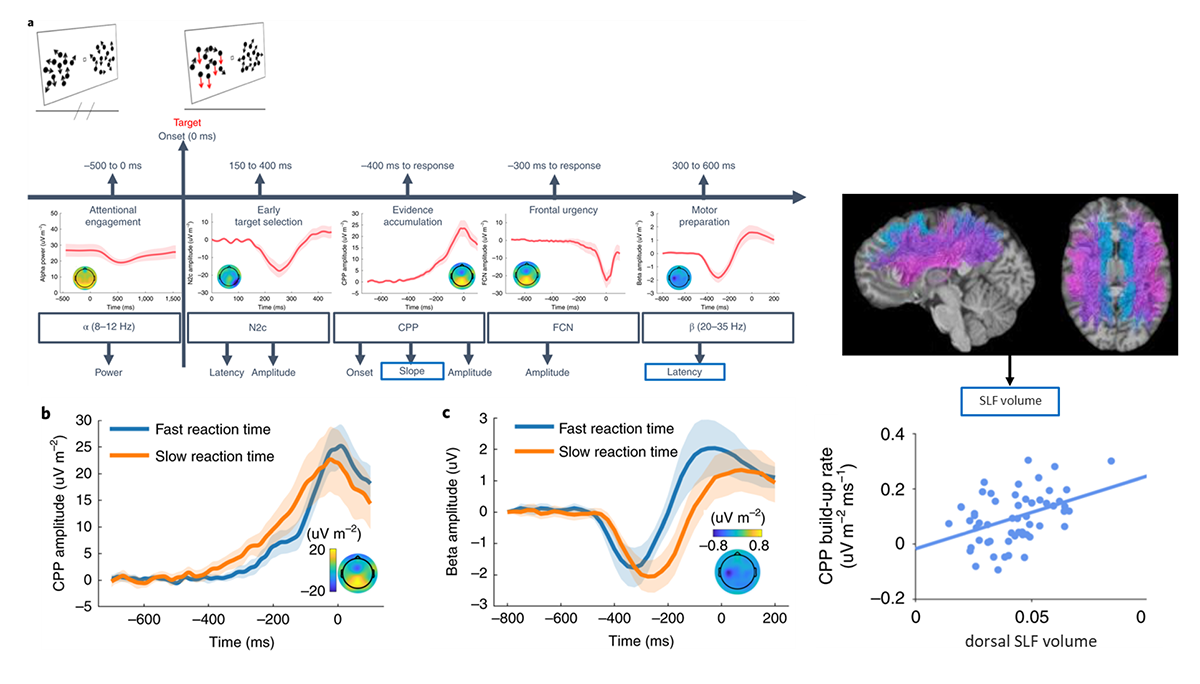
Figure 1: The combined perceptual decision-making- EEG framework isolating neurophysiological processes contributing to the speed of perceptual reports during the random-dot motion task, and the relationship between evidence accumulation and white matter organization of the dorsal SLF (Brosnan et al, 2020, Nat. Hum. Behav.).
Attention, Cognitive Control and Decision-Making
A core theme of the lab is understanding how the brain attends to and accumulates sensory information to guide decisions, as well as the neural processes that govern the ability to break or inhibit unwanted actions (cognitive control).
Using carefully controlled behavioural paradigms, we examine how individuals attend to and integrate evidence over time and how this process varies across genomes, contexts, and populations. We use targeted pharmacological interventions and computational modelling to understand the mechanisms that support these processes.
Neurophysiologically, we investigate how these computations are implemented in the brain using EEG, pupillometry and neuroimaging. Recent work has identified neural signatures of evidence accumulation and linked them to variability in behaviour.
This line of research provides a mechanistic framework for understanding variability in cognition, moving beyond descriptive behavioural measures.
Attention, Cognitive Control and Decision-Making in ADHD and Autism
A major focus of the lab is understanding cognitive function in neurodevelopmental conditions, particularly ADHD and autism.
We examine how differences in attentional allocation, cognitive control, and decision-making emerge from alterations in brain dynamics. Using EEG, we study neural variability, oscillatory activity, and event-related responses associated with attentional processes.
Our work aims to identify neurocognitive markers that explain behavioural symptoms and heterogeneity within these conditions. We interpret these differences within computational frameworks that can link behavioural variability to neural dynamics.
Importantly, this research has direct clinical relevance and informs psychoeducation of the brain bases of neurodevelopmental conditions. We have also contributed to national ADHD clinical guidelines [Australian Evidence-Based Clinical Practice Guideline for ADHD from aadpa], reflecting the lab’s commitment to translating neuroscience into practice.
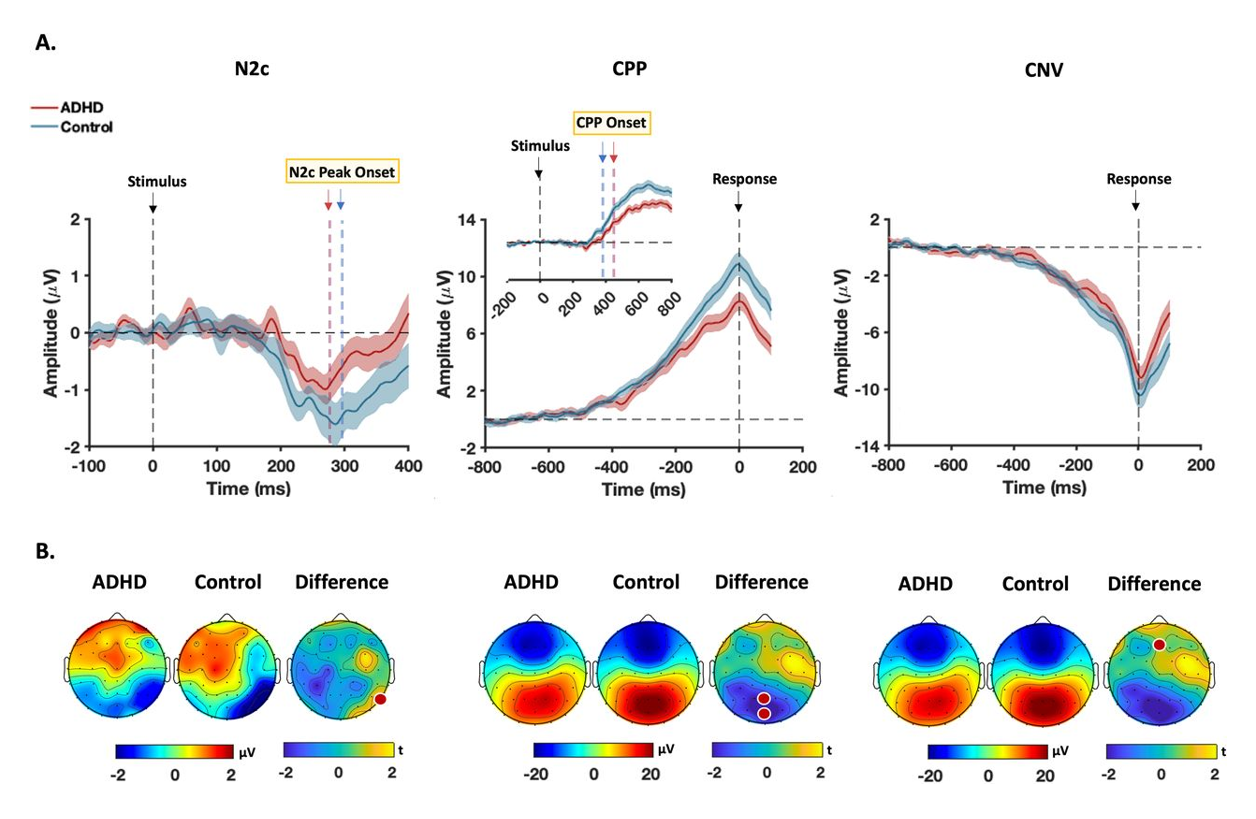
Figure 2: This work illustrates our lab’s approach to understanding cognition as a dynamic brain process. Using EEG, computational modelling, and perceptual decision-making tasks, we decompose behaviour into distinct neural stages, from early attentional selection to the accumulation of sensory evidence and preparation for action. In this study, children with ADHD showed altered neural dynamics across these stages, including reduced evidence-accumulation signals, providing a mechanistic account of individual differences in decision-making. More broadly, this research reflects our aim to link brain dynamics, behaviour, and clinical variation to better understand neurodevelopmental conditions and inform future personalised approaches (Biabani et al, 2025, J. Neurosci.).
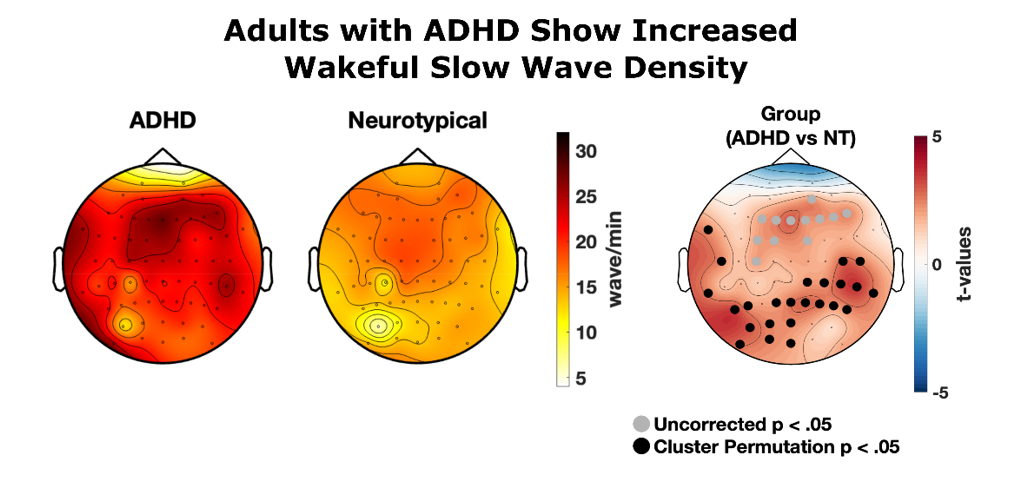
Figure 3: Adults with ADHD show greater slow wave density while completing a sustained attention task, particularly over centro-parietal regions, suggesting altered patterns of local sleep-like brain activity during wakefulness (adapted from Pinggal, 2026, J. Neurosci, Figure 5).
Cross-Species and Circuit-Level Approaches
A recent expansion of our research introduces animal models to enable causal investigation of neural mechanisms.
In rodent and non-human primate models, we implement behavioural paradigms analogous to human attention and decision-making tasks, allowing direct comparison across species. These experiments are combined with:
- Optogenetics to manipulate specific neural circuits
- Miniscope imaging to record population activity during behaviour
- Extracellular array recordings for high-resolution neural data
- ECoG and epidural EEG recordings for direct cross-species comparisons
- Pharmacological challenge
This approach allows us to move from correlation (human studies) to causation (animal models), bridging levels of analysis from circuits to cognition.
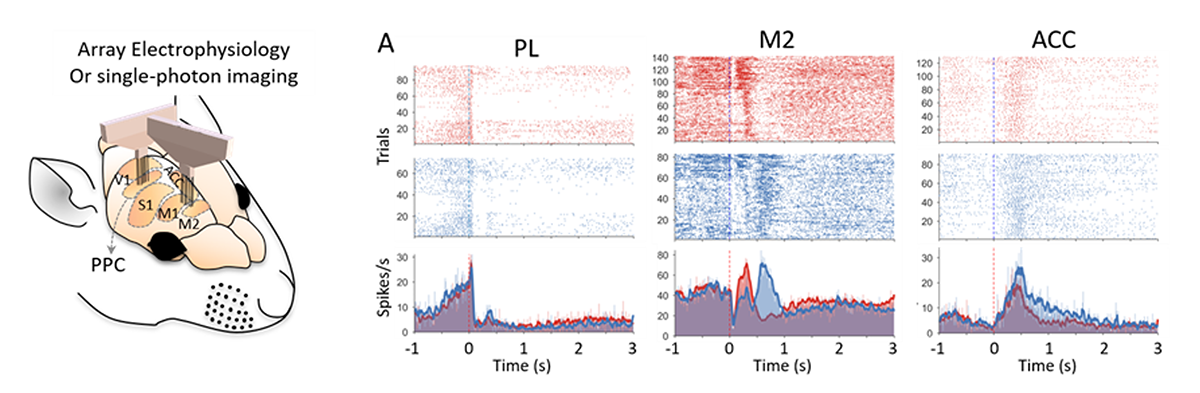
Rodent work is conducted at Monash University and collaborative work with non-human primates is conducted at Newcastle University, UK, with Professor Alex Thiele.
Transdiagnostic Approaches to Understanding Neurodevelopment and Mental Health
We bring together a multidisciplinary team of clinicians, academics, clinician-scientists, and experts through lived and living experience to transform the way we identify and support children and adolescents with co-occurring neurodevelopmental differences, disabilities, and mental health needs through the Monash Autism-ADHD Genetics and Neurodevelopment (MAGNET) Project led by Dr. Beth Johnson.
Our work aims to directly inform educational and health policies and practices by:
- Comprehensively mapping the diversity of cognitive, behavioural, emotional, social, adaptive, and academic functioning profiles among neurodiverse (i.e., autistic, ADHD, AuDHD, neurotypical) children and adolescents
- Developing an innovative, transdiagnostic model of how neurodevelopmental differences and/or disabilities and mental health problems interact with each other across diagnostic boundaries
- Generating novel ways for children, their families, and their support networks to understand and communicate each child’s unique strengths and needs across neurodevelopmental and mental health domains
- Critically evaluating and challenging current data governance structures for neurodevelopmental and mental health clinical information by amplifying community voices and preferences
Our overarching goal is to improve the quality of life of children and adolescents with neurodevelopmental and/or mental health needs by accelerating identification, minimizing missed and misdiagnoses, and providing clear guidance on how families, educators, and the broader community can become more inclusive for every body and every mind.
This work is conducted in collaboration with leading interstate and international research teams from The University of Sydney (Professor Adam Guastella, Dr. Kelsie Boulton), University of Melbourne (Professor David Coghill); Macquarie University (A/Prof Miriam Forbes); and King’s College London (Professor Eva Loth).