
First Nations women, cultural fire knowledge, wellbeing and memory
Project description
NIDR evaluated the first Australian Women-in-Fire Prescribed Fire Training Exchange (AUS-WTREX) program and found significant benefits for the wellbeing of First Nations women firefighters and rangers.
AUSWTREX was a 12-day program delivered in North Queensland by the Queensland Fire Department (QFD) in partnership with the Queensland Parks and Wildlife Service (QPWS), with support from AFAC, WTREX and Fire Networks.
The program brought 30 Indigenous and 7 non-Indigenous women together to enhance fire practitioner skills, share cultural and western burning knowledge, and develop a network of women in fire.
NIDR led an independent evaluation to understand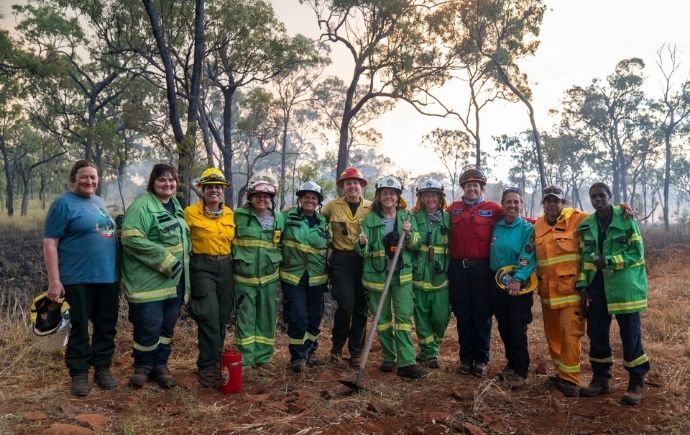 how participation impacted First Nations women's wellbeing. This research was proposed by the Queensland Fire Department and was funded by Natural Hazards Research Australia. Specifically, researchers looked at how First Nations women-led gatherings and cultural fire knowledge exchanges impact wellbeing and memory.
Learn more about this project here.
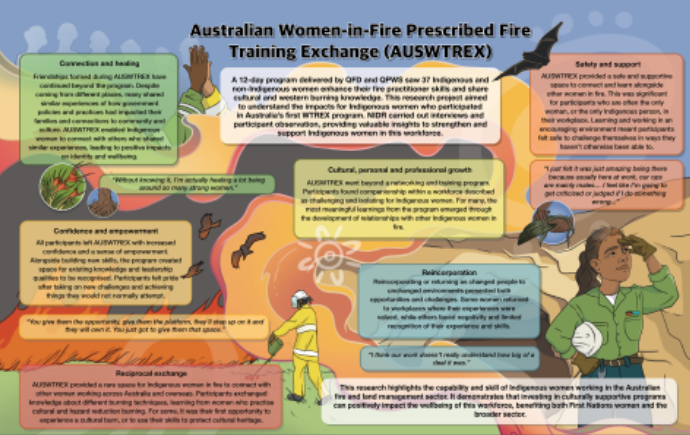
This evaluation found six key impacts using interviews and participation observation. The program was significantly valuable for First Nations women, and provided companionship within a workforce described as challenging and isolating for First Nations women.
This research also highlights the capability and skill of First Nations women working in the Australian fire and land management sector. It demonstrates that investing in culturally supportive programs can positively impact the wellbeing of this workforce, benefiting both First Nations women and the broader sector.
Resources
Researchers
Collaborators
- Natural Hazards Research Australia
- Queensland Fire Department
- Queensland Parks and Wildlife Service