
Michael Lynch
A pioneer alum reflects on 60 years of impact
On 8 April 1964, Michael Lynch became our first Economics graduate; the first of 67 students in our inaugural cohort to step on to the graduation stage and accept his degree. Michael shares his reflections on the early years, the importance of service and the power of a great education.
In 1964, Brother Michael Lynch was one of just 67 fresh-faced students taking part in Monash University’s inaugural graduation.
It was the culmination of three years of hard work, and there was an air of jubilation in the room.
But, he reflects, the excitement quickly turned to trepidation for the 21-year-old when he glanced at the program and saw he was to be the university’s first-ever graduate!
His fortune - or fate – had been decided by ballot.
“They held two ballots – one to decide the faculty to go first, which was Economics, and a second to determine the order of students to graduate,” he said.
“If I’m honest, the first thought that went through my head was that I would have much preferred others to go in front, so I had someone to follow.”
Thankfully, he survived the ceremony without incident.
“And, of course, now I am very proud to be Monash University’s first graduate – it’s a great privilege.”
The farm chronicles
When the Clayton campus opened in 1961, Monash was the first university built in Victoria in more than 100 years, and very much the “new kid on the block”.
With just 347 students studying arts, economics, science and engineering, most had come from high schools far larger than the university itself. “Melbourne University was known as ‘The Shop’ back then, and Monash became known as ‘The Farm’ because it had been established in Clayton on a market garden site – which we were reminded about by all the puddles on wet days,” Michael said.
“Sludge aside, it was a privileged time.
“Most of us knew little, or nothing at all, about what to expect from university life, but there was an air of quiet excitement, an understanding that we were part of a new enterprise, and a real sense of camaraderie – that we were all in it together.
“Of course, Australia in 1961 was very different from the Australia of 2024. It was pre-computer, before the Internet and mobile phones; there was no Google, Facebook, social media.
“And the nation’s population then was less than one half what it is now.”
“There was an openness to discussing ideas; we were encouraged to look at both sides of issues – and we spent a great deal of time drinking coffee and talking about controversial matters”
Getting to Clayton
Travelling to Monash at Clayton could be a challenge, he recalled, with many students who relied on public transport happy to “hitch” a ride home by car.
“I remember it was in just the second week of term that Dr Rufus Davis (Head of the Department of Politics), offered me lift,” Michael said.
“In his first two lectures he had quoted Harold Laski from the London School of Economics. (In the car) I asked ‘Did you know Laski?’ to which he replied: ‘Indeed I did, he taught me to be both a scholar and a gentleman.’
“I can vouch that he had both qualities and we maintained a friendship over the years.”
Other reflections from the early years
“Monash’s food catering facilities were pretty meagre at the start,” Michael said. Initially, staff and students frequently used the same canteen, before a staff club and a student cafeteria eventually created more options. “I recall Professor Don Cochrane (Faculty Dean) lining up behind me to get a meat pie for lunch,” he said.
Michael recalls many coffee-fuelled discussions in those early years.
“There was an openness to discussing ideas; we were encouraged to look at both sides of issues – and we spent a great deal of time drinking coffee and talking about controversial matters,” he said.
The Notting Hill Hotel was a favourite location for many of these debates.
“Back then, Professor Jock Marshall (Zoology) had nicknamed it ‘The Vicarage’ – you could say you were going to the vicarage to chat with the Vicar rather than ‘Slipping out for a drink’!”
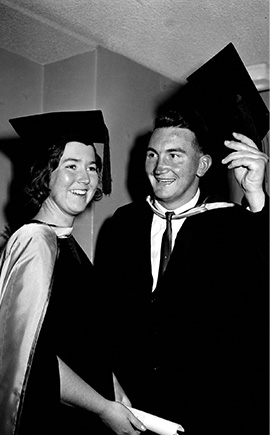
Michael Lynch with fellow graduate Nola Fisher on
graduation day, 8 April 1964.
Michael said he felt Monash, at the outset, reflected many of the ideas outlined in English theologian John Henry Newman’s famous text, The Idea of a University.
“Newman believed a university should be a place where people can explore ideas, seek truth, and consider different points of view. I feel this is what happened, without fanfare, in the early days at Monash.”
Answering the call
After graduating, Michael made what many would consider an unusual career choice, joining the international Catholic Religious order of priests and brothers: the Salesians of Don Bosco.
Founded by Saint John Bosco in 1859, the order is known for its social justice work and today there are Salesian schools and youth centres in 130 countries.
“At school, I had been reasonably good at maths and was increasingly interested in economics and politics, so that’s what I pursued at university. As I felt I was called by God to the Salesians, these studies and my time at Monash were an excellent preparation,” Michael said.
During the remarkable 56-year career that followed, Michael has worn many hats.
He was a teacher and headmaster at schools around the country, principal of John Fisher College at the University of Tasmania, and attended Harvard to further his studies.
In 1997, he embarked on a career-defining role with Salesian Missions Australia.
For a quarter of a century at the helm of the Salesians’ overseas aid and development work, he travelled widely, associated with a range of government and church officials and met not one but two Popes (John Paul II and Francis).
But it is his work helping disadvantaged people across the Asia Pacific region of which he is proudest.
“Quite simply, it was supporting development and encouraging self-reliance in schools and youth centres in several countries including Samoa, Fiji and Timor Leste,” he said.
Lessons from Monash
Much has changed at Monash University since that nerve-wracking ceremony 60 years ago.
From a single campus at Clayton with fewer than 400 students, Monash has grown into Australia’s largest university, boasting 10 faculties, more than 60,000 students and 350,000 alumni from 170 countries across the globe.
But Michael said one thing that hasn’t changed is the power of a great education.
“Universities, as centres of learning and research, have a core mission to impart knowledge, to hone the mind through debate, and to explore different perspectives,” he said.
“They are best placed to help pass on an appreciation of our cultural inheritance (from Aristotle and Plato) and the achievements of civilisation.”
He recalled a number of mentors reminding him that:
- Knowledge of itself does not mean much; rather it is what is done with the knowledge that counts;
- Always regard education as the starting point, an opportunity to explore and challenge ideas; and
- Don’t be satisfied with just one point of view.
“It was valuable advice.”
Life lessons outside the classroom
Overall, Michael said his life had been a fortunate one - and not just because of the educational and career opportunities afforded him by Monash and the Salesians.
Parental support and sheer luck also played a part when, as a 12-year-old in 1955, he was involved in a serious accident when the car in which he was travelling was crushed by a train at a level crossing in Seaford. The driver died on impact.
Following the collision, Michael was in a coma for a week - however, after spending time in hospital, he made a good recovery. After that challenging time, he never took good opportunities for granted, he said.
“I regard my days at Monash as a great blessing.”