
Monash Masterclass: The digital transformation and global markets
The digital transformation is bringing many new challenges and opportunities, at a pace not seen for more than a century.
This disruption is largely being fuelled by inexpensive connected devices, wireless technologies, cloud computing, and artificial intelligence. Estimates for the speed and scale of the transformation suggest that by 2025 there will be 75 billion devices connected to the internet, and at some time soon generating 100 zettabytes (billion terabytes) of data.
Companies and countries that successfully navigate this storm of disruption will embrace artificial intelligence while emphasising human creativity, develop nimble teams, be data driven and create new markets that both replace existing institutions and enable innovative new products and services that are impossible today.
In this masterclass, Professor Simon Wilkie, internationally acclaimed economist, Dean of the Faculty of Business and Economics at Monash University and Head of Monash Business School, will examine some of the profound changes affecting critical areas including metrics, markets, organisations and ultimately jobs.
We welcome all Monash alumni to join us from 6.30pm onwards for networking, drinks and canapés followed by the masterclass from 7pm - 8pm. After the masterclass concludes there will be a Q&A opportunity and further networking with your peers before the event concludes at 9pm.
Speakers
Professor Simon Wilkie, Dean of the Faculty of Business and Economics at Monash University and Head of Monash Business School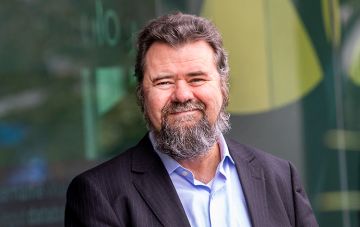
Professor Simon Wilkie’s career spans a remarkable array of roles that extend beyond the higher education sphere and include appointments as Chief Economic Policy Strategist at Microsoft Corporation and Chief Economist with the US Federal Communications Commission.
In 2019, Professor Wilkie joined Monash Business School from the University of Southern California (USC), where he was Professor of Economics in the Department of Economics and Professor of Economics, Communication and Law in the USC Gould School of Law. He was previously head of USC’s Department of Economics and the USC Center for Communication Law and Policy.
Prof Wilkie has a PhD and MA in Economics from the University of Rochester, and a BComm (Hons) with first-class honours in Economics from the University of New South Wales.
His research has particularly focused on game theory, its application to business strategy, economic and regulatory policy design, and the economics of the communications industries.
With an exceptional record for advancing multi-disciplinary collaborative research and leveraging its potential to transform policy and create lasting impact, he is widely published on the subjects of spectrum auctions, game theory and telecommunications regulation in leading scholarly journals.
He is a member of the editorial board of the International Journal of Communication and a former member of the editorial board of the Journal of Public Economic Theory.
Event Details
- Date:
- 3 November 2022 at 6:30 pm – 9:00 pm
- Venue:
- Westin Singapore 12 Marina View Asia Square Tower 2, Singapore 018961 Singapore
- Categories:
- Alumni; General
Description
The digital transformation is bringing many new challenges and opportunities, at a pace not seen for more than a century.
This disruption is largely being fuelled by inexpensive connected devices, wireless technologies, cloud computing, and artificial intelligence. Estimates for the speed and scale of the transformation suggest that by 2025 there will be 75 billion devices connected to the internet, and at some time soon generating 100 zettabytes (billion terabytes) of data.
Companies and countries that successfully navigate this storm of disruption will embrace artificial intelligence while emphasising human creativity, develop nimble teams, be data driven and create new markets that both replace existing institutions and enable innovative new products and services that are impossible today.
In this masterclass, Professor Simon Wilkie, internationally acclaimed economist, Dean of the Faculty of Business and Economics at Monash University and Head of Monash Business School, will examine some of the profound changes affecting critical areas including metrics, markets, organisations and ultimately jobs.
We welcome all Monash alumni to join us from 6.30pm onwards for networking, drinks and canapés followed by the masterclass from 7pm - 8pm. After the masterclass concludes there will be a Q&A opportunity and further networking with your peers before the event concludes at 9pm.
Speakers
Professor Simon Wilkie, Dean of the Faculty of Business and Economics at Monash University and Head of Monash Business School
Professor Simon Wilkie’s career spans a remarkable array of roles that extend beyond the higher education sphere and include appointments as Chief Economic Policy Strategist at Microsoft Corporation and Chief Economist with the US Federal Communications Commission.
In 2019, Professor Wilkie joined Monash Business School from the University of Southern California (USC), where he was Professor of Economics in the Department of Economics and Professor of Economics, Communication and Law in the USC Gould School of Law. He was previously head of USC’s Department of Economics and the USC Center for Communication Law and Policy.
Prof Wilkie has a PhD and MA in Economics from the University of Rochester, and a BComm (Hons) with first-class honours in Economics from the University of New South Wales.
His research has particularly focused on game theory, its application to business strategy, economic and regulatory policy design, and the economics of the communications industries.
With an exceptional record for advancing multi-disciplinary collaborative research and leveraging its potential to transform policy and create lasting impact, he is widely published on the subjects of spectrum auctions, game theory and telecommunications regulation in leading scholarly journals.
He is a member of the editorial board of the International Journal of Communication and a former member of the editorial board of the Journal of Public Economic Theory.