
The economics of gender equality
The economics of gender equality
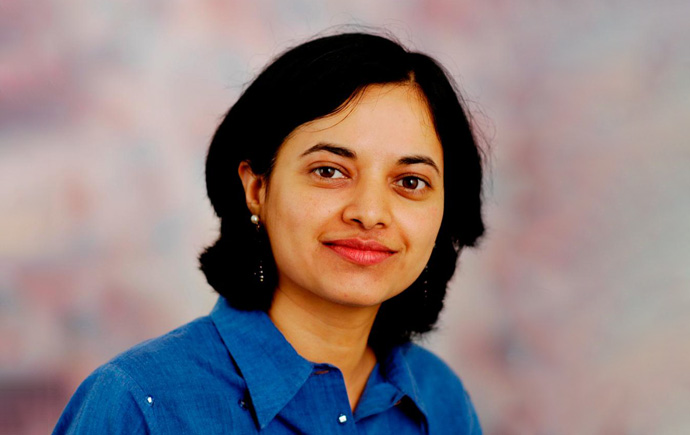
Award-winning economist Professor Lata Gangadharan is boldly following in the footsteps of Australia's first female Chair of Economics, Professor Maureen Brunt, to address the persistent leadership gender gap.
As an inaugural recipient of the Maureen Brunt Professorial Fellowship, Professor Lata Gangadharan is proud to carry the torch for one of Australia’s trailblazing female leaders.
The fellowship provides development opportunities and research support to senior women researchers, building on the legacy of Prof Brunt – Monash University’s first woman professor and Australia’s first female Chair of Economics.
Prof Gangadharan said that the Fellowship was both an honour and a source of inspiration.
“Holding the Maureen Brunt Professorial Fellowship is a prestigious acknowledgement and it is meaningful for me personally,” she said.
As an experimental economist, Prof Gangadharan explores decision-making in settings where actions are influenced by both economic and social considerations.
“As a woman in economics and in academics in general, you don’t see much diversity - there are very few women in leadership positions, very few female editors of journals, and this is a global phenomenon.”
“There is often an intricate relationship, sometimes a trade-off, between maximising profits and contributing to the community – you see this tension in areas like corporate conduct and climate change, where many decisions that benefit the public may hurt your pocket,” she said.
Her recent research focuses on the gender dynamics of the leadership gap – a challenge she is acutely aware of in her own academic world.
“As a woman in economics and in academics in general, you don’t see much diversity - there are very few women in leadership positions, very few female editors of journals, and this is a global phenomenon,” she said.
“When you see this gender gap, you do wonder about the causes, and what can be done about it.”
Also Monash Business School’s Joe Isaac Chair of Business and Economics, Prof Gangadharan points out that despite extensive policy efforts, the leadership gap remains intractable.
“We need more research to understand why policies to reduce gender inequality have not been effective, and what we can do to improve outcomes,” she said. These are questions she aims to help address in her own work.
“These gaps may partly be due to preferences and the occupations men and women typically chose, but there are significant institutional barriers that contribute as well, such as leadership selection processes and incentive structure in organisations,” she said.
Professor Gangadharan emphasised the positive impact of an inclusive environment. “Research has consistently shown that having a more diverse workforce brings more perspectives into the decision-making process, ultimately leading to better quality decisions,” she said.
“It also shows that an inclusive workplace environment encourages productivity, because when people feel valued, they are able to contribute in different ways without feeling they are being judged.”
Diversity also helps to inspire the next generation of women leaders – something she is passionate about contributing to herself.
“Of course, there are situations where I have felt left out, however, I’ve also had great supporters, both female and male, and I would like to contribute to the mentorship of aspiring female leaders - that’s an important part of what I hope to achieve through this fellowship,” she said.