
Breathing new life into workplace wellbeing
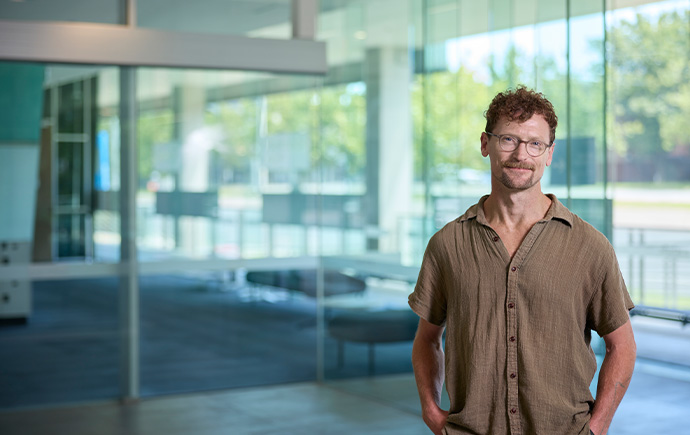
Monash Business School Management PhD candidate Shawn Ashkanasy.
July 31 2024
Modern workplaces can be stressful. But Monash Business School PhD candidate Shawn Ashkanasy hopes to provide a counterbalance by tapping into one of the fundamentals of life – breath.
Breathing. We do it about 22,000 times a day without a second thought.
But could this unconscious act also hold the key to navigating the stress of modern workplaces?
Monash Business School PhD candidate Shawn Ashkanasy, from the Department of Management, believes it does.
“It’s fascinating to see how something as fundamental as breathing is only now gaining recognition for its potential role in human performance and wellbeing,” he said.
“The connection between breathing and the heart-brain axis in everyday activities like self-regulation, decision-making, and strategic planning is intriguing.”
While breathwork is not new, Mr Ashkanasy said it was often dismissed as a practice exclusive to yoga or meditation enthusiasts.
“As a result, organisations may overlook the benefits of breathing techniques to enhance performance at work and improve safety,” he said.
He aims to shift this perception through research to inform new workplace interventions andstimulate opportunities to study breath-based interventions for vulnerable populations.
“For instance, neurodiverse employees who may struggle with body awareness could be more prone to emotional dysregulation, leading to personal and professional challenges,” he said.
“I see significant potential for these interventions to improve these individuals’ health and wellbeing outcomes at work.”
His research will test whether ‘slow-paced breathing’ - breathing about six times every 60 seconds for up to 20 minutes - and its effect on heart rate can improve stress resilience and cognitive performance.
To find out, he will conduct a pilot study at the Monash Business Behavioural Lab, followed by a four-week randomised control study.
The pilot study, scheduled to start in August 2024, will involve up to 60 Monash University students randomly assigned to one of two treatments: slow-paced breathing (SPB) and a control group.
Under the larger study, planned for 2025, 100 Monash students will be randomly assigned to the same treatments.
“Ultimately, I want to see whether a single intervention has a training effect compared to daily practice over a four-week period,” Mr Ashkanasy said.
His supervisor, Professor Charmine Hartel, who is also Director of Monash Business School’s Opportunity Tech Lab, said the work would make a significant contribution to the emerging field of breath and cognition.
“This research has implications for informing, designing and evaluating new workplace interventions for comprehensive stress management and healthier, productive workplaces,” Prof Hartel said.
“It’s important because it addresses the high cost to individual wellbeing that often arises from pursuing high performance in today’s modern work environment.”
Mr Ashkanasy said pursuing a PhD was not a solo effort.
“When things get tough, as they inevitably do, I now understand that I can reach out to a broad range of people at Monash,” he said.
“My supervisors and the Department of Management have been reliable sources of wisdom and compassion.”
Working with the Opportunity Tech Lab and the Behavioural Lab has allowed Mr Ashkanasy to meet world-class academics and participate in conversations at the forefront of human performance and emerging technologies - and he is eager to explore this further.
“I would love to collaborate more closely with specific industries and technology companies to develop new and exciting wearable devices and feedback systems,” he said.
Read more about Monash Business School’s Opportunity Tech Lab.
Read more about our Monash Business Behavioural Lab.