
Monash Business School leading manufacturing industries through circular economy transformation
January 3 2023
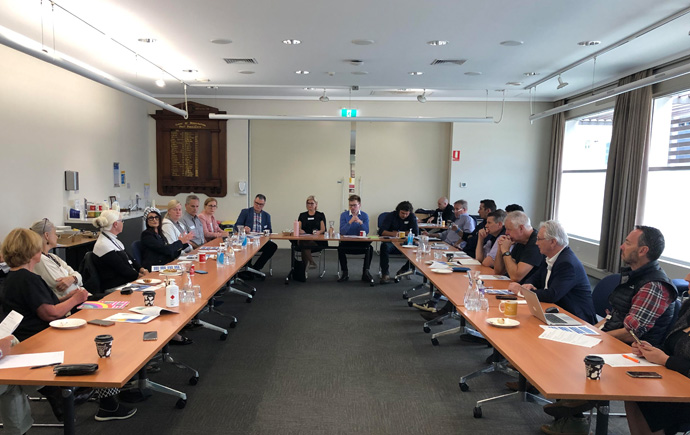
Participants at the workshop hosted by Mornington Peninsula Shire Council.
A passionate group of Department of Management academics are instilling circular economy expertise in key manufacturing industries through a new government partnership.
The circular economy is the transition from a traditional linear business model to a sustainable one, where minimal waste is produced and sent to landfill and products are repaired, reused, recycled or remanufactured.
Professor Amrik Sohal and his Circular Economy and Sustainability Research Interest Group team at Monash Business School have spent the last year raising awareness of the circular economy among small and medium sized manufacturing companies in greater Melbourne.
They are working in partnership with the South East Melbourne Manufacturers Alliance (SEMMA), and are funded by the Circular Economy Business Innovation Centre (CEBIC), delivered by Sustainability Victoria, to run the Circular Economy Journey project.
The project’s next step involves educating local councils so they can keep reaching out and supporting local businesses on the journey towards zero waste.
“I want to establish Monash Business School as a leading one-stop-shop for the circular economy, where companies and councils come to us to take part in training programs, learn more about circular economy strategy and develop their production and delivery systems in more sustainable ways,” Prof Sohal says.
Learning from the early adopters
Project members have so far worked with businesses across four different sectors - food and agriculture, textiles, plastic and general engineering/manufacturing - to help them adopt a more circular economy within their production and supply chains. Often this means going right back to the initial design stage of a product.
“We help companies think about how materials and products can be repurposed and reused at the end of their life, Prof Sohal says.
“This kind of thinking needs to start at the design stage to make sure products can easily be disassembled or materials used for different purposes,” he says.
“We want to keep products at the highest value for the longest time possible and keep them in use for as long as possible.”
In the project’s first phase, 25 businesses who had already started their circular economy journey were interviewed to identify the major hurdles and challenges they faced, along with success factors.
The results then formed the basis of several public seminars, where representatives from hundreds of businesses took part. Further half-day workshops were run with both local businesses and councils.
The 10 R’s of sustainability
The project’s methodology is based on the 10 R’s of sustainability model, with the first R standing for “Refuse”.
“We must acknowledge there are things we need to refuse – like buying new clothes,” Prof Sohal says.
“It’s the same for companies; they must refuse to work with certain materials that are hazardous or rare, or stop buying from a certain unethical supplier.”
“When we learn how to remanufacture products and figure out what critical materials we can take out of a product, the mindset changes completely. And this affects all levels in a company, (with employees learning) to think in new and different ways”, he says.
There’s also a large appetite among businesses for information and knowledge about the circular economy, Prof Sohal says, adding that once companies acquire circular economy knowledge, they need to take it onboard and start transforming services, operations and production to become more sustainable.
Researchers have now submitted a report to Sustainability Victoria and launched a website packed with information for business and councils to access - but the work is far from done.
Next steps: Capability-building within councils
The Circular Economy Journey is now educating and building capabilities with key council employees, who will become key agents for change through their close connections with local businesses through rates schemes and waste collections.
“My goal is to create a golden triangle of three parts,” Prof Sohal says.
“Businesses (first) need to deliver products and services in more sustainable ways.”
“The second part is councils as key contacts for businesses.”
“The third part is us at Monash Business School - we are a knowledge broker working together with these entities.”
“Collaboration is key. We need to work together rather than individually.”
Through the efforts of Prof Sohal and his team, a circular economy network across Australia and New Zealand has been created, connecting 150 researchers working on different themes to constantly develop new projects.
Professor Sohal also wants to start Circular Economy Roundtable meetings with business and council representatives, as well as a Monash Business School hub for seminars, training programs, strategy development and general help for those wanting to join the CE movement.
Another ambition is to extend the project to the Monash Malaysia campus and start working with businesses there.
“We have applied for funding for several different projects to get everyone onboard to kickstart their circular economy journey. It never stops basically,” Prof Sohal says.