
Our new climate partnership to empower a small island nation in the South Pacific
18 November 2024

Much of Naoero's interior has been mined for phosphate.
Image: John Gollings.
As the effects of climate change grow on a global scale, Naoero, the world’s smallest island nation, is facing the fight of its life.
But a new project by the Monash Business School and Fiji National University PACT (Pacific Action for Climate Transitions) research centre will help the world’s third smallest country.
PACT has been engaged by the Secretariat of the Pacific Regional Environment Programme (SPREP), a Pacific Islands-based non-government agency, to help the government of Naoero (formerly known as Nauru) complete its national climate change adaptation plan and access finance from the global Green Climate Fund (GCF).
Located about 3000 km north-east of Australia, Naoero is just 21 square kilometres, with a population of approximately 11,000 residents.
Limited by remoteness, with a lack of natural resources outside fisheries, the island’s interior has also been gutted by more than a century of open-cut phosphate mining.
Past mining practices have rendered more than 80 per cent of its landmass uninhabitable and devastated the landscape.
This has increased Naoero’s vulnerability to climate change, with most of its population living on the coast and exposed to inundation from rising sea levels, king tides, storm surges, rain pattern changes, seawater acidification and coastal erosion.
The aim of PACT, which is a research collaboration between Monash Business School and Fiji National University, is to help Pacific islands - including Naoero - strengthen their resilience to impacts of climate change, PACT Director Prof Paul Dargusch said.
The SPREP partnership
“We’re working to set up the climate change adaptation systems that will enhance capacity and enable Naoero to build critical infrastructure and make big steps towards a sustainable future,” Prof Dargusch said.

Residents are threatened by damaging king tides.
Image: Tyrone Deiye.
With 150 staff and an annual budget of approx US$35 million, SPREP has 21 Pacific island member countries. It is the Pacific region’s major intergovernmental organisation tasked with promoting environmental cooperation, providing assistance to protect and improve the environment, and ensuring sustainable development for present and future generations.
As the world’s largest climate fund, the GCF is mandated to ensure access to climate finance for developing countries. It has approved 253 projects worldwide, worth a collective US$53 billion, that mitigate and adapt to the effects of climate change.
Challenges for Naoero
The PACT/SPREP partnership’s National Climate Change Expert, Naoeroan national Tyrone Deiye, who is studying a Master’s degree in Urban and Regional Planning, was born and raised on the island.
Mr Deiye said the island’s coastal-dwelling residents were increasingly at risk of homelessness. With land in Naoero already scarce, with around 80% of Nauero owned by its indigenous people, any further loss of any of their land to the elements was heartbreaking, Mr Deiye said.
“A lot of people residing on the coast have already lost land - some have had their entire houses engulfed by king tides and they have lost everything,” Mr Deiye said.
“It’s really starting to affect people where they live, and the government is under pressure to relocate them, and find them new housing higher up. But for a small island, where the population is growing and most of the land is privately owned, these are really hard problems to solve,” Mr Deiye said.
With no fresh natural freshwater sources for potable use, the island is heavily dependent on a desalination plant with high maintenance and operational costs. Water trucks enable access and distribution throughout the island, but also pose several challenges, Mr Deiye said.
Hope on higher ground
A key project in Naoero for which GCF funding is being sought, which could be transformational for the tiny nation, is to move more than 300 households from vulnerable coastal areas to a three-acre section of higher ground in the interior, which is owned by the government.
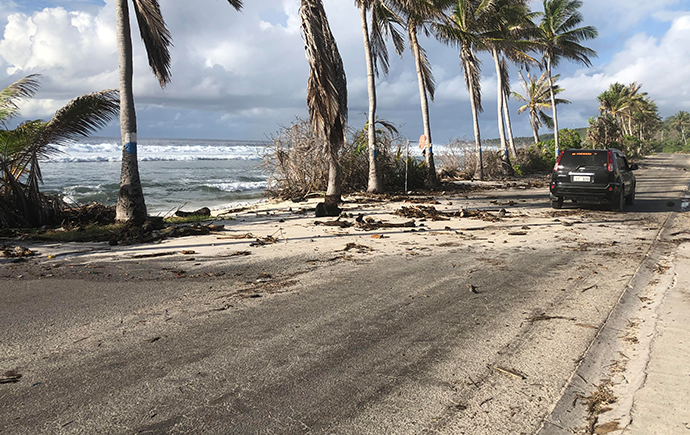
Rising sea levels are threatening basic infrastructure.
Image: Tyrone Deiye.
That would be part of a broader plan to remediate Nauero’s degraded “moonscape”.
“This plan is very significant for the island,” Prof Dargusch said, explaining climate finance would help fund vital infrastructure for resettlement, including energy and water.
Under the partnership, PACT would also assist the Naoeroan government with a longer-term goal - development of their national climate change adaptation plan.
The project is an opportunity to apply lessons already learned from work in other parts of the Pacific, Prof Dargusch said.
Monash Business School’s Deputy Dean, Research, Professor Russell Smyth, said PACT embodied “Monash University's commitment to address the global grand challenges in Impact 2030 by working with some of our closest neighbours.”
“Nauero, like many South Pacific nations, is at the coalface of the existential threat that climate change represents,” Prof Smyth said.
“Finding ways to minimise the inevitable adverse effects of climate change on the way people live and work is the number one priority. This is what this PACT initiative, in conjunction with SPREP and the GCF, seeks to do."