
Network Visionary: Economics professor honoured for groundbreaking research
25 November 2025
When Monash University announced its 2025 research awards, one name appeared twice: Professor Yves Zenou.
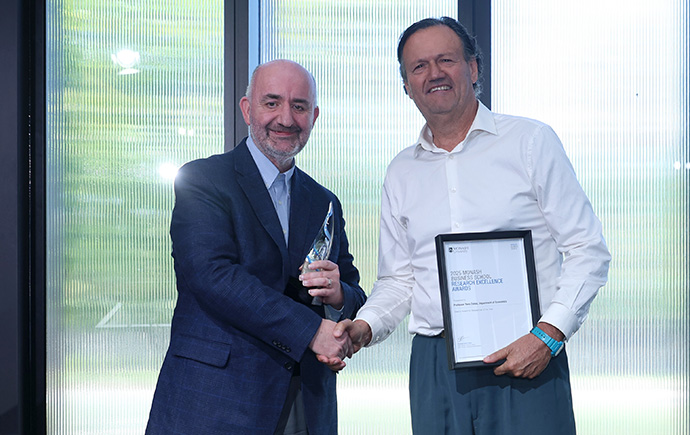
Prof Yves Zenou (right) receives his Monash Business School Research
Excellence Award from Deputy Dean Research Prof Russell Smyth.
The Richard Snape Chair in Business and Economics earned the Vice-Chancellor’s Researcher of the Year (Humanities and Social Sciences) and a Monash Business School Research Excellence Award - a double recognition for a scholar whose work has reshaped modern economics.
“It’s a very nice recognition. I’m very happy, and it’s a real honour,” he said. “Coming from economics and being acknowledged at a higher level means a great deal.”
Over more than two decades, Professor Zenou has become one of the world’s leading figures in network economics.“My work is really about understanding how social context shapes economic behaviour,” he said.
“Economists have focused on market forces for more than a century – prices, supply, demand – but markets are very abstract. In reality, people interact directly with each other, and those interactions matter enormously.”That shift in perspective produced one of his most influential contributions.
The idea that changed the game: the ‘key player’ effect
Long before network effects became common in economic research, Professor Zenou developed the mathematical tools needed to study how influence travels through social groups.
His breakthrough ‘Key Player’ theory identifies the person within the network whose connections give them outsized influence.In Sweden, Professor Zenou used detailed co-offending data to map criminal networks and pinpoint the individuals whose connections fuelled wider offending.
The findings suggested that focusing on these key players could cut crime by about a third.
In the UK, he and collaborators advised law-enforcement agencies on how to deploy scarce resources to combat crime more effectively.
The prevailing strategy, ‘hot spot policing’, allocates officers to high-crime areas, but Professor Zenou’s work shifts the attention to other locations.
“We suggest a different strategy: identify and target the key districts who drive the spread of crime.”
Simulations show this approach could save the force around £255 million a year.
He has applied his modelling to a wide range of challenges, including analysing systemic risk in the 2008 global financial crisis, understanding how new technologies spread through villages in developing countries, and exploring the dynamics of COVID-19 vaccination uptake.
New frontiers in human behaviour
Professor Zenou has published more than 150 papers, has a string of prestigious fellowships, including the Econometric Society and the Academy of the Social Sciences in Australia, and is a Foreign Member of the Royal Swedish Academy of Sciences.
Yet he continues to push the boundaries of economic research, and is currently developing a theory called ‘multiplexing’ to examine how the multiple networks each person belongs to interact and how they affect their outcomes.
“Most research in networks looks at a single layer, but in the real world, each of us belongs to many networks at once: family, neighbours, colleagues, friends.”
Understanding how influence moves across those layers is the next frontier of his work.
“We’re modelling these multi-layer networks and testing how they shape behaviour - it’s very new and very exciting,” he said.
“It builds directly on my earlier work, but takes it in a new direction. I hope it will have a real impact.”
‘Monash helps keep the passion alive’
A decade into his Monash career, Professor Zenou said the university has played a crucial role in sustaining his drive.
“I have very good colleagues and a very strong research culture around me,” he said.
“After 40 years in the profession, it could become boring, but Monash helps me to keep the passion alive - especially meeting colleagues from so many different countries.”
What matters most to him, though, is the growing influence of the ideas themselves.
“It took a lot of time, but what matters is to see that impact, to see the influence of the work growing,” he said.
“My greatest achievement has been helping to establish network economics and showing that interactions between people can matter just as much as markets.”His advice to young researchers is to follow their passion.
“Some people try to plan everything strategically, but in the end, you need to work on what genuinely excites you, and stay passionate about it,” he said.“It’s a long journey; it’s a marathon. So do the work because you love it, not for publication or money.”