
Pitch Perfect: Business School duo shines at Monash innovation challenge
19 November 2025
Two Monash Business School researchers have taken out top honours in the 2025 PITCH (PhD Interdisciplinary Team Challenge) competition.
Novita Puspasari and Borui (Eric) Fang were part of the winning team (pictured) at the immersive hack-a-thon held at Monash Indonesia from 20-24 October.
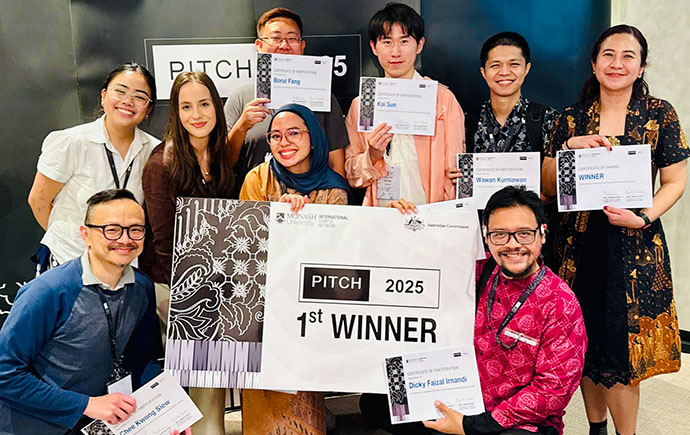
From bottom left: Tyrell Chee Siew, Enise Tatlidil, Kai Sun,
Novita Puspasari, Uyen Le, Wawan Kurniawan, Dicky Faizal,
Borui Fang and Nur Sabrina Abdul Basit.
Now in its third year, the week-long program brings together outstanding PhD candidates from across Monash’s global campus network to devise innovative, interdisciplinary solutions to some of the world’s most complex social and economic issues.
Throughout the program, participants are mentored by senior Monash researchers, gaining experience in translating academic expertise into practical, high-impact ideas.
Working in cross-disciplinary teams, they develop and pitch their proposals to a panel of government, industry and academic leaders — producing tangible concepts local stakeholders can use to drive positive change.
Ms Puspasari and Mr Fang’s team focused on Cibaduyut in Bandung, Indonesia’s famed footwear craft centre, where family-run workshops known for their handmade shoes are struggling against imports, shifting consumer tastes, and limited market access.
Their solution — the Cibaduyut Craft Collective — is a community-led, scalable model to strengthen local identity and connect artisans with designers and students to expand co-creation, marketing, and tourism opportunities.
For Ms Puspasari, the experience was as rewarding as it was challenging.
“Personally, it allowed me to reconnect with Cibaduyut as a place that shaped my childhood pride in wearing local shoes,” she said. “Professionally, the experience reinforced the importance of community-first design and the idea that meaningful innovation emerges when we listen, co-create, and build with the people at the heart of the story.”
Mr Fang said the event was a lesson in collaboration, communication, and the real-world impact of research.
“As a PhD candidate who studies large multinational enterprises, this hands-on work with micro and small businesses was a powerful reminder that international business principles can - and should - be applied to empower smaller players,” he said. “It inspired me to explore how a cooperative model, based on large-firm alliances, could help MSMEs access global markets.”
Professor Matthew Hall, Professor of Accounting and Associate Dean (Graduate Research) at Monash Business School, praised the winners for their creativity and ability to draw on the strengths of different disciplines.
“They created an approach that empowers the local community to address its own challenges — an innovative, technology-led initiative showcasing how digital tools can help local artisans reach international markets.”
Prof Hall said programs like PITCH play a vital role in helping future researchers think beyond disciplinary boundaries and engage meaningfully with global problems.
“PITCH gives students the opportunity to apply their research to real-world challenges while collaborating across disciplines and cultures,” he said. “It also helps them build professional networks and perspectives they might not gain through traditional academic pathways.”
Find out more about PITCH.