
Monash launches critical minerals initiative as global supply pressures mount
8 June 2026
Australia is sitting on some of the world’s richest reserves of the critical minerals needed to power the global clean energy transition.
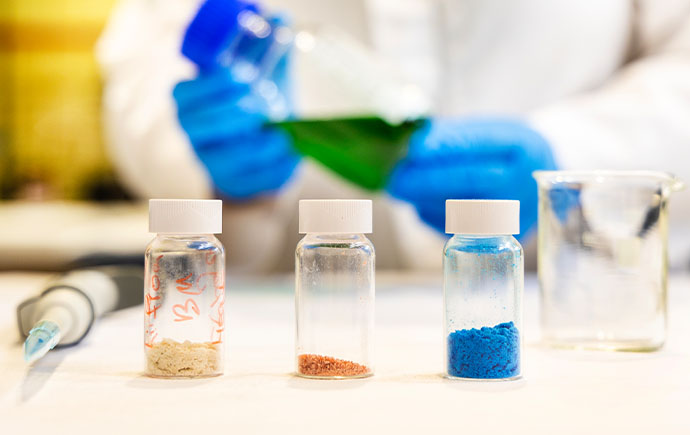
Critical mineral samples in a Monash University lab.
Yet exploration rates have fallen, processing capacity remains heavily concentrated offshore, and domestic capability is fragmented across institutions and sectors.
With the International Energy Agency forecasting demand will double - or even quadruple - by 2040, Monash University has launched a major cross-disciplinary initiative aimed at securing Australia’s place in the global supply chain.
The Monash Critical Minerals Initiative (MCMI) brings together more than 40 researchers from the university’s faculties of Business and Economics, Science, Engineering and Arts.
Its work spans the full minerals value chain, from resource discovery and extraction technologies to environmental stewardship, supply chain modelling, investment policy and social licence outcomes.
Professor Russell Smyth, Deputy Dean (Research) in the Faculty of Business and Economics, said the challenge could not be solved within a single discipline.
“The MCMI brings together expertise from across disciplines to help balance supply security with sustainability, ensuring that extraction, processing, and recycling are efficient and responsible,” Professor Smyth said.
“By drawing on the considerable expertise on critical minerals across Monash, the MCMI can tailor solutions that anticipate market volatility, reduce geopolitical risk, and accelerate the transition to clean energy technologies.”
From discovery to delivery
The initiative is built around six research pillars: new mineral resources, future processing technologies, mine rehabilitation, environmental and social impact systems, policy and economics, and national security.
The minerals in focus - rare earth elements, lithium, cobalt, and others - are essential for technologies such as electric vehicles, batteries, wind turbines, solar panels, and defence applications.
Researchers will work alongside partners including CSIRO, Geoscience Australia, Resources Victoria, the International Energy Agency, and the ARC Research Hub for Carbon Utilisation and Recycling.
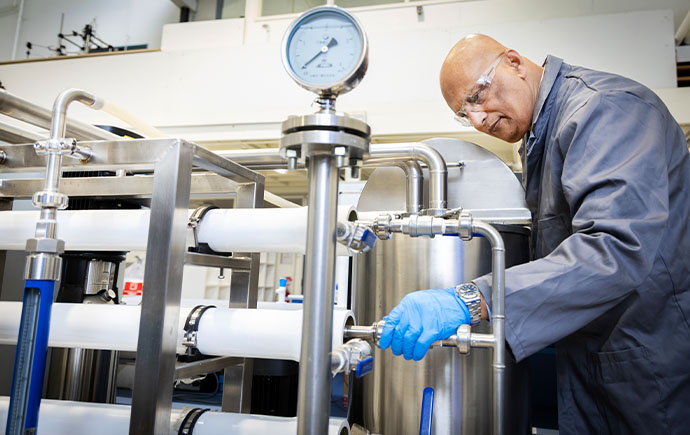
Prof Sankar Bhattacharya inspects industrial
laboratory equipment.
Professor Sankar Bhattacharya from the Department of Chemical and Biological Engineering in the Faculty of Engineering said the initiative positions Monash as a leading Indo-Pacific hub for critical minerals research.
“Our focus is in developing and rapidly scaling-up fundamental scientific proof-of-concept into future processing technologies that are environmentally sustainable and economically feasible,” Professor Bhattacharya said.
“This confidence is backed by our publications and patents harnessing critical metals from low-value and legacy wastes from other industries.”
Beyond the technical
For Professor Andy Tomkins, from the Faculty of Science’s School of Earth, Atmosphere and Environment, the initiative represents an opportunity to make a difference.
“For too long we've been hearing about how climate change is going to cause catastrophic change,” Professor Tomkins said. “Now we can start to solve the problems by building the pipeline of critical minerals needed for renewable energy infrastructure, electric vehicles and advanced battery technologies.”
Professor Elizabeth Lester, Director of the Monash Climate Change Communication Research Hub in the School of Media, Film and Journalism, Faculty of Arts, said the sector’s future would depend not only on scientific and technical advances, but also public confidence.
“Net zero and the energy transition are among the greatest economic, technological and infrastructure challenges Australia has faced. Yet, it is increasingly clear that a real challenge is social,” Professor Lester said.
“MCMI is well equipped to tackle the complexities and opportunities that come with critical minerals through its approach that draws on expertise from across a range of disciplines. This is the approach Australia needs to ensure it achieves a viable industry with a strong social licence.”
To learn more, explore the Monash Critical Minerals Initiative website.