
All roads lead to reform: Reimagining power in university leadership
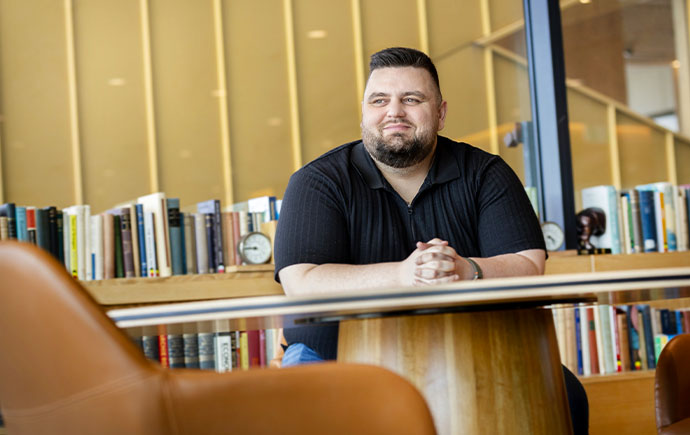
Monash Business School PhD candidate Auren Sol.
May 13 2025
Biripi man Auren Sol began his academic career studying ancient Rome. Now, he's redirecting his focus to the future to help embed Indigenous leadership at the highest levels of academia.
Biripi man and Monash Business School PhD candidate Auren Sol never imagined he would end up researching the power dynamics that govern universities.
His background in Ancient History—focusing on Stoic philosophy under Emperor Marcus Aurelius—is hardly typical for the field.
Yet, as he examined historical systems of authority, he began questioning how power operates in modern institutions.
This intellectual curiosity sparked a deeper interest in leadership philosophy, which, combined with his Indigenous heritage, inspired his research into how Indigenous governance frameworks can be better embedded within academia.
“While universities acknowledge the importance of Indigenous perspectives, they struggle to meaningfully integrate them,” Mr Sol said.
“Indigenous knowledge and governance should not be tokenistic or advisory—they should hold real decision-making power.”
Addressing structural inequality: A blueprint for change
Like many institutions, Australian universities operate within a Eurocentric governance framework. While Indigenous leaders are often consulted, true power-sharing remains rare.
Mr Sol’s research explores how universities can move beyond symbolic inclusion to achieve meaningful, systemic reform.
Drawing on case studies and interviews with university leaders, his PhD examines the feasibility, challenges, and impact of a dual Vice-Chancellorship model—where an Indigenous Vice-Chancellor holds equal authority.
“This work is important because it addresses structural inequality in university leadership,” he said.
“Embedding Indigenous leadership at the highest levels is a step toward decolonising universities and ensuring that Indigenous peoples are not just included but are leading the way in shaping education and research.”
His supervisor, Deputy Vice-Chancellor (Indigenous) and Senior Vice-President, Tristan Kennedy, said the work would be critical in building a strong pipeline of Indigenous leaders in the sector.
“Universities here and around the world need to urgently address the low participation rates of Indigenous peoples in sector governance,” Prof Kennedy said.
“This work will identify novel ways to establish meaningful Indigenous leadership and governance based on principles of self-determination.”
From research to real-world change
For Mr Sol, this research challenges the belief that governance systems are static.
“I’m motivated by the idea that governance structures are not fixed—they are constructed, and therefore, they can be reconstructed,” he said.
“While I'm still early in my PhD, knowing that I am creating research that could enhance opportunities for future Indigenous staff and students is really exciting.”
As he progresses his research, he hopes his findings will drive policy reform, organisational restructuring, and broader discussions on Indigenous sovereignty.
He also hopes his work will inspire a shift toward genuine collaborative leadership.
“I want to see this research translated into action—whether through policy reform, university governance restructuring, or broader discussions on Indigenous sovereignty,” he said.
“Long term, I hope to contribute to a reimagined higher education system that fully embraces Indigenous governance as an equal and necessary part of its structure.”
Learn more about Monash Business School PhD programs