
Boss versus bot: Closing the senior leadership AI gap
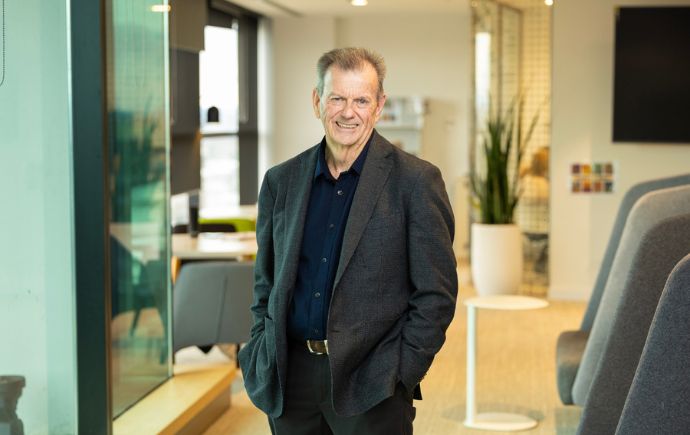
Monash Business School PhD candidate Tom McAtee.
22 July 2026
For most of his career, Tom McAtee worked in environments where bad leadership decisions had life-and-death consequences.
From underground coal mines in the Hunter Valley to oil refineries across the Asia Pacific, he has spent decades leading and advising high-risk organisations.
“I have been deep underground at the coal face, where if procedures are not followed, people can die,” he said.
Now he is watching leaders face a different kind of pressure - one that has drawn him back into study.
“AI is now reshaping how leaders think and decide, and I wanted to understand that shift properly, rather than watch it from the sidelines,” the Monash Business School PhD candidate said.
“What excites me is that it is not really about the technology, it’s about people: how experienced leaders can use AI to sharpen their judgement rather than hand it over.”
Mapping the future of leadership
While much of the current conversation around AI focuses on productivity and automation, Mr McAtee is focused on where the field is heading next.
Until recently, leadership has relied on human-to-human interaction.
The emerging frontier is human-to-agent interaction - a leader directing AI systems.
Beyond that lies agent-to-agent interaction, where intelligent systems operate as part of a leader’s decision-making environment.
“Agents are no longer science fiction; they exist now,” he said.
“To be AI-enabled as a leader, you need to learn how to direct agents and influence their outputs as part of your decision-making environment. That is where the future is heading, and there is a significant research gap in that space.”
'That’s the mission’
His research question is deceptively simple: What enables and disables senior leaders' engagement with AI in their decision-making?
“The working idea is: How do we harness the power of AI to help senior leaders make better decisions? That’s the mission,” he said.
The PhD will unfold in three stages.
The first involves a comprehensive review of existing research, the second will examine the experiences of a range of senior leaders across industries.
The final stage will see Mr McAtee design and test a practical intervention based on the barriers and opportunities identified by participants.
Professor Juliana Sutanto said it would tackle an important deficit in understanding.
“How senior leaders engage with AI in their decision making remains unclear,” Prof Sutanto said.
“Tom’s research, using an approach that draws from the disciplines of management and information systems, will provide new insights into how senior leaders evaluate, trust, and act on AI-generated insights in increasingly data-driven contexts.”
Associate Professor Brian Cooper said the research could also help explain why some leaders adapt to AI while others don’t.
“Tom’s research addresses an important question of how senior leaders engage with AI, the barriers they face, and why some embrace it more readily than others,” A/Prof Cooper said.
The misfit advantage
Mr McAtee is one of only a handful of candidates enrolled in the Interdisciplinary PhD program, which allows researchers to work across faculties.
His research spans the Department of Management and the Faculty of Information Technology - a structure he believes is essential to the work.
“The ‘M’ in my name stands for three things: Mission, mastery and misfit,” he said.
“Mission means I need a cause; mastery means whatever I take on, I have to master it.”
Misfit, he said, explains why he gravitated towards interdisciplinary research.
“Very few people take this path, because you have to work across two completely different disciplines with two very different ways of seeing the world,” he said.
“It has let me study a real-world problem the way it actually shows up, across boundaries, rather than forcing it into one field.”
Learn more about Monash Business School's Interdisciplinary PhD program