
Circular solutions: ending the vicious cycle of waste
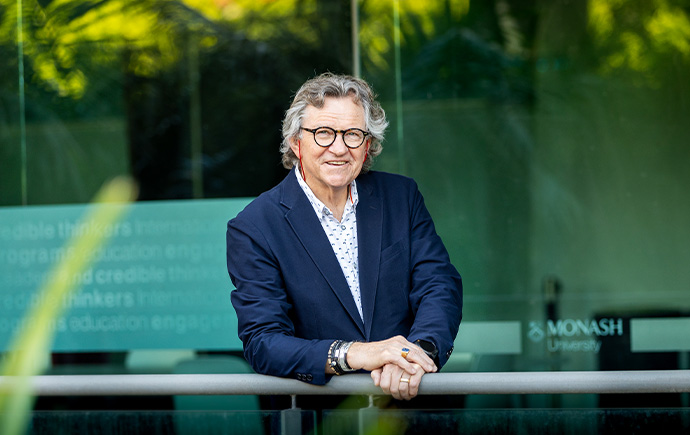
PhD candidate Roelof Vogel has transitioned from a packaging industry career.
April 11 2024
Industry veteran Roelof Vogel has shifted career gears in a bid to drive Australia’s transition to a circular economy. His focus? Empowering local councils to lead the charge.
During his 35-year career in the packaging industry, Roelof Vogel had front-row seats to the escalating crisis of global waste management.
Now a Monash Business School PhD candidate within the Department of Management, Mr Vogel is on a mission to defeat the ‘take, make, use, waste’ cycle that plagues our world.
His weapon of choice is the circular economy.
“I’m passionate about the circular economy as a solution to some of the long-term transition issues and ‘wicked problems’ current political structures are struggling to deal with, such as resource depletion and the need to decouple this from economic growth,” he said.
Mr Vogel’s wealth of corporate experience has given him a unique perspective on end-of-life challenges in the plastic packaging supply chain.
Applying corporate background to new academic goal
“My prior global corporate career has certainly given me a deep appreciation of the complexity of resolving plastic waste streams, and resource efficiency and sufficiency more generally,” Mr Vogel said.
“It is one of the key drivers that has motivated my research into the circular economy as an important pillar in delivering a sustainable future.”
He intends to use these insights to explore the impact local governments can have in the adoption of circular solutions by businesses.
Tackling climate change from local government up
“I was inspired to pursue this particular topic, within the very broad field of the circular economy, in 2016 when I learned that Darebin City Council in metropolitan Melbourne had become the very first local government globally to declare a climate emergency,” he said.
“It got me thinking about the role of the circular economy in helping to deliver greenhouse gas reduction and other sustainability targets at a local level.”
Co-supervisor and Director of Engagement at the Department of Management, Associate Professor Glen Croy said Australia’s standing as the world's second-biggest per capita contributor to climate change served as a stark backdrop to the research.
“The data is staggering. If everyone used the earth’s resources like Australians do, we would overshoot the world’s annual regenerative capacity by early April. This is well ahead of common comparative countries such as China and the United Kingdom,” he said.
“Mr Vogel’s research will enable local governments to better facilitate the transition to a circular economy, and reduce our nation's contribution to climate change.”
Australia lagging behind
Based on over 60 interviews with local and state government representatives, businesses, and NGOs involved in promoting the circular economy in Australia and the Netherlands, the comparative study reveals a substantial gap in progress between the two countries.
“While the Netherlands is well ahead of Australia in many respects, this is not a reflection on our capability and capacity to implement the circular economy, it is a reflection of timing and when the respective journeys started,” Mr Vogel said.
Mr Vogel stressed the importance of policy, governance and regulation in bridging this gap, leading him to develop a framework to guide local governments.
He aims to present this framework to influential forums such as the Australian Local Government Association and its state-based counterparts.
“Ultimately, I intend to keep seeking ways in which I can maximise my impact in the adoption of circular economy principles in consumption and production of goods in society,” he said.